Tag Archives: Robert Masters Chart

Private Geoffrey Chart

DEATH OF PTE. CHART.

—Mr. R. M. Chart. C.A., is so well-known for many years’ work as surveyor to the old Rural District Council and as County Alderman, that the sympathy will be wide for the loss he has sustained in the death at the front of his son, Pte. Geoffrey Chart, who joined up on the outbreak of the Boer War, and after the campaign was over started in business in Cape Town. When this war commenced he again joined the Highlanders, and last spring came back for a few days to his old home. He was wounded in action on Sept. 21st, and hopeful news was sent as to his recovery, but he died Sept. 23rd. He was 36, and leaves a wife and two children. Alderman Chart has three other sons serving.

Source: Surrey Mirror – Friday 12 October 1917 from the British Newspaper Archive (subscription required)

ALD. CHART’S BEREAVEMENT.

Pte. Geoffrey Chart, South African Contingent, whose death on Sept. 23rd from wounds received on the 21st is reported, was the fourth son of Mr. Robert M. Chart, St. Mary’s, Mitcham, Alderman of the Surrey County Council, and chairman of the Small Holdings and Allotments Committee.

Source: Surrey Advertiser – Saturday 06 October 1917 from the British Newspaper Archive (subscription required)

From the Commonwealth War Graves Commission:

Rank: Private
Service No: 10196
Date of Death: 23/09/1917
Age: 36
Regiment/Service: South African Infantry, 4th Regiment
Grave Reference: I. E. 6.
Cemetery: Nine Elms British Cemetery, Poperinge, Belgium.
Additional Information: Son of Robert and Florence Chart, of St. Mary’s, Mitcham, Surrey, England; husband of Margaret Chart, of Limebrook Cottage, Bingham Street, Bangor, Co. Down, Ireland.

The Nine Elms British Cemetery contains 1,556 Commonwealth burials from the First World War.

According to Eric Mobtague, in his Mitcham Histories : 1 The Cricket Green, page 105, St. Mary’s was the home of Robert Masters Chart from 1911 until his death in 1942. The house was near the old Methodist church, on the eastern side of the Cricket Green, and was demolished in the 1950s.

This image, part of a 1903 postcard, shows the old Methodist church and some houses next to it, which may include St Mary’s, where the road Chart Close is today.
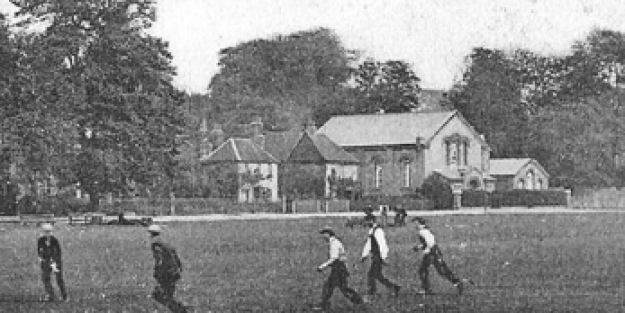
c. 1903

c. 1903

Unveiling of the Mitcham War Memorial

From the Mitcham and Tooting Mercury, 26th November, 1920

UNVEILING OF MITCHAM’S WAR MEMORIAL.

The war shrine, situated on the Lower Green, Mitcham, was unveiled last Sunday by Major-General Sir H. E. Watts, K.C.B., C.M.G. (formerly commanding the 7th Division and 19th Corps, B.E.F.). The weather, although very cold, was fine, and about 5,000 people were present at the unveiling.

Alderman R. M. Chart (Chairman of the War Memorial Committee) said that this shrine was to commemorate the self-sacrifice of those who made the supreme sacrifice, and show our undying sorrow felt by those who have lost dear ones in the late war. Two years ago the war terminated, and in February, 1919, a committee was formed for the purpose of raising funds for the war shrine. There was some difficulty as to the most prominent place for the shrine, and on Peace Day, when the temporary memorial was put behind the Vestry Hall, it was proposed that that should be the site for the permanent one. It is also proposed now that a fencing should be placed round the shrine, but with facilities for the public to place flowers on it, which he (Mr. R. M. Chart) was sure they would do from time to time. He also said that every effort had been made to obtain the names of men who had been killed in action or died of wounds, and, at present, there were 557 names inscribed on the shrine, and since then more had come to hand, and would be inscribed in due course. The speaker then said it was his duty and pleasure to introduce Major-General Sir H. E. Watts, K.C.B., C.M.G., who had well served his country in the late war. He was commanding in the first and third Battle of Ypres.

Major-General Sir H. E. Watts, K.C.B., C.M.G., said, after what Mr. Chart had said, there was not much more to say, but there was one incident that he would like to remind them of, and that was the late Earl Kitchener’s appeal of “Your King and Country need you,” at the beginning of the war, in which all men flocked to enlist. “Why !” because they knew that they were going to fight for freedom and endure the hardships of war, which was a fine example of self-sacrifice and unselfishness. All honour was due to them who came forward at the country’s call. The men, women and children were also a great help, for, while we soldiers were fighting, those at home endured many hardships, but without murmuring. He then unveiled the memorial, and the “Last Post” was played by buglers of the East Surrey Regiment.

The hymn, “Nearer my God to Thee,” was sung, and then the invocation and prayers were said by Rev. C. A. Finch, the Vicar of Mitcham, after which Rev. J. F. Cowley, the the Zion Congregational Church, said a few words.

Rev. J. F. Cowley said that, in doing honour to those who laid down their lives for us, there should be no mistake, for if they had not done so, no English home would be intact and safe to-day, but the unspeakable happenings in Belgium would have happened in England, and, perhaps, have been even worse, because it was against England that the Germans were so bitter and revengeful. He said we should thank God and our fallen heroes for such a merciful deliverance, and also think God for such sons, fathers, brothers and sweethearts who so cheerfully laid down their lives to save us from shame and dishonour. They must not forget to honour and thank the mothers who gave the best, they had got; and in the future, when one was in despair, they should just go to the shrine and remember what, Englishmen could and did do for their country, because they thought that, if it was worth living for, it was worth dying for. Those present then proceeded to place their floral tributes on the shrine, during which Mr. Rudyard Kipling’s “Recessional” was sung.

The Jubilee Lodge, R.A.O.B., sent a wreath in memory of fallen “Buffs.” Other lodges also sent wreaths.

The special constables were present under the command of Inspectors Webb and Freeman. Colonel Bidder, D.S.O., was present, and a detachment of ex-Service men lined up round the inside of the ropes. The music for the hymns was played by the Mitcham and Wimbledon Military Band, conducted by Mr. H. Salter.