Tag Archives: Surrey Iron Railway

Walter Mays Ltd.

The Abbey Cork Mills of Walter Mays Ltd was built on the site of William De Morgan’s pottery, Colliers Wood, in around 1890.
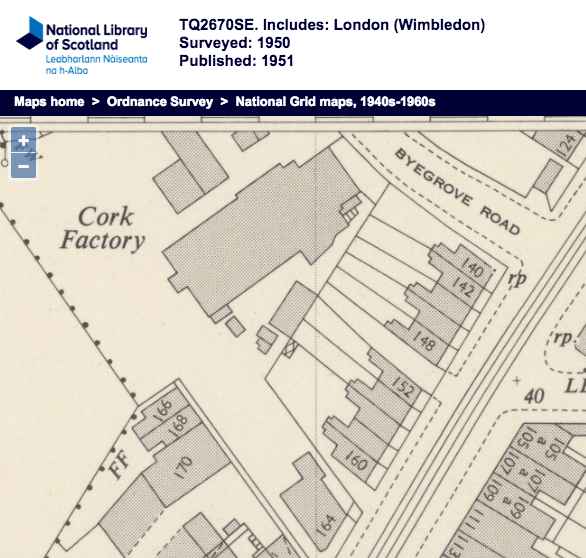
1950 OS map

Walter Carden-Mays born December 1865 in Camberwell. He married in 1888 and died on 21st January 1941 in Surrey. The ‘Carden’ part of the family name was dropped at some point, and his company was known as Walter Mays Ltd.

Listed in the 1925 street directory as Walter Mays Ltd. (Abbey Cork Works), 150 & 152 Byegrove Road.
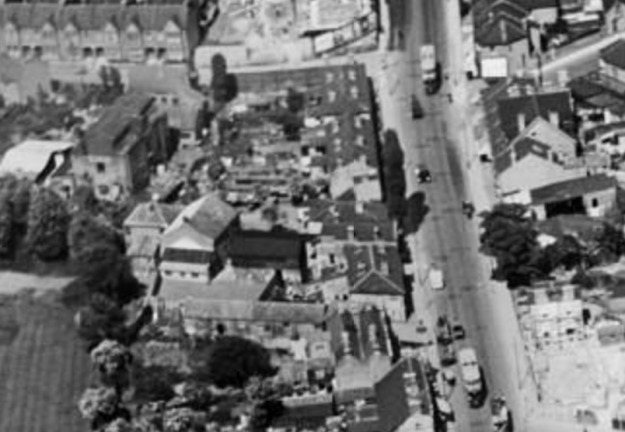
1924 aerial photo. The site for Colliers wood underground station can be seen bottom right. The cork factory is on the left of the High Street.
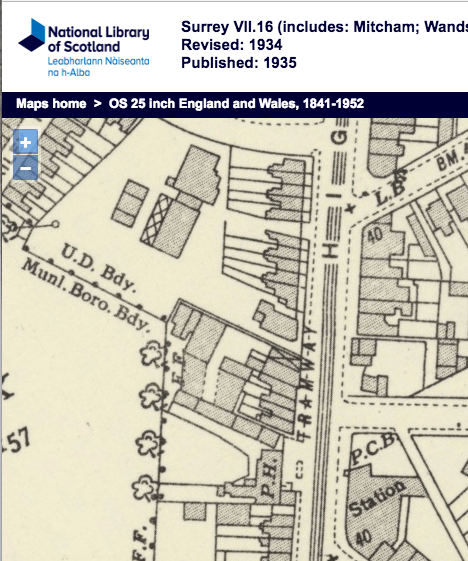
1934 OS map rotated to show same view as aerial photo above


Ad from Flight Magazine of 1938 :
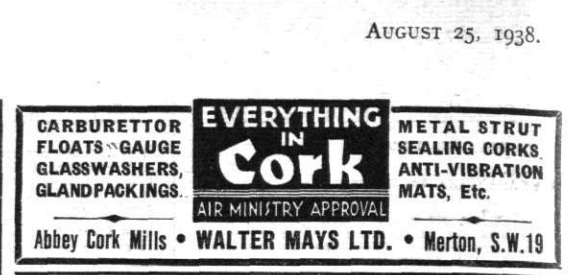
and directory listing from same:

WALTER MAYS, LTD., Abbey Cork Mills, London, S.W.19 (Liberty 3764).—” Everything in cork “; carburettor and oil indicator floats, gauge glass washers, gland packings, strut sealing corks, anti-vibration mats, composition cork jointing to D.T.D.219A, laminated and plain.

In an entry on Grace’s Guide to British Industrial History from 1939 about suppliers to the aircraft industry, cork joints to specification DTD 219A were widely used for petrol tank gaskets and packings.


The Stone Cottage of the Surrey Iron Railway stood on the Walter Mays Ltd site for over 150 years.


Mitcham Military Service Tribunals

As reported by the Mitcham and Tooting Mercury, 16th June 1916, an employer of a cork business in Colliers Wood, appealed for his son. Although not named, it is likely that the company was Walter Mays Ltd.

Exemption was asked for a skilled mechanic, by the owner of a cork manufacturing business in Colliers Wood. The employer said the man was very valuable in his present employment and he will be practically impossible to replace. A large proportion of their manufacturers were for government uses. He employed about 17 men of whom are only three were eligible. He pleaded that his son was capable of doing almost anything in the business and his departure might cause the closing down of the business.

Three months exemption.

In the Mitcham and Tooting Mercury, 2nd November 1917, the company and employee are named in an appeal.

Mr Walter Mays, cork manufacturer, of the Abbey Cork Works, High Street, Colliers Wood, asked for a exemption for Mr T.W.S. Cavey, age 41, B1, motor driver and mechanic, residing at Birdhurst Road, Colliers Wood.

Applicant: An exemption for so long as the man remained in his employment. He was engaged in delivering all Mr Mays’s important Government contract work. The average mileage was 250 miles a week.

Counc. Baker : I suppose it is all Government work that Mr Mays does?

Applicant: Oh, yes, it is most important.

The appeal was disallowed.

In the 1919 electoral register a Thomas William Sherrin CAVEY was living with his wife Florence Louisa in 28 Birdhurst Road. He died in 1950 as stated on the Find-A-Grave website, which also says he was a Music Hall performer known as Stirling Fred.


Maps are reproduced with the permission of the National Library of Scotland.

1855 : Fatal accident on Wimbledon and Croydon Railway

From page 6 of the 30th October 1855, edition of the South Eastern Gazette.

ALARMING AND FATAL ACCIDENT UPON THE WIMBLEDON AND CROYDON RAILWAY.

The above-named line of railway, which it was at first said would be opened on the 1st of October, then on the 15th of the same month, was opened on Monday, the 22nd. The London, Brighton, and South Coast Company issued bills, announcing that they would run 13 trains per diem. The South Western Railway Company also issued bills, stating that they intended running 5 trains per diem, by means of which passengers could be conveyed to the Waterloo terminus. These, however, were not to be what are generally termed “through trains,” but passengers wishing to go to Waterloo station would have to change trains at the Wimbledon station.

The line, which is a single one, is as near as possible upon the same route between Croydon and Mitcham, as that formerly occupied by the earliest railway in England, viz. the old tramway formed at the commencement of the present century, for the purpose of conveying stone and lime from Merstham. Those who recollect the old tramway are aware that after passing Waddon Marsh, there was a short cutting familiarly known as the “high banks,” after passing which it ran upon a level by the side of a farm now occupied by Mr. Atherfold and then across Mitcham-common.

On Wednesday afternoon the London, Brighton, and South Coast train, consisting of a small engine with tender attached, and four carriages, arrived at the Croydon West station, and proceeded on to Mitcham; at the time we learn there were not more than 8 or 10 passengers in the train. When it reached Mr. Atherfold’s farm, and was consequently between the “high banks” and the road leading from Beddington to the Windmill upon Mitcham-common, the engine got off the rails, after which it evidently continued to run for nearly a hundred yards, when the engine and tender went off at the right hand side of the line, and the carriages at the same time went off at the opposite side. The engine immediately tumbled over, and Bingham the engine driver, who it would appear was at the time working the lever, for the purpose of reversing the engine was with the exception of his head and right arm buried beneath the engine. His death must have been almost instantaneous. The stoker (Weller) jumped off and was much scalded, but not otherwise materially injured. The first carriage was completely smashed, but fortunately there were no passengers in it, and those who were in the other carriages escaped with very slight injuries, as did also the guard who was attending to the break, which fortunately was attached to the last carriage.

Intelligence of the event was immediately conveyed to New-Cross station, and an engine, with what they term the tool box, and about a dozen men arrived at the spot at about 7 o’clock; the remains of the unfortunate engine driver however, were not extricated from beneath the engine till past 8 o’clock, when they were conveyed to the Plough public-house, Beddington, to await a coroner’s inquest.

Another report mentions that one of the passengers was from Mitcham.

From page 351 of the 31st October 1855 issue of the Watchman and Wesleyan Advertiser:

On Thursday (sic) night a serious accident occurred on the Croydon and Mitcham Railway to a passenger train in the neighbourhood of the village of Beddington. The line from Croydon to Mitcham, a distance of four miles, was only opened on the preceding Monday. It consists of a single line of rails until its junction with the Croydon and Epsom line, about half a mile from Croydon.

The train to which the accident happened started from the terminus at London-bridge at 4.15. About midway between Croydon and Mitcham, the engine ran off the rails, dragging the tender and passenger carriages after it, for between fifty and sixty yards, until, falling over on its side, its career was suspended. One of the carriages was smashed to atoms, and the driver killed on the spot. There were, fortunately, but five passengers, all second class, and, with the exception of a Mrs. Jacobs, the wife of a retired gentleman residing at Upper Mitcham, who was very much shaken, they all escaped unhurt.

From page 564 of the 7th November 1855 issue of the Watchman and Wesleyan Advertiser, the inquest recommended a speed limit of 20 m.p.h.:

On Monday, the coroner resumed the adjourned inquest on John Bingham, the engine-driver who lost his life on the 24th ult., on the newly-formed West Croydon and Mitcham Railway. Colonel Yolland gave it as his opinion that the accident was caused mainly by the speed at which the engine was travelling. The jury found, “that the deceased met his death by accident, but recommend that the maximum speed, until the lines becomes consolidated, should not be greater than twenty miles an hour.”