Category Archives: Fire Service

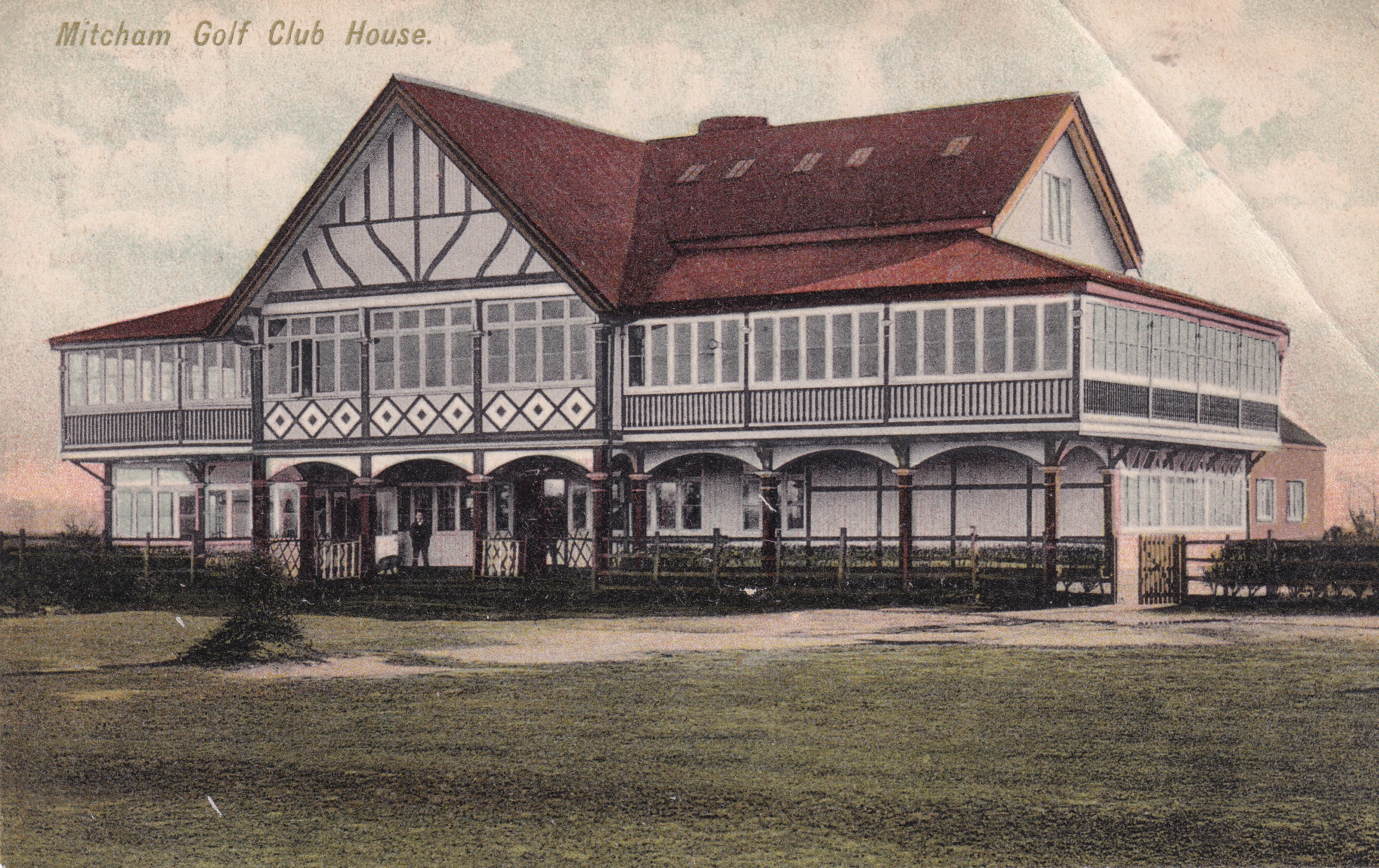
Mitcham Golf Club pavilion fire in 1933

Early 1900s colourised photo of the pavilion


Mitcham Advertiser – Thursday 21 December 1933

BURNT OUT.

MITCHAM GOLF CLUB PAVILION DESTROYED.

CARETAKERS’ NARROW ESCAPE.

Mitcham Common Public Golf Club’s famous pavilion near Mitcham Junction Railway Station was burnt to the ground just after daybreak on Saturday morning.

It was a large and picturesque building of many rooms, built in 1892, mainly of wood, and it blazed like an enormous torch, providing a thrilling and rather splendid spectacle for the hundreds of train passengers passing through Mitcham Junction to London.

Mr. T. W. Pinfold, the recently appointed caretaker and course instructor, and his wife, who lived on the premises, discovered the outbreak just in time and fled from the furnace in their nightclothes after rescuing their cat and dog.

A thick fog enveloped the Common at the time and the smoke was held in it as in a net. When the blaze was at its height the flames could scarcely be seen from Carshalton-road. Mitcham Junction platforms made excellent grandstands for the scores of people waiting for trains, and some of them became so absorbed in the scene that they missed their trains. Motorists hurrying to town spared a few minutes to watch the fire. They left their cars outside Mitcham Junction till the road became blocked to passing bus traffic. But only for a short time.

THE GAME AS USUAL.

Before nine o’clock a number of golfers arrived by train and car with their kits on their backs and were startled to find the pavilion a heap of smouldering ruins. They were not long dismayed. A few packets of tickets were found and handed out as usual from the box near the pavilion, and while spurts of flame continued to attract the attention of the firemen play began on the course.

BRIGADE’S HANDICAP.

Mitcham Fire Brigade was called by telephone at 7.18. The pavilion was blazing furiously when they arrived, for a considerable breeze fanned the flames. They were handicapped to some extent by an insufficient water supply. Lengths of hose were carried over the footbridge at Mitcham Junction from hydrants on the south side. There was little chance of saving the building. In little more than an hour nothing of it remained except the tall brick chimney shaft bearing the date of its erection in stone, a bit of brick wall here and there and a huddle of twisted iron.

DANGER TO MITCHAM JUNCTION.

Passengers in trains calling at Mitcham Junction felt the intense heat, especially those alongside the north platform, where the wood fence was scorched. The station is separated from the pavilion by only a few yards on the Croydon side and the telegraph poles in the narrow grass verge between the north platform and the rear of the pavilion containing the workshops were charred. Railway officials stood by guarding the property while danger remained, and Chief Officer Wells concentrated the efforts of the firemen on the protection of the station.

RECENT RENOVATIONS.

Recently the pavilion has been repainted and thoroughly overhauled, and a new heating apparatus was installed. It was decorated in readiness for the Christmas season and all the Christmas stock of refreshments had just been laid in. One of the sufferers was the new manageress who lost personal belongings. Another was Mr. R. H. Pratt, the elderly professional, whose large stock of golf requisites, tools and material in the workshops in the basement of the pavilion was totally destroyed. The club also lost a valuable stock of clubs and balls and property of individual members was destroyed, too

CARETAKERS’ ESCAPE.

Mr. and Mrs. Pinfold, who were appointed caretakers about five months ago, lost everything they possessed, including Mr. Pinfold’s valuable collection of Indian curios. And they were lucky to escape with their lives. For a time Mrs. Pinfold was sheltered in the station master’s house at Mitcham Junction.

Telling the story of their escape to the “Advertiser,” Mr. Pinfold, still in his pyjamas under a heavy coat, said he had just got up and was walking along a corridor when he saw smoke coming through a door. He hurried downstairs to see if the heating apparatus was all right and found smoke thick in the basement and a boxroom on fire.

“I ran at once to warn my wife,” he said, “and then tried to get at the telephone, but I was cut off by the flames. So I ran to the station and telephoned from there, but found that the fire brigade had already been called. When I got back Mrs. Pinfold, half dressed, was trying to round up the cat and dog. We managed to save them after some trouble. They were frenzied and the cat I had to drag from death by its tail.”

Mr. Pinfold came from India, where he had been soldiering for many years. He was greatly concerned at the loss of his native works of art, one of which was an inlaid ivory table.

With the recent reorganisation of the Golf Club and the restriction of the links to the south side of the common, the staff was almost entirely changed. One of the first persons on the scene was Mr. J. B. Wallace, the secretary of the club, who was appointed about six months ago in succession to Capt. Smith, a one time member of Mitcham Urban Council. He lives at Whitford Lodge, close to Mitcham Court, the home of Sir H. M. Mallaby-Deeley, Bart., president of the club, and chairman of the Trustees of Mitcham Golf Course. Many of his books and personal belongings were destroyed.

Sir Harry Mallaby-Deeley visited the ruins on Saturday. Several years ago he presented the course, pavilion and everything connected with Prince’s Golf Club. of which he had been chief proprietor for many years, and which was one of the most exclusive golf clubs in the country, to the public, and the new Mitcham Common Public Golf Club was opened by Mr. Ramsay MacDonald, the Prime Minister.

The fire appears to have started in the basement close to one of the new boilers. Most of the damage is covered by insurance.

Many books and papers, some of historical interest, were burnt. Firemen found a cash box containing a considerable sum of money in silver and copper, a good part of which was melted — eloquent testimony to the fierceness of the fire.

While crossing the smouldering ruins Second Officer A. Tilley was struck in the face by the contents of a canister that burst with the heat and he was blistered a good deal.

All day Sunday a stream of people from all parts of London visited the scene of the fire. More golfers than usual were on the course and a brisk trade in new clubs, bags and balls was done by Mr. Pratt, the professional, who had secured a large quantity for the purpose.

The clubhouse building was originally built for the Royal Naval Exhibition in 1891, which was in the grounds of the Royal Hospital in Chelsea.
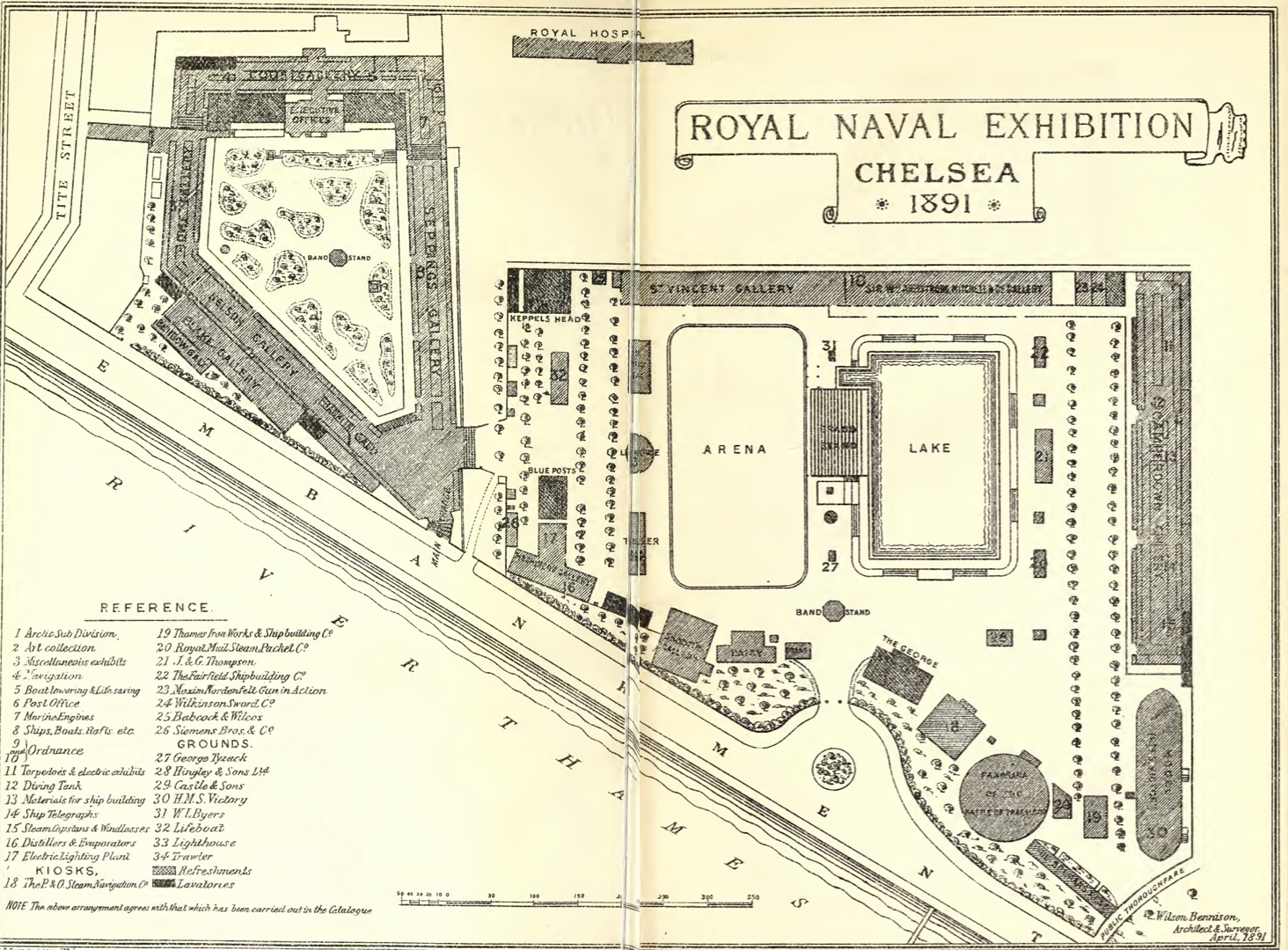
Plan of the Naval Exhibition. The building marked ‘The George’, bottom right, was bought by R. Hippisley-Cox for the golf club after the exhibition.

The architect of the building, and all of the Naval Exhibition was Wilson Bennison.
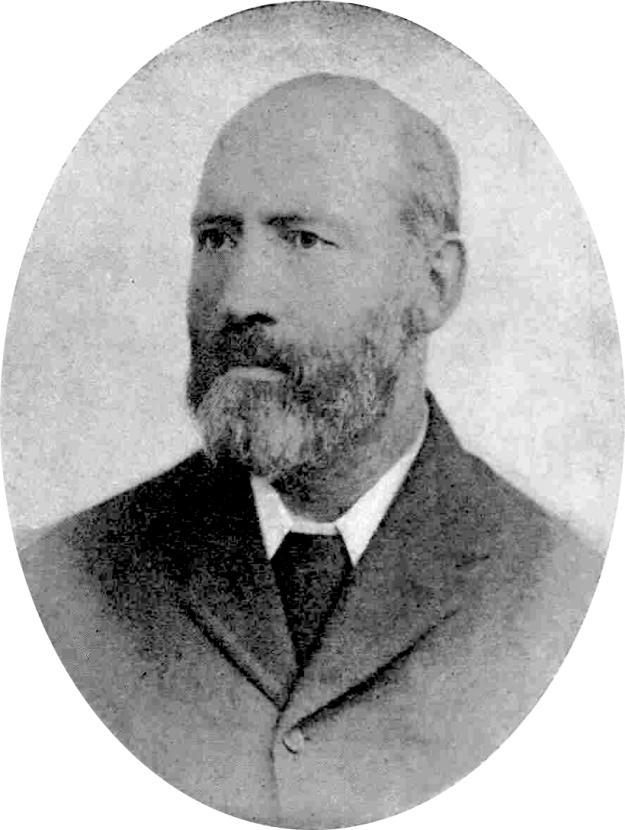
Photo of architect Wilson Bennison from the Illustrated News 22nd June 1895, via the British Newspaper Archive.

The guide to the Naval Exhibition can be downloaded from Archive.org as a pdf.
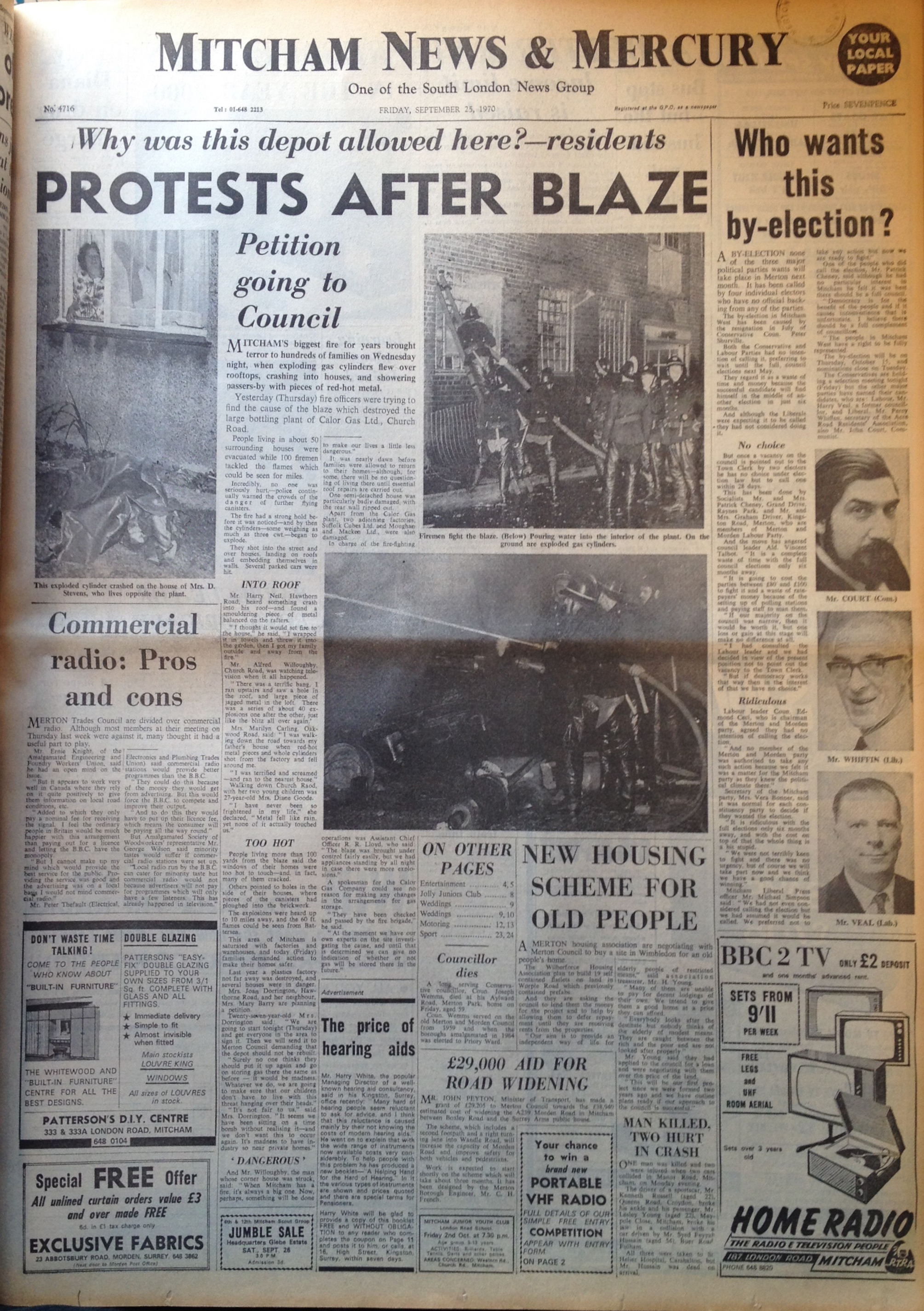
Calor Gas Explosion of 1970

“It was like the Blitz all over again”, said one of the nearby residents when on the evening of Thursday 24th September, 1970, the Calor gas bottle storage depot in Church Road, Mitcham, caught fire. Gas bottles flew through the air raining chunks of hot metal onto houses and streets. The explosion was heard as far away as Battersea.

The following are from two issues of the local newspaper reporting the fire and the decision by the company not to store gas bottles at their depot any more.

25th September 1970, page 1, Mitcham News & Mercury

From the Mitcham News in Mercury, Friday 25th of September, 1970.

Protests after a blaze

Why was this depot allowed here, say the residents.

Mitcham’s biggest fire for years brought terror to hundreds of families on Wednesday night
when exploding gas cylinders flew over rooftops, crashing into houses and showering passers-by
with pieces of red-hot metal. Yesterday Thursday, fire officers were trying to find the cause of the blaze which destroyed a large bottling plant of Calor Gas Limited, Church Road. People living in about 50 surrounding houses were evacuated while 100 firemen tackled the flames which could be seen for miles. Incredibly no one was seriously hurt.
Police continually warned the crowds of the danger of further flying canisters. The fire had a strong hold before it was noticed and by then the cylinders, some weighing as much as 300 weight, began to explode. They shot into the street over houses, landing on roofs and embedding themselves in walls. Several parked cars were hit. Mr Harry Neil, Hawthorne Road, heard something crash into his roof and he found a smouldering piece of metal balanced on the rafters.
I thought it would set fire to the house, he said. I wrapped it in towels and threw it into the garden.
Then I got my family outside and away from the fire. Mr Alfred Willoughby, Church Road, was watching television when it all happened. There was a terrific bang. I ran upstairs and I saw a hole in the roof and a large piece of jagged metal in the loft. There was a series of about 40 explosions, one after the other, just like the Blitz,
all over again. Mrs Marilyn Carlin, Oakwood Road, said, I was walking down the road towards my father’s
house when red-hot metal pieces and whole cylinders shot from the factory and fell around
me. I rang the notify and screamed and rang to the nearest house. Walking down Church Road with her two young children was 27-year-old Mrs Diane Goode. I had never been so frightened in my life, she declared. Metal fell like rain, yet none of it actually touched us. People living more than 100 yards from the blaze said the windows of their homes were
too hot to touch and, in fact, many of them cracked. Others pointed to holes in the side of their houses where pieces of the canisters had ploughed into the brickwork. The explosions were heard up to ten miles away and the 60-foot flames could be seen from Battersea. This area of Mitcham is saturated with factories and warehouses and today, Friday, families demand inaction to make their homes safer. Last year, a plastics factory not far away was destroyed and several houses were in danger. Mrs Joan Dorrington, Hawthorn Road, and her neighbour, Mrs Mary Berry, are planning a
petition. 27-year-old Mrs Dorrington said, We are going to start tonight, Thursday, and get everyone in the area to sign it. Then we will send it to Merton Council demanding that the depot should not be rebuilt. Surely no one thinks they should put it up again and go on storing gas there the same as before. It would be madness. Whatever we do, we are going to make sure that our children don’t have to live with this threat hanging over their heads.
It’s not fair to us, said Mrs Dorrington. It seems we have been sitting on a time bomb without realising it, and we don’t want this to occur again. It’s madness to have industry so near private homes. And Mr Willoughby, the man whose corner house was struck, said, When Mitcham has a fire, it’s always a big one.
Now perhaps something will be done to make our lives a little less dangerous.
It was nearly dawn before families were allowed to return to their homes, although for some
there will be no questioning of living there until essential roof repairs are carried out.
One semi-detached house was particularly badly damaged with the rear wall ripped out.
Apart from the Calor Gas plant, two adjoining factories, Suffolk Cubes Limited and Moughan Macken Limited, were also damaged. In charge of the firefighting operations was Assistant Chief Officer R. R. Lloyd, who said,
The blaze was brought under control fairly easily, but we had appliances standing by
all night in case there were more explosions. A spokesman for the Calor Gas company could see no reason for making any changes to the arrangements for gas storage. They have been checked and passed by the fire brigade, he said.
At the moment we have our own experts on the site investigating the cause, and until that is determined we can give no indication whether or not gas will be stored there in the future.

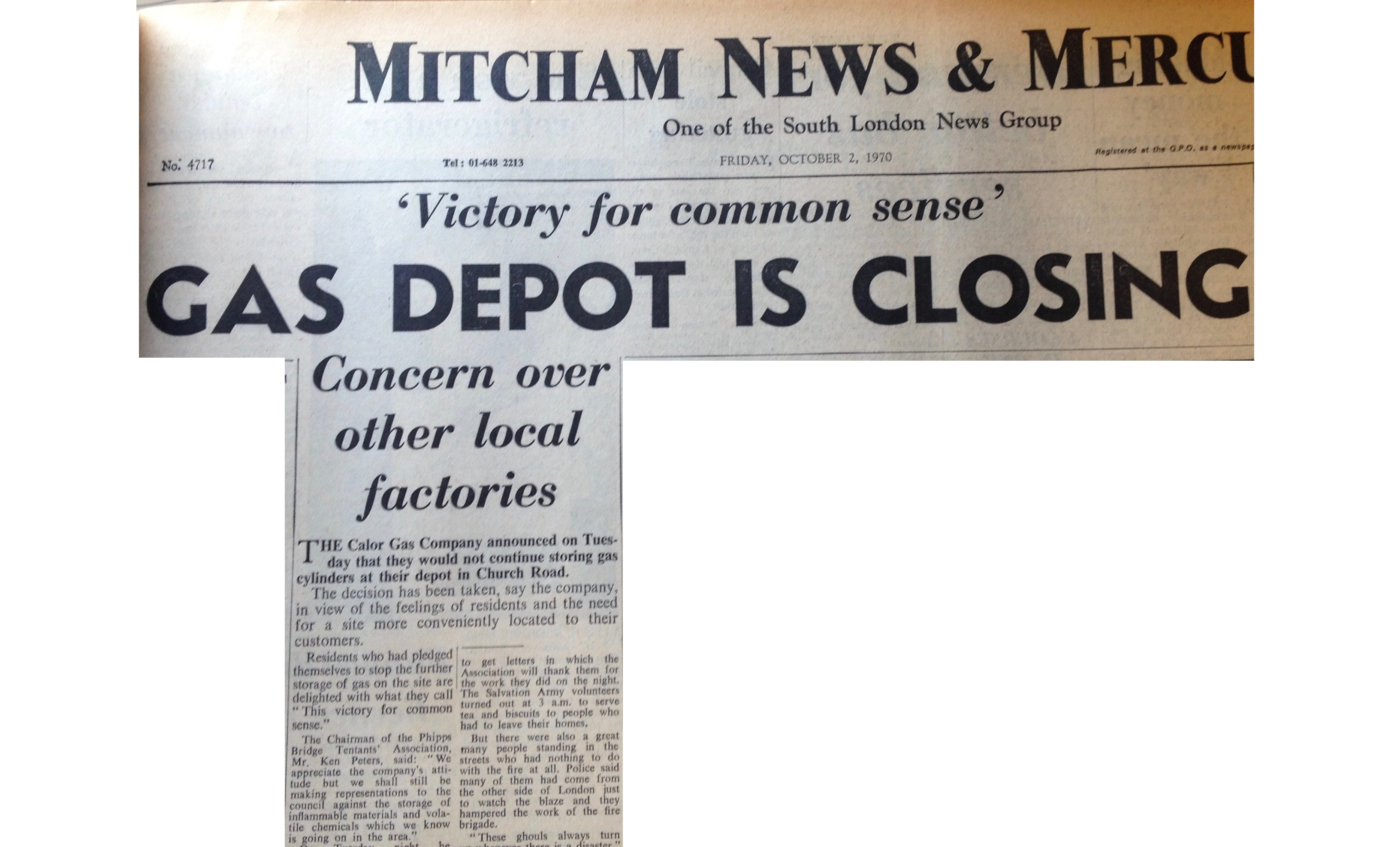
2nd October 1970 issue of the Mitcham News and Mercury, page 1

Mitcham News and Mercury, Friday October 2nd 1970.

Gas Depot is closing.
Victory for common sense.

The Calor Gas company announced on Tuesday that they would not continue storing gas cylinders
at their depot in Church Road.
The decision has been taken, say the company, in view of the feelings of residents and the
need for a site more conveniently located to their customers.
Residents who pledge themselves to stop the further storage of gas on the site are delighted
with what they call this victory for common sense. The chairman of the Phipps Bridge Tennis Association, Mr. Ken Peters, said, We appreciate the company’s attitude, but we should still be making representations
to the council against the storage of inflammable materials and volatile chemicals which we
know is going on in the area. On Tuesday night he addressed the first committee meeting of the new Mitcham Community Association. All the association’s members live near the site of the fire and first met on Sunday morning
outside the new Bath Tavern on the Phipps Bridge Estate. Among the crowd of 200 were several people who claimed they would be prepared to lie down in front of lorries in order to stop more gas containers being brought into the
area. This will no longer be necessary, but there is still an intense feeling of anger at the
council for having allowed firms in the area to use or store inflammable materials.
A map was produced showing a further 15 companies in the area, all of which the association
considered to be possible fire risks. But their main concern was that there should be so many factories in the area in the first place. Mr. Peters explained, The former Mitcham Council designated this
area for residential purposes and their plans included the destruction of the factories
and the building of houses and flats. When the London Borough Merton was formed in 1965, these plans were handed over to the new council together with a surplus on the housing revenue account with which to carry
them out. But what has in fact happened is that the factories are still standing, the Phipps Bridge
Estate was never finished and though they want to build a car parking woman and world
Mitcham has been left high and dry. The association are now to ask for an interview with the Mayor to discuss what will be done to prevent another fire. A great part of their dissatisfaction with the council stems from the fact that they
claim they have been ignored by their councillors. Councillor H.T. Sims, who lives in Baron Grove, said on Wednesday,
I really haven’t had a chance to go and see the people. I suppose I should have done, but I shall be getting in touch with them soon. MPs on the other hand have shown more interest in the disaster.
Mr. Robert Carr and Miss Janet Fuokes have visited the site and spent some time talking
to the people whose homes were damaged. Mr. Carr promised the right to the Home Secretary, expressing their feelings.
The police, the fire brigade and the Salvation Army are also to get letters in which
the association will thank them for the work they did on the night. The Salvation Army volunteers turned out at 3am to serve tea and biscuits to the people who had to leave their homes.
But there are also a great many people standing in the streets who had nothing to do with
the fire at all. Police said that many of them had come from the other side of London just to watch the
blaze and they hampered the work of the fire brigade. These ghouls always turn up whenever there is a disaster, said one policeman. They always seem to be the same kind of people and they are invariably a nuisance.
I rather fancy many of them hope to see bodies being dragged from the fire.
But although no one was hurt at this time, the association are worried about what may
happen on Guy Fawkes night. It only needs someone to throw a firework in the wrong direction for the whole lot to
go up, said one member. It was suggested that maybe a firework display could be staged in Ravensbury Park and Mrs.
L. Oxley, who keeps a shop in Oakwood Avenue and sells fireworks, gave parents a few tips
on safety measures. The best system, she said, is for children to order the fireworks beforehand and then
the parents can collect them on the day. The trouble comes when older boys buy them for their younger brothers.
A full report on the circumstances of the fire was presented to the Town Planning and
Development Committee last night Thursday. In the meantime, the Town Clerk, Mr. Sidney Austin, gave his assurance that the site had been leased by Calor gas on condition that they comply with the most stringent safety
precautions. All of these had been adhered to, he said, and in fact the company even instituted a
few of their own. They know better than anyone else for precautions needed in storing these containers, and this
was their first accident in 35 years. The site will probably now be used for storing some innocuous material.

A video is available on the YouTube channel where thses reports are read and includes colour photos by Eric Montague:

Comments from that video:

I was one of the first crew of 4 from Mitcham fire station on scene, our other engine had been sent to a big fire at Richmond just a few minutes before this call came in, our leading fireman called for more machines twice on the radio before leaving the cab. Myself and another fireman had taken a hose up the side alley to spray the cylinders to cool them, we pulled a wooden pallet to try and protect ourselves as the cylinders exploded, we couldn’t get out !! The driver and leading fireman, dealt with 2 serious house fires on their own. My pal and I eventually managed to get out of the alley and as a canteen wagon had just arrived we went to it, we were knackered, a divisional officer came up to us whilst we were drinking our tea and called us lazy B’s, needless to say my pal told him we were from Mitcham, he apologised and went red. I had only been at the station for a few weeks and in the job for about 4 months but it wasn’t the first ‘big job’ I’d been on in that time at Mitcham. The area had lots of old factories besides this site, there were Pains fireworks, Pye records, A big paint factory and a Victorian workhouse with industry in it plus several more places I can’t remember. This brought back memories, thank you.

My cousin, who worked on the site, helped the firemen to find their way around the place, in the morning we were told that some canisters were found over a quarter of a mile away…

Remember this so well. Living in Mount Road, we wasn’t far from the site. Dad woke me up and told me to go and find out what was going on. Outside lots of people running, not away but towards the fire. So we all watched from the junction with Church Road..

The stupid thing is that the cylinders have an overpressure release valve to prevent explosions. But most of them don’t work.