Category Archives: Industry

Hadfields (Merton) Ltd.

Phipps Bridge Road, Merton, SW19

and

131/3 Western Road

Varnish, paint


Source:
Borough of Mitcham List of Factories,
Town Clerk’s Department,
July 1963.
Available at Merton Heritage and Local Studies Centre at Morden Library.
Reference L2 (670) MIT


Demolition of paint factory in Western Road. Photo is looking south, part of the gas works can be seen in the background on the left.

George Hadfield’s varnish business was at Phipps Bridge, and moved into the premises of Charles Blume in Western Road, when his varnish business was wound up in 1916 by the government under the Trading with The Enemy Act.

From the minutes of the Mitcham Parish Council
Volume 11 April 1913 to March 1914
Report of the No. 1 Fire Brigade Committee
24th March, 1914

Page 193

The Committee beg to report the receipt of a letter from Mr. Hadfield, thanking the Brigade for their services at the fire on March 9th.

The Superintendent’s report included

March 9 Fire at Phipp’s Bridge … Expenses £2 2s. 0d.

Page 194

                                              Phipps Bridge,
                                              Merton,
                                              Surrey,
                                              10th of March, 1914.

The Chairman of the Fire Committee,
Mitcham Parish Council.

Dear sir,

We write at the earliest possible moment to put on record our thanks to your Fire Brigade for the prompt manner in which they responded to our call, the fine way in which they worked and the splendid stop which they helped to effect. It was a great achievement to have confined damage to such small proportions, and we congratulate the Parish Council or having such a very efficient service.

                           Yours faithfully,

                            (Signed) GEO. HADFIELD.

From Surrey History Centre

Hadfields (Merton) Ltd, were formed in 1917 to act as manufacturers of or wholesale or retail dealers in varnish, japans, enamels, colours, oils, paints, pigments, cements, dye wares and other such, and particularly to acquire the businesses of varnish, paint and enamel manufacturers carried on under the name of George Hadfield, Phipps Bridge, Merton and George Hadfield (successor to C H Blume), Western Road, Mitcham. These businesses were conveyed to the company by George Hugh Hadfield and Samuel Rogers Hadfield, both of whom were directors. The Merton company claimed to have been trading since 1840 (letterhead seen at the depositor’s office), and it appears that George Hadfield, father of George Hugh and Samuel Rogers, had purchased Paul Addington’s varnish works at Phipps Bridge in 1892. Addington was certainly already working there in 1851.

In 1969 the UK paint manufacturing business and trade name ‘Hadfield’, with the fox trademark, were sold to Bestobell Paints and Chemicals Ltd, and the parent company’s name changed to G H Successors (Merton) Ltd. (A new company, called Hadfields (Merton) Ltd, was formed for the purposes of the transfer, to acquire the parent company’s UK interests.) The parent company was purchased in 1972 by the Land and House Property Corporation, which was itself acquired by the depositor in 1978.

Source: 2640 G H SUCCESSORS (MERTON) LTD, PREVIOUSLY HADFIELDS (MERTON) LTD, PAINT AND VARNISH MANUFACTURERS AND DEALERS: COMPANY RECORDS

Job ads that appeared in local papers in 1972/3 showed the company name as Carson / Hadfields, as it was Bestobell’s paint subsidiary, Carson-Paripam, that had merged with Hadfields.


1947 Institution of Mechanical Engineers visit (from Grace’s Guide to British Industrial History)

These works are devoted essentially to the production of highclass paints for decorative and for specialized industrial use, including transport finishes.
Manufacture in the main paint shop is based on the following sequence: (1) edge-runner, (2) roller mill, of which a variety of types is employed, (3) mixer, and (4) refining mill. The shop is designed to facilitate a steady flow of medium-size batches in a wide variety of colours.
Ball mill production of both large and small batches is well illustrated in a second paint shop; and other departments produce water paints of various types, especially emulsion paints, cellulose lacquers, and the most modern synthetic enamels.
The laboratories, recently rebuilt after bomb damage in 1944, show very clearly the impact of science on the paint industry, and the lengths to which it is necessary to go to ensure suitability of the products for specific purposes. In addition to this factory, the laboratories are responsible for development and testing oi paint media and varnishes, including insulating varnishes, produced at the Merton factory.
A very clear system of identification, necessitated by the wide range of materials employed, is an important feature of the factory organization.


Minutes of meetings held by the Mitcham Parish Council are available on request from the Merton Heritage and Local Studies Centre at Morden Library.

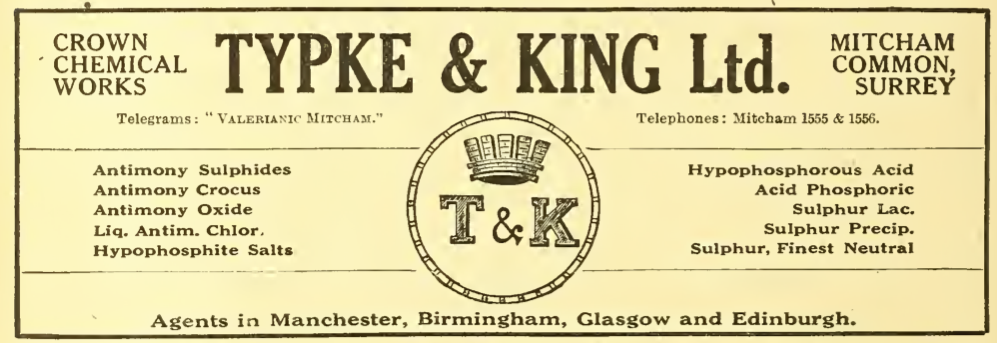
Typke and King

The Crown Chemical Works of Typke and King was between Commonside East and Tamworth Lane, where at present are the roads Marlowe Square, Johnson Close and Donne Place.

1919 Association of British Chemical Manufacturers Official Directory, from the Internet Archive

1909

1919


1921

1921


In 1938 directory

Typke & King Ltd. chemical mfrs. Crown chemical works, 295 Commonside east. T A “Valerianic, Mitcham;” T N 2136 (2 lines)


1886 Chemist and Druggist as for Typke and King

1886


From the East Mitcham Log of 7th July 1932

A Local Industry

Recent discussions regarding Incorporation have reminded our readers of the many industries in Mitcham whose products are known throughout the world, and probably a desire has arisen for further information.

Interesting to report that Messrs. Typke & King Ltd., Commonside East, were established in 1883 by the late Mr. P.G.W. Typke, F.I.C., F.C.S., and the late Mr. W.R. King, for the manufacture of chemicals for the rubber and allied trades.

At that time there were just a few wooden cottages on Commonside East, about 12 houses in Manor Road, and our Sherwood Park estate of today was then Sherwood Farm. Wheat was grown at the end of Manor Road, and there was a large forest adjacent, while between the Works and Streatham Park Cemetery were meadows and beds of osier, used for basket making.

The land now covered by Messrs. Typke & King’s Works, which occupy about 9 acres, was formally an orchard, but today a very different sight meets the eye.

Many of their products are made in large wooden vats provided with powerful mechanical agitators to ensure thorough mixing. Material is then dried in specially constructed rooms at a temperature and it does not exceed a certain maximum, and finally milled and passed through a fine silk or metal sleeve to remove all traces of grit.

Power is provided by three large Lancashire Boilers, supplemented by one of a smaller vertical type and by several gas engines driven by gas produced on the spot. One of these gas engines operates on an Air compressor which pumps water from the firms Artesian Wells rate of 5000/6000 gallons per hour. The large water storage tank is a familiar sight to habitues of Mitcham Common.

The firm takes great precautions to prevent the escape into the atmosphere of any objectionable fumes or odours. There is a large absorption plant in the middle of the works to which gases are conducted on the suction from a fan. As a final precaution the residual air is passed through a bed of absorbent material. The opinion has been expressed that gasses created during the manufacture of certain products are injurious to the operatives, but this is not so, as several of the Firm’s Pensioners can testify.

Is not generally appreciated that pure rubber is hardly ever used in practice as it has very little elasticity or strength, it gets very hard in cold weather and very sticky in hot weather. In order to correct this it has to be vulcanised, i.e., it is mixed with sulphur and heated under definite conditions. There are other methods of vulcanising but this is by far the most common and this simple mixture produces rubber such as is used for winding golf balls. Even then the rubber is not suitable for many purposes and it is thus necessary to modify it still further. This is done by the incorporation of various powders, the actual powder used depending on the purpose for which the rubber is intended.

It is in the production and sale of these powders that Messrs. Typke & King Ltd. specialise. Thus they make the red compound which is extensively used in inner tubes, football bladders, etc., and which, besides giving a pleasing colour, prevents the rubber from perishing rapidly.

Another product for which they are famous is a material known as Factice or rubber Substitute. This is vulcanised vegetable oil, and its principal use is in the waterproofing trade. The rubber in Macintoshes for example may contain 75% of Rubber Substitute, which is added in order to give a smooth silky feel to the rubber, to prevent rapid perishing, and to allow the material to be applied to the cloth with greater ease. In other forms, rubber Substitute will act as a kind of lubricant for vulcanised rubber and thus allow it to be worked more easily.

Nowadays, rubber articles can be obtained in all kinds of pleasing colours, but this has only been accomplished by patient research work. Very few colours can be used in rubber, as some will be destroyed during vulcanising, some will cause the rubber to perish very rapidly, and some will bleach or darken when the rubber is exposed to sunlight. Messrs. Typke & King Ltd. have always specialised in suitable colours, and actually make several at their Mitcham Works.

They also have selling agencies for many powders which it is impossible for them to make. One of the most important of these is Carbon Black which is used to an enormous extent the manufacture of tyres, and rubber shoe soles. The latter may contain 50% of Carbon Black, the object of which is to produce a rubber which has great strength, small stretch, and great resistance to cutting and abrasion. This Carbon Black is made in America where vast quantities of natural gas issue from the ground in certain localities. The gas is burnt in special burners so as to give a smoky flame and the soot so produced is collected and refined. Many thousands of tons of this soot are used annually in the rubber trade in England alone.

It will be realised that in order that they may meet the exacting requirements of the present day, it is necessary for Messrs. Typke & King Ltd. to have special research facilities. Their Laboratory contains a complete miniature rubber plant, which not only allows them to test out their products exact way in which they will be used, but enables them to carry out research work which not only benefits the rubber manufacturer, but eventually is to the advantage of the small purchaser, either because he gets better value for his money or similar quality at a lower price.

It will thus be seen that Messrs. Typke & King Ltd. are well to the fore in an industry which has today reached such tremendous dimensions, and their work has made the name of Mitcham known throughout the world.


From The Scotsman – Friday 27 November 1931, via the British Newspaper Archive.

LAND AND MONEY TO BOY SCOUTS TROOP

Paul George William Typke, (45), of Lawn House, Sycamour Grove, New Malden, Surrey, founder of Typke & King (Ltd.), Mitcham Common, manufacturers of fine chemicals, &c.

Net personalty, £19,671; gross £39,431.

He gives a piece of land in New Malden and £100 towards the erection of a pavilion thereon to the First Malden Troop of Boy Scouts, 200 Ordinary shares in Typke & King (Ltd.) to James Bray, 100 shares each to Thomas Dawson and Albert Mayland, £ 200 each to Constance Stevenson and Margaret Oakey, £100 to Harold Bond and £50 each to Terry Constable and Harry Wilkinson “in recognition of their services to me.”

Note: age given in newspaper article differs to that in Grace’s Guide entry on the firm.