Category Archives: Industry

Norman Smee & Dodwell

Varnish company, established in 1896.

Miles Road

1949 ad from Grace's Guide

1949 ad from Grace’s Guide

In the 1913 directory, Wilfred DODWELL and William SMEE are listed as varnish manufacturers, with referral to the entry for Norman Smee & Dodwell in Miles Lane.

MANUFACTURERS OF HIGH-CLASS VARNISHES for Coach Builders and Decorators, Railway Carriage and Locomotive Builders, and Ship Builders.

Special insulating Varnishes for electrical Purposes

Offices and Factory : MILES LANE, MITCHAM, SURREY.

Text of ad from Wireless World May 1918 (pdf)


From the Military Service Tribunals:
Mitcham & Tooting Mercury, 20th April, 1917
SURREY APPEAL TRIBUNAL.

Mitcham Cases.

R. P. Dodwell, 31, single, varnish and paint manufacturer, works manager and chemist, whose case had been adjourned for medical examination, had been classified B1. It was claimed that it would be impossible to carry out orders, which were chiefly for war purposes, without his special knowledge. Twelve months ago he was given total exemption, and the Military Representative now appealed.

A further two months’ exemption was granted, and not final.


From the Croydon Times – Saturday 01 July 1944

MR. HERBERT SMEE

A director of Messrs. Norman. Smee and Dodwell, paint manufacturers, of Mitcham, Mr. Herbert Smee, of St. Augustine’s-avenue, South Croydon. has been killed by enemy action. Aged 57, Mr Smee had lived in the district for eighteen years. He leaves a widow and a daughter. The funeral was at Croydon Crematorium on Tuesday.

According to the Commonwealth War Grave Commission, he was husband of Hilda Louise Smee, of 41 St. Augustine Avenue, South Croydon. Died at London Road. He was an Air Raid Warden.

According to the 1961 Kelly’s directory, the company had moved to Croydon:

NORMAN, SMEE & DODWELL LTD
Union road, Croydon, Surrey
T N THOrnton Heath 8355;
Grams, “Decor. Croydon”; estab. 1896
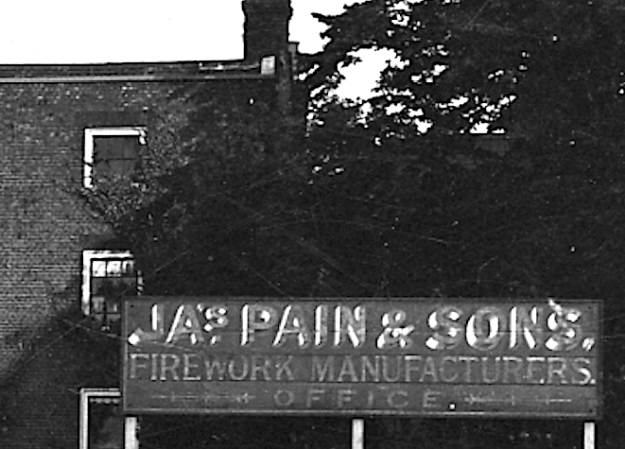
James Pain and Sons, Ltd.

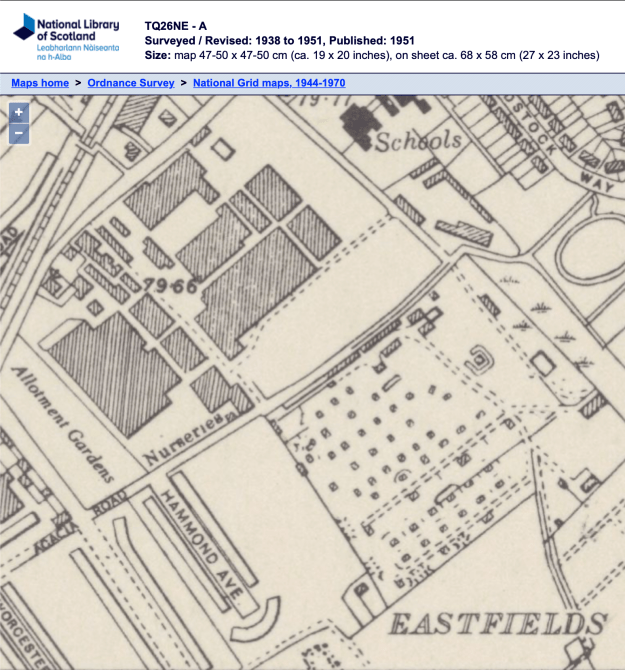
Firework factory, off east side of Acacia Road, that came to Mitcham in 1872. The company was taken over by the British Match Corporation in 1960 and transferred its factory to Salisbury.

The Eastfields Housing Estate was built on the site. The roads were named Clay Avenue, Moore Close, Mulholland Close, Pains Close, Potter Close and Thrupp Close.

Clip from Merton Memories Mit_Work_Industry_6-3 copyright London Borough of Merton.

The offices were at Renshaw Corner until after WW1.

Clip from Merton memories photo Mit_Work_Industry_6-1 of

See also the entry on Grace’s Guide to British Industrial History.


News Articles

MATCH FIRM DO DEAL IN FIREWORKS BRYANT and May, chief operating subsidiary of the £30,750,000 British Match Corporation, is in the take-over field again.

It has acquired Waeco Ltd., whose main products are fireworks and marine distress equipment and a range of smoke pesticides and fungicides.

This company has two factories near Salisbury and a third has recently been acquired at Cambourne to provide room for further expansion.

British Match, which has been carrying out an energetic diversification programme, already owns two firework firms, James Pain and Sons, of Mitcham, and Octavius Hunt, the Bristol makers of sparklers and Bengal lights.

Its other interest, besides matches, range from man-made timber to boxes, steel wool and ticket issung machines.

Source: Newcastle Journal – Tuesday 22 May 1962 from the British Newspaper Archive (subscription required)

Elephant frightener

AT the firework and distress & signals makers, James Pain, they have just finished a consignment of 6,600 gross fog signals — and one of their purposes will be to frighten elephants.

They are part of an annual consignment to Nigeria where fog signals are used for a great variety of purposes on the railways.
They are most useful in frightening elephants and other animals from the tracks.

The Eastfields factory has also completed special smoke signals for a film to be made about the Jordan Army.

Source: Mitcham News & Mercury, 27th January, 1961

BRITISH MATCH
PROGRESS OF DIVERSIFICATION
THE MATCH INDUSTRY

Three-quarters of group sales were again made overseas, mainly in the Commonwealth and South America. In the home market competition was intense; higher sales of SWAN VESTAS offset lower sales of other British matches. Bryant & May’s new match factory in Glasgow, though relatively small, is the most modern in the world.

DIVERSIFICATION

As consumption of matches is static, other interests are hems expanded or acquired. A new £2.5 million ‘WEYROC’ factory is to be built near Annan. Packaging, pulp mouldings, ticket machines, steel wool, scourers and wire products are other main interests in the U.K. In total. 26.4%, of the group profit was earned outside the match industry compared with 14.6% last year. James Pain, the firework makers, joined the group in June 1960.

Source: Birmingham Daily Post – Monday 29 August 1960 from the British Newspaper Archive (subscription required)

Advertisements

Lloyd’s List – Monday 07 September 1874

People
Miscellaneous notes on staff.

from marriage banns 14th June 1905 – Alfred Albert Henry COOPER, 27, living at Eastfields, assistant manager firework factory, father William COOPER, firework maker. In 1911 and 1925 he lived at 5 Langdale Avenue. Died December 1950 in Bognor Regis.


Maps are reproduced with the permission of the National Library of Scotland.