Category Archives: Schools

Rumbold Farm

Farm house and land off west side of Carshalton Road, on part of what is now the Willow Lane industrial estate. Also known as Rumbold’s Farm or Rumbold Castle, it dated back to the 17th century.
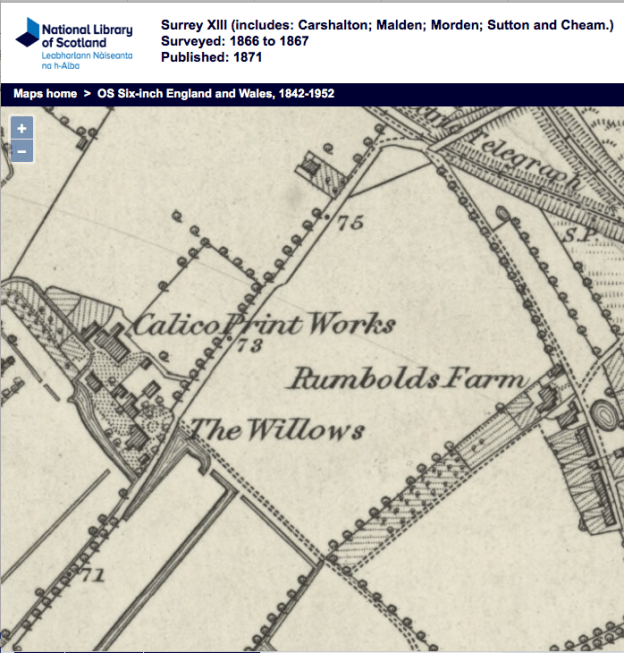
1867 OS map

As reported in the London Evening Standard – Saturday 16 February 1861, the Great Ormond Street Hospital, which had been established in 1852, used its Samaritan Fund to obtain for convalescing children

the renovating influence of sea and country air, and in a large measure the committee were indebted for the opportunity of doing this to the kindness of two friends of the charity, one of whom, at Brighton, undertakes the entire cost of the Home which she has established there, whilst Lady Harding receives the children at a moderate charge of Rumbold’s Farm, Mitcham, a home founded by and still under her management.

The archivists at Great Ormond Street Hospital said that from 1869, the Hospital for Sick Children had its own convalescent home at Cromwell house in Highgate, but prior to that, after opening in 1852, they used the Mitcham home run by Lady Harding and another private home in Brighton. From 1927-83 the hospital had a larger ‘Country Branch’ further out in Surrey at Tadworth Court, which continues to operate today as a charitable trust providing respite care services for children.
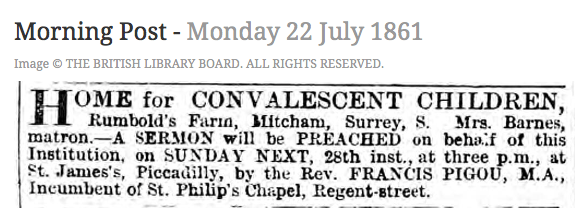
Morning Post – Monday 22 July 1861 via British Newspaper Archive

The 1881 census shows a Rumbolt Boarding School, listed between Flat Tops and the Mitcham Junction Railway station. The census lists 46 pupils at the school, with ages from 3 to 12.

Who had the right spelling? The OS maps show Rumbold and the census as Rumbolt.

The farm went up for sale in 1885:
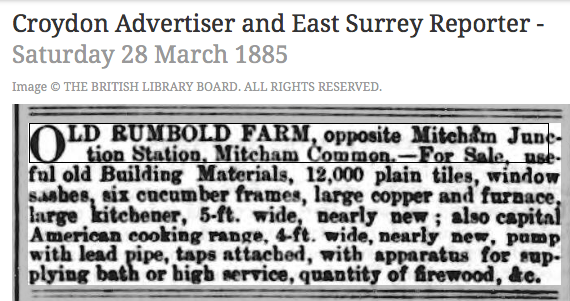
Croydon Advertiser and East Surrey Reporter – Saturday 28 March 1885 – via British Newspaper Archive

Text of ad:

OLD RUMBOLD FARM, opposite Mitcham Junction Station. Mitcham Common.—For Sale, useful old Building Materials, 12,000 plain tiles, window sashes. six cucumber frames, large copper and furnace, large kitchener, 5-ft. wide, nearly new; also capital American cooking range. 4-ft. wide, nearly new, pump with lead pipe, taps attached, with apparatus for supplying bath or high service, quantity of firewood, &c.

Tom Francis took a photo of the farmhouse, which can be seen on Merton Memories.

Maps are reproduced with the permission of the National Library of Scotland.

1933: Iolanthe performed by Mitcham County School

The Mitcham County School’s headmaster (1930 – 1952), Alan John DOIG, was an enthusiast for Gilbert & Sullivan, and his Iolanthe production was reported as a ‘remarkable show’ on the front page of the 27th January, 1933 issue of the Mitcham News & Mercury.

“IOLANTHE”
Remarkable Show by
Schoolboys

The Lord Chancellor – J. P. MacLaren
Earl of Mountararat – A. L. Watts
Earl Tolloller – P. C. Didcock
Private Willis – J. H. Stainforth
Strephon – H. A. Packer
Queen of the Fairies – S. A. R. Rose
Iolanthe – R. Stainforth
Celia – D. Trench
Leila – W. E. Trench
Fleta – V. C. Clark
Phyllis – S. J. Ashby

Chorus of Dukes, Earls, Viscounts and Barons: P. Adams, O. D. Brooks, R. Brown, K. S. Bulbeck, C. C. Creed, R. Cronk, R. C. Gifkins, T. A. Henry, D. A. Lucy. J. S. Seeley, J. Selby, B. Taylor, R. H Watts, E. W. Warner, S. Wilhelm, M. Wilkie, G. Winchester.

Chorus of Fairies: D. Andrews, J. A. Brett, K. F. Campbell, P. B. Chappie, J. H. Cliff, J. F. Courteney, D. P. Curran, C. Hale, Y. S. Hart, C. W. Hollowell, H. R. J?ffs, H. F. Johnson, P. F. Lockyer, L. A. Miller, E. G. Nichols, S.A. Rose, D. F. Mackay, E. W. Sanders, E. Y. Towner, R. O. West, A. White, E. T. Wilkie.

English peers and immortal fairies rubbed shoulders at Mitcham Baths on Friday and Saturday of last week, when the Mitcham County School for Boys presented “Iolanthe ” as their third annual Gilbert and Sullivan production.

Mr. A. J. Doig (heed master) showed great courage in the selection of such a difficult work, but he evidently knew the abilities of his pupils, especially in the chorus work. Twenty odd youngsters, obviously from the lower school, were transformed into flitting, silver-voiced fairies, who sang with that natural, clear tone which a female chorus can never do.

SPLENDID SINGING.

Obviously. for a young, all-male cast the opera presented difficulties, but from the vocal point of view it did not suffer owing to the absence of females. The singing was the greatest of all the features of the show, and a school able to produce a better standard of singing would be hard to find.

Mr. A. J. Doig once again shouldered the great responsibilities of producer, coach and musical director, and excelled himself in all three capacities. Evidence of his coaching was seen in the way in which the entire cast combined action with singing, not an easy thing for amateurs. Even with the large amount of talented human material available, the show must have been the result of tremendous effort and thought on Mr. Doig’s part. Whether the acting satisfied Mr. Doig or not, the large audiences assured him that they were more than delighted with the show.

Of the cast, perhaps J. P. MacLaren, as the Lord Chancellor, was the most Gilbertian. Possessing a pleasing voice, he sang and frolicked his way through a role which required constant action. He was warmly encored for his singing in the second act, and he seemed quite comfortable when fooling with Mountararat (A. L. Watts) and Tolloller (P. C. Didcock), the two noble suitors. Watts’s remarkably mellow voice was heard to advantage in the second act, and he and his partner, Didcock, worked in perfect harmony. Didcock also possesses a promising voice, and he combined well in the trio.

Iolanthe was played by R. Stainforth, and was the most difficult role in the cast. To look young and yet be the mother of a senior member of the school is no easy task for a boy of Stainforth’s age. The extent of his successful interpretation seemed to frighten him, and his small voice did not encourage him. A very creditable performance of an uncomfortable and very difficult part.

GOOD ACTING.

S. J. Ashby was charming as Phyllis, the shepherdess, and many of the audience thought that a girl was playing the part. Ashby gave a display worthy of sincere congratulation. Singing, acting and deportment were necessary for the part, and he sang delightfully, acted naturally and carried himself so daintily that a few females might be envious of such grace. What a pity that such a clear voice will perhaps before long give place to more manly tones.

H. A. Packer was a spirited Strephon, and got through those uncomfortable love scenes with Phyllis quite creditably. His duets with Ashby proved very popular. Private Willis (J. H. Stainforth) had little to do, but proved that he was quite capable of more deserving parts.

The chorus of dukes, earls, viscounts and barons lent colour to the settings, but their voices were hardly heavy enough to bring out the finer points of the chorus work. The fairies out-weighed them in strength, but lacked some of the finer points of acting.

S. A. R. Rose was rather apathetic as the Fairy Queen, but improved considerably towards the end. His difficulty was the problem of using his hands. After several attempts, he adopted the stance of a weight-lifter posing before camera. Nervousness seemed to be troubling him, but he acted more easily in the second act.

The admiration of the large audiences was for all those who interpreted female parts. An announcement in the programme said that the proceeds of the performances were for improvement in the school’s new playing field. The programme also contained an invitation to the public to see the school “Rugger” teams in action. To see Phyllis tackled by the Fairy queen would be good fun, and would show that operatic production is not the only winter pastime in the school curriculum.

Mr. A. J. Doig conducted the orchestra, which consisted of the following:

First violin – Mrs. D. Stickings, Mr. A. White, Mr. E. V. S. Ericson;
Second violin – Mr. L. A. Johnston, Mr. C. G. Reed, Mr. C. Jones;
Viola – Mr. R. W. E. Stickings,
Violoncello – Mr. John Podel;
Trombone – Mr R. A. Johnson, Mr Caldow;
Pianos – Mr F. C. Hambleton, Mr. L. W. Stephens.

For a history of the school, see the Old Mitchamians website.