Category Archives: Transport

1866 – Six die when bridge collapses during construction of Mitcham – Sutton railway

From the South Eastern Gazette, 1st May, 1866, page 6:

Frightful Accident at Sutton, Surrey — Six Men Killed by the Falling of a Bridge.

— A lamentable catastrophe occurred at Sutton on Saturday afternoon. The South Coast Company are constructing a new line of railway, which is ultimately intended to connect the London termini with Portsmouth by a direct route. A portion of this line is known by the name of the Mitcham and Sutton Railway, and after crossing Mitcham-common runs at the back of Carshalton and joins the existing Epsom line on the London side of the Sutton station.

A deep cutting through chalk, about half a mile from the junction, renders a bridge necessary for the public road. The work was here in active progress, and the bridge which fell was constructed by means of leaving a keystone of the native chalk and building the brick work upon the chalk abutments. The bridge was nearly completed, but some weeks since a doubt of its stability was entertained, and reports are current in the neighbourhood that the bridge was condemned, and that workmen had absolutely been discharged by the contractor for refusing to work at it, under apprehension of danger. Notwithstanding this, on Saturday afternoon, at half-past two, six men and a ganger were employed. Three of the six were cutting away the chalk, and three others were scraping the brickwork to make it ready for pointing, from which it appears that there was no intention of pulling down the bridge. At half-past two the whole mass of brickwork gave way and buried six poor fellows. The ganger, John White, escaped. Every effort to get at the buried men was made, but it was nearly two hours before they were extricated.

All six were of course dead, and there is reason to hope that their death was almost simultaneous with their apprehension of danger. On visiting the spot on Sunday morning we found the six poor fellows were lying on the floor of a cottage adjoining, and exhibiting a frightful aspect of violent deaths. One of them had his face and head absolutely torn in halves horizontally; another’s countenance could scarcely be recognised.

The names of the poor fellows are Edward Berry, Chas. Collard, Wm. Cook, Henry Hyder, and Hutchinson ; the sixth was not identified at the time of our visit. The contractor for the line is Mr. Joseph Firbank, of Newport, Monmouth, and the construction of the bridges is underlet to Mr. Henry King, of Lower Norwood.
Walter Mays Ltd.

The Abbey Cork Mills of Walter Mays Ltd was built on the site of William De Morgan’s pottery, Colliers Wood, in around 1890.

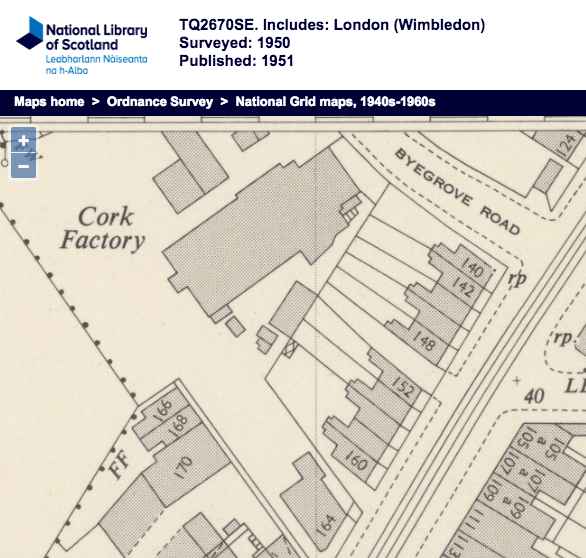
1950 OS map

Walter Carden-Mays born December 1865 in Camberwell. He married in 1888 and died on 21st January 1941 in Surrey. The ‘Carden’ part of the family name was dropped at some point, and his company was known as Walter Mays Ltd.

Listed in the 1925 street directory as Walter Mays Ltd. (Abbey Cork Works), 150 & 152 Byegrove Road.

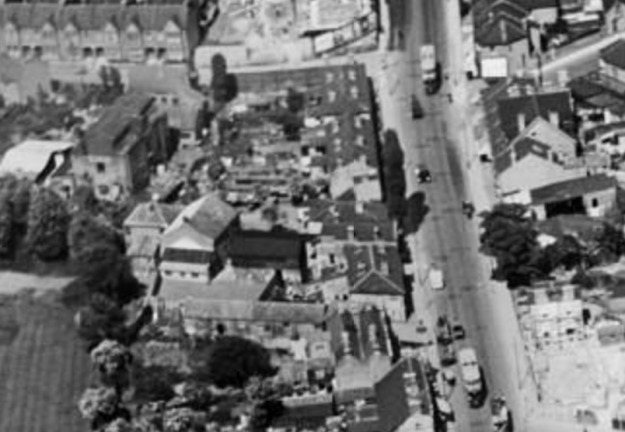
1924 aerial photo. The site for Colliers wood underground station can be seen bottom right. The cork factory is on the left of the High Street.

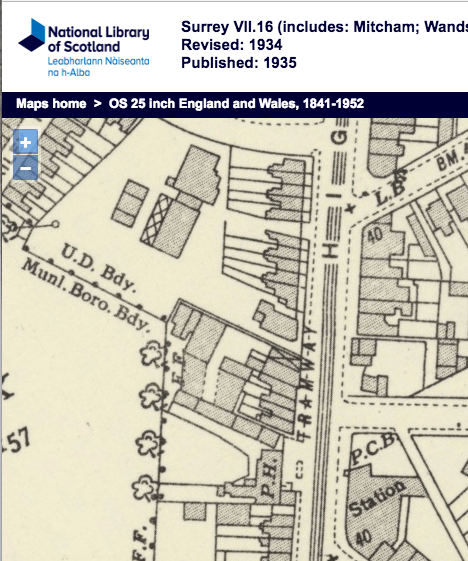
1934 OS map rotated to show same view as aerial photo above


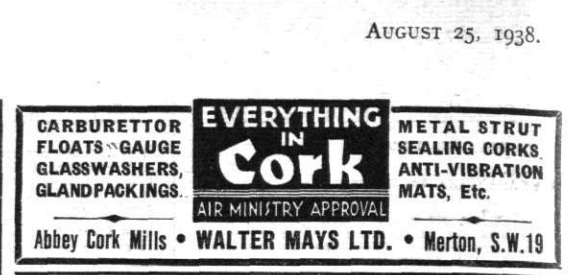
Ad from Flight Magazine of 1938 :

and directory listing from same:

WALTER MAYS, LTD., Abbey Cork Mills, London, S.W.19 (Liberty 3764).—” Everything in cork “; carburettor and oil indicator floats, gauge glass washers, gland packings, strut sealing corks, anti-vibration mats, composition cork jointing to D.T.D.219A, laminated and plain.

In an entry on Grace’s Guide to British Industrial History from 1939 about suppliers to the aircraft industry, cork joints to specification DTD 219A were widely used for petrol tank gaskets and packings.


The Stone Cottage of the Surrey Iron Railway stood on the Walter Mays Ltd site for over 150 years.


Mitcham Military Service Tribunals

As reported by the Mitcham and Tooting Mercury, 16th June 1916, an employer of a cork business in Colliers Wood, appealed for his son. Although not named, it is likely that the company was Walter Mays Ltd.

Exemption was asked for a skilled mechanic, by the owner of a cork manufacturing business in Colliers Wood. The employer said the man was very valuable in his present employment and he will be practically impossible to replace. A large proportion of their manufacturers were for government uses. He employed about 17 men of whom are only three were eligible. He pleaded that his son was capable of doing almost anything in the business and his departure might cause the closing down of the business.

Three months exemption.

In the Mitcham and Tooting Mercury, 2nd November 1917, the company and employee are named in an appeal.

Mr Walter Mays, cork manufacturer, of the Abbey Cork Works, High Street, Colliers Wood, asked for a exemption for Mr T.W.S. Cavey, age 41, B1, motor driver and mechanic, residing at Birdhurst Road, Colliers Wood.

Applicant: An exemption for so long as the man remained in his employment. He was engaged in delivering all Mr Mays’s important Government contract work. The average mileage was 250 miles a week.

Counc. Baker : I suppose it is all Government work that Mr Mays does?

Applicant: Oh, yes, it is most important.

The appeal was disallowed.

In the 1919 electoral register a Thomas William Sherrin CAVEY was living with his wife Florence Louisa in 28 Birdhurst Road. He died in 1950 as stated on the Find-A-Grave website, which also says he was a Music Hall performer known as Stirling Fred.


Maps are reproduced with the permission of the National Library of Scotland.