House that was home for Lt. Col. Harold Bidder DSO, son of George Parker Bidder QC.

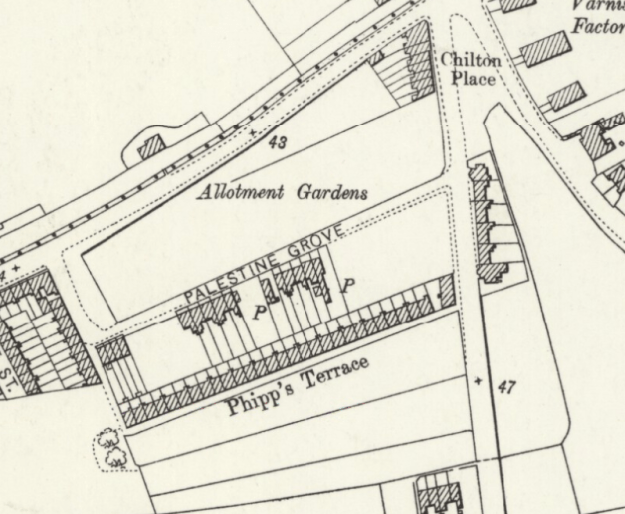
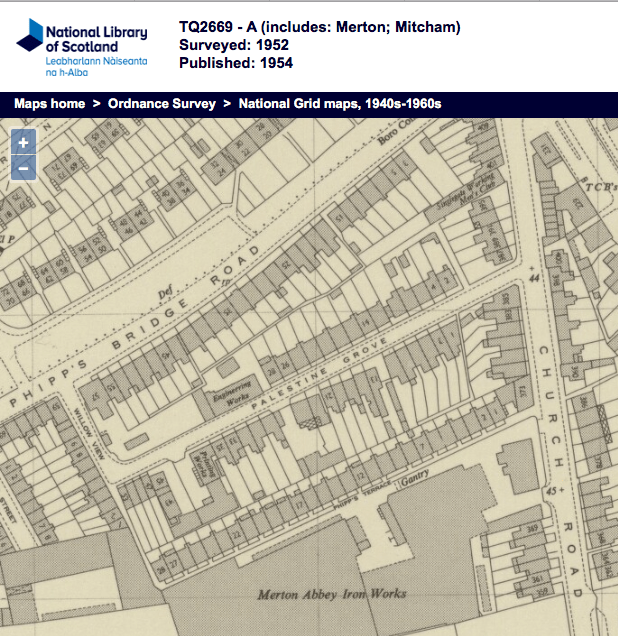
1910 OS map reproduced by permission of the National Library of Scotland, reuse CC-BY
According to Eric Montague, in his Mitcham Histories : 10 Ravensbury, Harold bidder commissioned the house in 1910, to the design of his brother-in-law Horace Porter and Percy Newton. Finished in 1912, it was conceived in the new Queen Anne style popularised by Lutyens, with classical doorcases and a wealth of interior panelling, and stood on a stone balustraded terrace with steps descending to the water’s edge.
An article appeared in Country Life, 8th March 1913, “The Lesser Country Houses of Today”.
March 8th, 1913.
COUNTRY LIFE.THERE can be few sites within a ten-mile radius of Charing Cross which present so many attractions as that of Ravensbury Manor. It has an air of seclusion altogether delightful, and the river Wandle meanders pleasantly through the grounds, and stretches a backwater through tall trees. That the merits of the place have been appreciated for at least fifteen centuries is clear from the Anglo-Saxon finds which have been recorded by its owner, Captain Bidder, in
the solemn pages of Archaeologia. Seventy-seven graves were examined, and yielded many typical objects which illustrate the art of the West Saxon inhabitants of Surrey. In Captain Bidder’s house, now illustrated, is preserved a wealth of beads and brooches, buckles and knives, and among the
finds was a charming tumbler of pale blue glass and of a curiously modern shape which suggests the Arts and Crafts Exhibition.From the fifth century we must needs jump to the eighteenth, for by the river bank are the remains of the manor house of that period. Less
than a century ago this was abandoned, doubtless because its construction was ill-adapted to resist the floods to which the Wandle was addicted, and a new home was built some distance away on much higher ground. Such ruins as remain suggest that the old house had some pleasant characteristics. Of late, Captain Bidder, appreciating the peculiar merits of the river-side, has built his new house there, but on the opposite bank and on much higher ground. The unusual
placing of the house with reference to the Wandle Road and the odd shape which the garden has taken were due to the desire to secure from the chief windows the pretty view along the course of the river. But for this the architects would have prepared to set it parallel with road and river. The
desire to utilise the highest point above water-level also made it needful to put the house very close to the road and to banish the motor-house to the far side of it. None the less, privacy has not been sacrificed, for an adequate wall divides the forecourt from the road, and no rooms of importance
overlook, that side. This is a case, however, where the exigencies of the site compel a disrespect of the usual practice with reference to sunny aspect. The living (and dining) room faces north-east and north-west, and the parlour north-west and south-west, by no means an ideal arrangement, but the best that could be done as things were. The plan generally marks Ravensbury Manor as a bachelor’s home. The building is conceived in the quiet manner
of the eighteenth century and is attractive, but it lies open to the criticism that height is over-emphasised in proportion to width. On the north-west front is laid out pretty paved garden, from which the stable block with its lantern is seen to group well with the entrance gates. To divide this garden from the forecourt, very good use has been made of a treillage screen, a feature of garden treatment which is employed too little. Surrounding
the paved garden and marking it off from the meadow, above which it is raised, is an attractive balustrade, seen best in our second picture, which was taken from the far bank of the Wandle. Advantage has been taken of the front door being at the internal angle made by the two wings of the house to provide an interesting dome-shaped porch. The inside of the house is plainly treated save for the dining room, where charming panelling is interspersed with big romantic landscapes by Stansfield, some in tempera and one in oil. It is impossible to exaggerate the increase in restfulness which comes from giving to pictures a definite part in the architectural treatment of a room, instead of making them excrescences emphasised by gilded frames which usually bear no decorative relation to their surroundings.The word “manor” when applied to a small place has a large sound which is inappropriate, and, moreover, it is usually meaningless. In this case, the house is, in fact, the house of the manor, and, despite its modest extent, has a dignity which adds a certain fitness to the just use of the word. Mr. Porter and Mr. Newton have shown in the general scheme of the design a gift for overcoming the difficulties presented by a site of unusual character and hampering conditions.
W.
In 1926, the London County Council selected 825 acres of farmland to the south of the house for its housing estate of 10,000 homes for inner London families, which became known as the St Helier Estate. Other plots of land near the house were snapped up as well, and the country mansion aspect of the house dwindled as a result.
Mitcham Urban District Council approached Merton and Morden Urban District Council with a suggestion that they join forces and buy the remains of the Ravensbury estate to establish a park. At a cost of £6,000, as reported in the Daily Herald of Tuesday 23 April 1929, Ravensbury Park of 16.5 acres was established (14 acres was in Mitcham). It was formally opened on 10th May 1930 by George Lansbury MP, Commissioner of Works.
Ravensbury Manor House, now having lost its former grounds, and the wider area no longer part of the countryside, was put up for sale in 1930. There were no buyers. It was then demolished and the site used for building maisonettes.
News Articles
Shepton Mallet Journal – Friday 15 March 1929
BAPTISM IN GARAGE
In a tiny chapel constructed in corner of the garage at Ravensbury Manor, Mitcham, the residence of Colonel H. F. Bidder, Rosemary Vivian, the youngest child of Colonel and Mrs. Bidder, was baptised on Saturday afternoon. The service was conducted by the Rev. A. J. Culwick, Rector of Morden. A silver-mounted bowl presented to the six-weeks old baby by members of the Essay Club, Society of Antiquaries, of which Colonel Bidder is member, was used as a temporary font.
The chapel, which seats about a dozen people, is used for Sunday evening services by the Bidder family, and by number of residents near the manor, to save the long walk to Mitcham or Modern Churches. Colonel Bidder occasionally takes the services himself.
Daily Mirror – Tuesday 30 June 1914
MAN WITH REVOLVER AT BEDSIDE.
How an Army captain awoke to find a man standing by his bed with a revolver was described at Croydon yesterday, when Alfred Goddard was committed for trial, charged with burglary at Ravensbury Manor, Mitcham. Captain Bidder stated that he awoke and found prisoner standing by his bed with a revolver pointed at his head. Prisoner said, ” You are a dead man !” but witness jumped out of bed, seized the man, threw him to the ground and held him there.
Morning Herald (London) – Thursday 30 June 1831
MITCHAM.
 Mitcham History Notes