Tag Archives: 1939

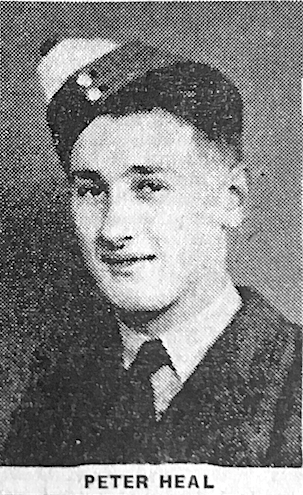
Sergt.-Navigator Peter Heal reported missing on D-Day, was rescued


From the Mitcham News and Mercury 1st September 1944, page 1:

Missing Airman Rescued

In Hospital In Normandy

When Germans Fled They Left Him Behind

Comes to England by Air Ambulance

We are delighted to be able to report that Sergeant-Navigator Peter Heal, whose home is at 65, Greenwood Road, Mitcham, reported as missing on D-Day, is now safe, although injured and in hospital. He was rescued by American troops in the capture of Normandy, and was flown to a hospital in England.

The good news comes in a letter from Peter’s father (Mr J.C. Heal) to the O.C. 1807 Squadron, A.T.C., to which the young fellow belonged.

Our 1807 Squadron correspondent writes:-

During the week the good news came to hand that our ex-Flt.-Sergt. Peter Heal is not only alive but in England,, which as yet, make makes remarkable reading.

HIS FIRST “OP.”

Sergt.-Navigator Heal as he now is, made his first operational flight on D-Day and his aircraft was shot down over Northern France. Peter was reported missing and not one word had been heard of him since until this week, when his parents, who refused to give up hope received a letter from him posted from a hospital in Lancashire!

In this letter he states that when his aircraft landed he sustained a broken leg and thus became easy meat for capture. The Germans placed him in one of their hospitals in Normandy, and there he remained until August 4th, when the district in which the hospital was situated was captured by the American Army. The Germans in their haste to get away, had to leave Sergt Heal behind. He was gathered in by the Americans, who couldn’t do sufficient for him, and he enjoyed good food and plenty, for the first time for two months.

BY AIR AMBULANCE

A few days later he was brought in by air ambulance to an American hospital in England and then later transferred to a British hospital in Lancashire.

Although a bed case, a leg still being in plaster, he writes most cheerfully and hopes once again to be up and doing in the near future .

The news of Heal is a real tonic to the Squadron and must surely cause other parents less fortunate at the moment to once again take heart in the hope that faith and patience ultimately bring its reward.

The 1939 Register shows the occupants at 65 Greenwood Road:

Frederick C. Heal, born 22nd March 1893, shop assistant book keeper
Beatrice C. Heal, born 14th February 1897, housewife

This 1954 OS map shows 65 Greenwood Road as near the junction with Holly Way, and the Church of the Ascension at the corner with Sherwood Park Road.
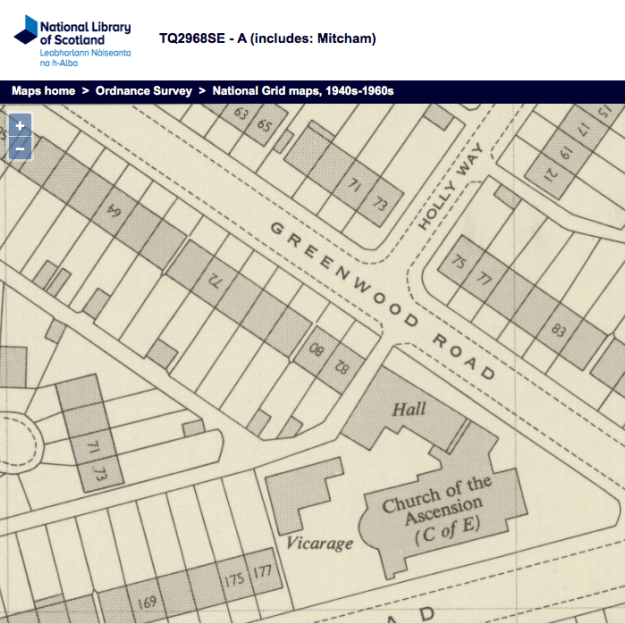
1954 OS map


Maps are reproduced with the permission of the National Library of Scotland.

Lance Corporal George Philpott

from the Mitcham News & Mercury, 6th October, 1944, page 1:

Lance-Corporal George Philpott, Riverside Drive, London Road, Mitcham, a tailor’s cutter and trimmer at Gieve’s, Piccadilly, before the war, now wields a blacksmith’s hammer at Suez, and has Egyptian strikers, whose only language is Arabic, at his anvil.

In peace-time he was a keen motor and polo cyclist, and hoped to get a job as despatch rider when he joined the Army, but they sent him to Longmore to train as a blacksmith. Later, he worked at Wilmot, Newport and London. While working at the Albert and King George V docks London, he claims to have had a wonderful time, because he was so near home, and able to visit his father and brothers frequently.

Of his job Lance-Corporal Philpott says: ”It’s interesting work, and I quite like a change, but I shall go back to my own trade after the war. Only, maybe, If I get absent-minded, I might begin to cut clothes with a hammer and chisel.

DANGER AT THE DOCKS

“We came to the Middle East in May, 1942,” he said,” and I was posted straight to Suez, where we are now. When the push was on a detachment of us went to Mersa Matruh and Tobruk, to work on the docks there. We repaired cranes and installations destroyed by the Germans before they left. There were air attacks when we were at Tobruk and at Benghazi. Most of the troops were quartered outside the town, but we got the full benefit, because we had to stay right on the docks, and whenever a ship came in, the attacks were redoubled.”

Lance-Corporal Philpott is in charge of the blacksmith’s shop for his present Company, and has Egyptian strikers at his anvils. Language is something of a difficulty but he has picked up enough Arabic to make himself understood, and he can give measurements in Arabic. Work is hard and the climate difficult, being very hot, indeed, in summer; but pressure is less than it was when the Allies were invading Sicily. Then the Company worked long hours, and nobody got any off-day during the week.

“My Army experience has been interesting,” he says. “I have seen things I shall never forget. I do not regret my Army service for a moment.”

BROTHER THERE, TOO.

His brother, Frank, is also in the Middle East. He too was a keen motorcyclist, and was more fortunate than his brother, for he became a despatch rider. Their younger brother, Ronald is a member of Mitcham Army Cadet Corps.

KEEN CYCLIST

L-Cpl Philpott, a member of Tooting Cycling Club, was one of the club’s top scorers. He played in their bicycle Polo team and holds several medallions awarded for his part when the club won competitions. His brother, like his father, is a keen racing cyclist, and won several prizes on the road; he held the 25-mile record of the Tooting Cycling Club in 1931, his time being 1 hour 3 minutes 53 seconds.

The 1939 Register shows the occupants of 62 Riverside Drive:

James I Philpott, born 19/02/1881, Newsagent’s Warehouseman
Florence A Philpott, born 28/02/1884, housewife
George Philpott, born 31/01/1910, Uniform – Tailor’s Trimmer
Esther F Philpott, born 28/07/1911, Packer – Confectionery
Grace Philpott, born 17/06/1912, Packer – Confectionery
Gladys Philpott, born 13/07/1915, Chain Store Supervisor

Source: The National Archives; Kew, London, England; 1939 Register; Reference: RG 101/1372H

A relative on the Facebook group Mitcham History wrote “As he and his brother Frank volunteered for service, they both thought that their skills in civilain life would be put to use. Instead they were both posted to North Africa. George was trained as a blacksmith, somewhat different to a military tailor! He was posted to the London Docks to repair cranes, then was shipped out with them.”