Tag Archives: 1947

Bridge Road

Road that was off east, or right-hand, side of Christchurch Road, opposite Runnymede. It was closed in 1966.

In this 1952 OS map, the road is shown with a single terrace of eleven houses on the north side, numbered sequentially 1 to 11.
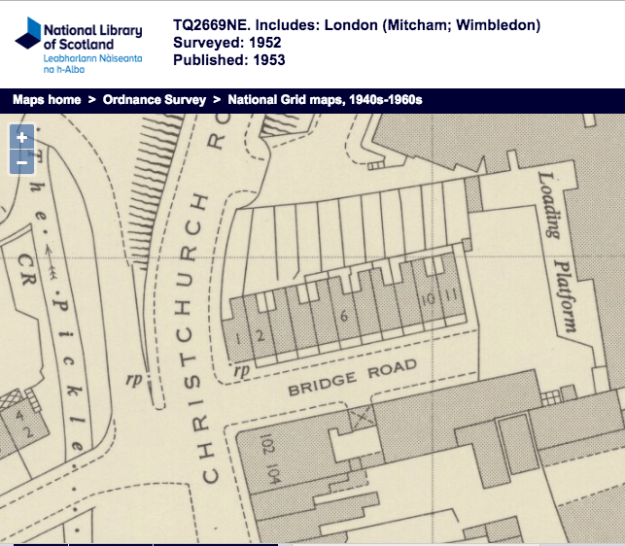
1952 OS map

1952 OS map

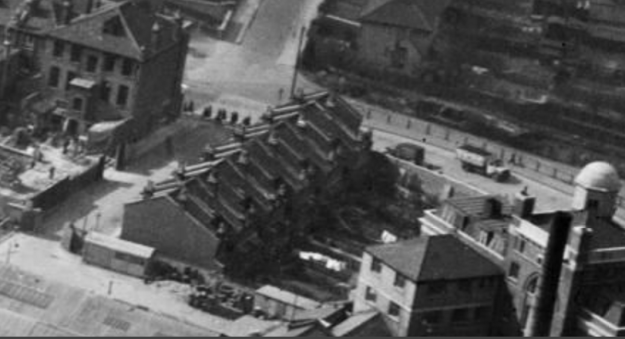
Aerial photo from 1947 shows the row of houses on the left side of the road.
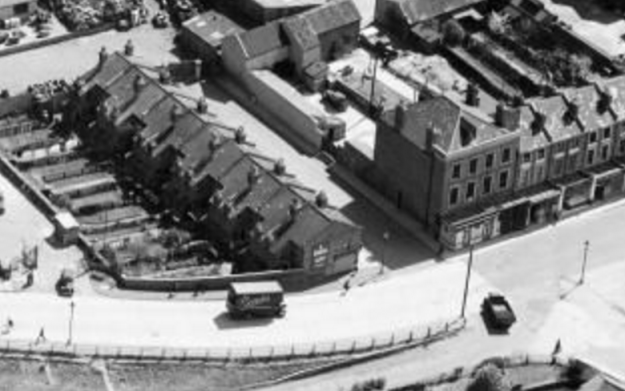
29th April 1947 from Britain From Above

29th April 1947 from Britain From Above

Aerial photo from 1949 shows the road looking to the west. The dome atop the tower on the right was Frys Metals factory.
19th March 1949 from Britain From Above

19th March 1949 from Britain From Above

It is not mentioned in the 1891 street directory, but there are two houses listed in the 1896 street directory and all eleven in the 1904 street directory:

1896

1, James CAVENDER, stationer
2, John STOPHER, greengrocer

1904

1, James CAVENDER, stationer
2, Arthur Thomas THORNS, greengrocer
3, Auburn Frederick ISACKE
4, Austin C HOLLANDS
5, William SHARPE
6, Arthur Albert FRISBY
7, Charles TAYLOR
8, Arthur SWINDELL
9, Robert SWINDELL
10, Edwin YOUNG
11, William YOUNG

The road was closed in 1966:

Bridge Road is to be closed down

Bridge Road, a cul-de-sac off Christchurch Road, Mitcham is to be closed. Merton Council have given planning permission to Frys Metal Foundries Ltd., for redevelopment which involves the closing of the road.

The road was originally the principle means of access to residential properties which have since been demolished. It now serves the factory premises only.

RIGHTS OF ACCESS

The council agreed to give permission provided the council’s right of adequate access to the public sewers were preserved.

Also provided that the owner of the factory should take over the responsibility for the street lamps and cables in the road, and also bear any costs incurred in closing the road.

Frys have also offered land near Bridge Road to the council free of charge for the proposed widening of Christchurch Road. The offer has been accepted.

Source: Mitcham News & Mercury, 13th May, 1966, page 1.

Occupants in 1939

1, Leonard Douglas and Elizabeth HAYNES
2, Mary Jane and Rosa FISK
3, William Charles and Alice Louisa and Christopher ADAMS
4, James and Maude BURLING
5, Robert and Gertrude MARSHALL
6, Alfred and Mabel Frances FORD
7, Robert and Doris May TAYLOR; Edith Mahala FRISWELL
8, James Alfred and Sarah Ellen DURLING
9, Henry William and Rose Florence and Florance DALTON
10, Ernest John and Flora BURLING
11, Charles Walter and Susan FRANCIS


Maps are reproduced with the permission of the National Library of Scotland.
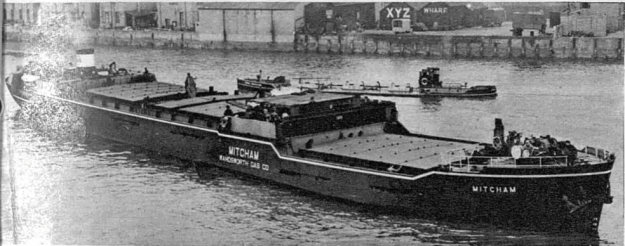
Wandsworth Gas Company’s Coal Ship “Mitcham”

19461102-mv-mitcham

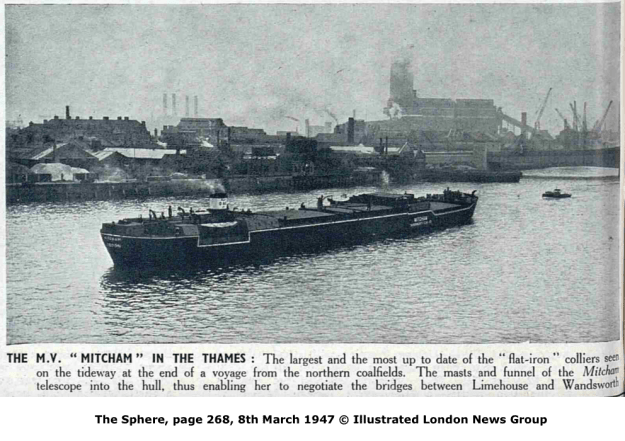
THE LAST WORD IN “FLAT IRONS”: The 1,780-ton coasting collier “Mitcham,” the Wandsworth Gas Company’s new vessel, seen on the Thames at Wandsworth after negotiating the fifteen miles of river from the estuary. When she turns round at Wandsworth there is little room for other traffic to pass. The “Mitcham” has a squat funnel to save her lowering it at each bridge, and her collapsible masts are stepped down into the holds.

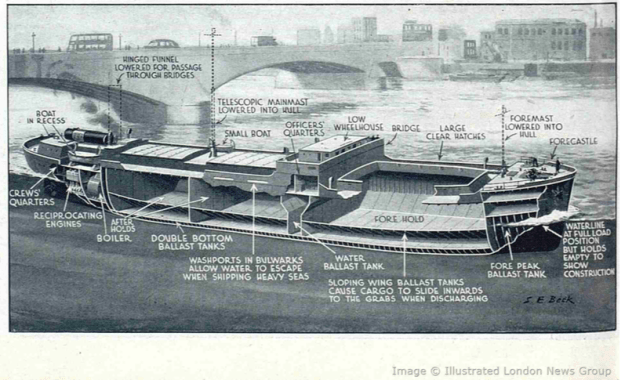
The Wandsworth Gas Company are adding several new ships to their fleet, and the “Mitcham” bears a close resemblance to the “Chessington,” details of which were given in “The Sphere” of June 29. She is equipped with sloping wing ballast-tanks, which ensure that the cargo automatically precipitates itself to within the range of the mechanical grabs during the discharging operations.

Source: The Sphere – Saturday 02 November 1946 from the British Newspaper Archive (subscription required)

19460629-mv-chessington

AN IMPORTANT ADDITION TO LONDON’S COLLIER FLEET : A diagrammatic drawing of the S.S. “Chessington,” the largest vessel to pass the Thames bridges. The “Chessington,” belonging to the Wandsworth and District Gas Company, is known as a “flat-iron,” and she is able to carry 2,700 tons of coal on each trip from the Durham coalfields. The ”Chessington” recently completed her maiden voyage, attracting much attention as she came upstream beyond the Pool and Westminster Bridge. She is nearly 260 ft. long, and as she passes under the bridges her funnel lowers in the usual manner and her masts telescope into the holds. The “Chessington” is equipped with sloping wing ballast tanks which ensure that the cargo automatically precipitates itself to within the range of the grabs during discharging operations. The general lay-out of the ship is of much improved pattern, and special attention has been paid to the officers’ and men’s quarters.

Drawing by S. E. Beck

Source: The Sphere – Saturday 29 June 1946 from the British Newspaper Archive (subscription required)

19470308-mv-mitcham

How They Bring The Coal To London

The Colliers which Supply the Gas Works abd the Power Stations

The fuel crisis has thrown into high relief the role of the Thames up-river colliers, the “flat-irons” which supply the gasworks and the power stations with the vital fuel to keep the lights of London burning.

Some of these colliers come from South Wales, making the trip down the Bristol Channel, round Land’s End, through the Straits of Dover and into the Thames Estuary. The majority, however, come from Tyne and Humber ports, and it is upon these that attention has been focused during the recent fateful week.

From Tyne to Thames is no long voyage, but it is very much London’s lifeline and, thanks to the devoted work of the collier skippers and their cres, who through their way through the February gales and ice-floes, London power stations will once again able to build up their stocks. Many of those same men, it must be remembered, braved the perils of the same East Coast trip when they had more than weather to contend with – first the magnetic mine and then the E-boat constantly menacing the ships as they came south laden with their precious cargoes.

The largest of these ships are found in the Wandsworth and District Gas Company’s fleet, whose works are situated the farthest upstream. Their ships have to negotiate seventeen bridges before they can reach their discharging-point at Wandsworth. This Company has for long set the standard for the design of these of ships, and practically each their ships has been, when built, the largest in this trade. Now they have the first diesel driven “flat-iron” the Mitcham, which can carry a total of 2,700 tons of coal. This compares with 1250 tons for the pioneer ship Wandle of 1909 and 600 tons for the first screw collier, John Bowes, which in turn carried about twice as much as a collier brig.

Depth of water and amounts of head room under bridges are items of paramount importance in up river navigation, and it is essential for the ships to arrive at the wharf during the latter stages the flood-tide. After cargo has been discharged the passage down-river must be begun as soon as the flood-tide appears, for in this light condition the vessel is much higher out of the water.

Source: The Sphere – Saturday 08 March 1947 from the British Newspaper Archive (subscription required)