Tag Archives: 1951

Raising the Ale Garland

Raising the ale garland was an old custom that was revived by Youngs Brewery when they reopened rebuilt, or repaired, pubs after the Second World War. This was done when the Cricketers pub was reopened officially on 8th January 1956 for example.

A letter to the Illustrated Sporting and Dramatic News, published on Wednesday 2nd January 1963, explained the custom:-

SIR,

— When a new inn was opened in Bristol earlier this year, the ancient custom of hoisting the ale-garland was observed. The accompanying photograph shows the garland hanging over the door of the house.

The custom has links with the Romans, who used a bush as their sign to advertise a tavern. Other references to the garland or bush are found over a long period of literature. For instance in 1603 a traveller records that he “spied a bush at the end of
a pole (the ancient badge of a country ale house ) “.

It is from this custom that the saying arose, “good wine needs no bush” —i.e., is advertisement enough for itself. The “bush” was often composed of ivy leaves, not only because of ivy’s lasting quality, but also because of Bacchus’ connection with ivy.”
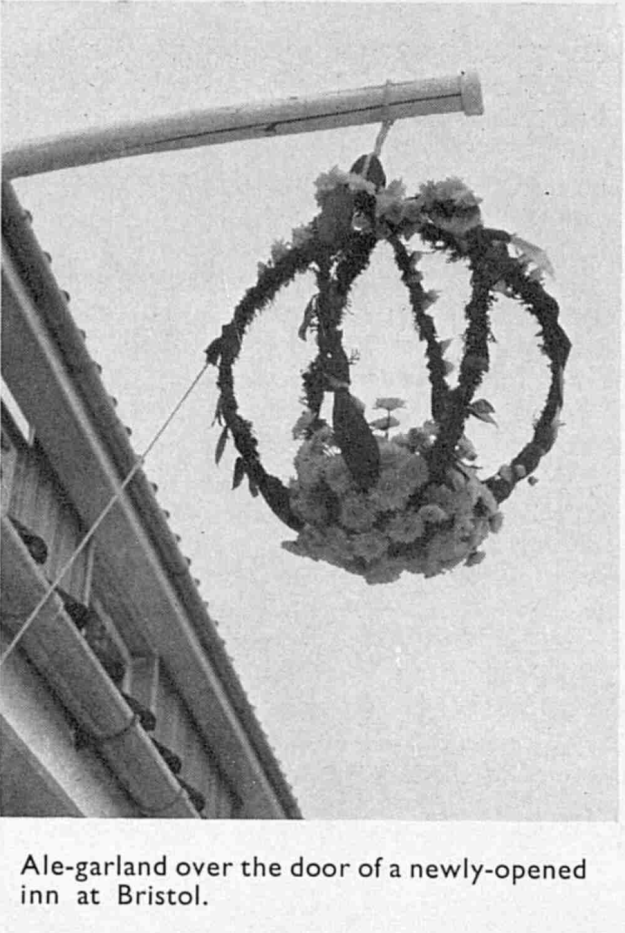
Image © Illustrated London News Group. Image created courtesy of THE BRITISH LIBRARY BOARD!

A longer explanation can be found in this article from the Lewisham Borough News, Tuesday 16th January 1951:

STORY OF THE ALE GARLAND
‘Conning The Brew’ In Ancient Times

By Stephen E. Hutchins

The hoisting of the ale garland in City and suburban taverns which is much observed about the New Year together with what is known as “ale conning” is regarded as the revival of a custom of the time of William the Conqueror and involves an expression of goodwill to all, and a kind of public protest against all sorts of vexatious regulations.

In olden days all garlands were to be seen outside all the inns at the festive season as a sign that fellowship and hospitality reigned within.

To “con the brew” is to sip at the mulled ale, the wassail bowl, and the ale posset, and the lambs wool — (meaning pulped roasted apples, sugar, nutmeg and ginger in warmed ale) — and pronounce it to be an excellent concoction.

The ale garland is usually displayed from a pole known as the “ale-stake” — in former days such ale-stakes had to be exhibited by inn-keepers to tell the travelling ale-conners that the new beers were ready to be tested.

The punishment for brewing poor beer was to be ducked in a pond in the ducking stool.

Under an Act of 1604 ale houses had to be inspected by constables to see if they were properly conducted and the object of the law was “to restrain inordinate tippling in inns and alehouses” and to confirm that the true use of the English inn was to relieve wayfarers and supply victuals, and not to entertain idle people and encourage them to spend their money.

Penny a Quart

Fines were levied by the constables and church wardens on people who indulged in drink for “an unreasonable time” and the money was given to the poor.

There was a fine of 5s. for being drunk and the alternative if the offender was unable to pay was to be awarded a spell in the stocks.

The price of the best ale was fixed at one penny a quart and “small” ale was one half penny a quart.

In 1614 the City had a thousand breweries with 40,000 barrels in their cellars. Beer was made at the back and sold for consumption in the front.

The old English ale was made from malt, yeast and water, and eventually beer flavoured with hops, called “hopping beer,” was brought in from Germany. This beverage became very popular.

Inns were often owned by the Church and we still have reminders of this in titles like the Seven Stars, the King and Keys, the Mitre and the Angel and “The Case is Altered” — the later signifying the period after the Reformation when the inns passed to other ownership.

Many inns were in the nature of hostels for pilgrims to the religious shrines. The poorest often received free hospitality and they were usually situated in a town near to the abbey or cathedral.

Among notable examples of this type of establishment may be listed the Falstaff of Canterbury, the “Star” at Alfriston, and the Pilgrims Rest beside Battle Abbey. The “Star” was a house of call for pilgrims travelling eastward to the noted Abbey at Battle and it was owned by the Monks of Battle.
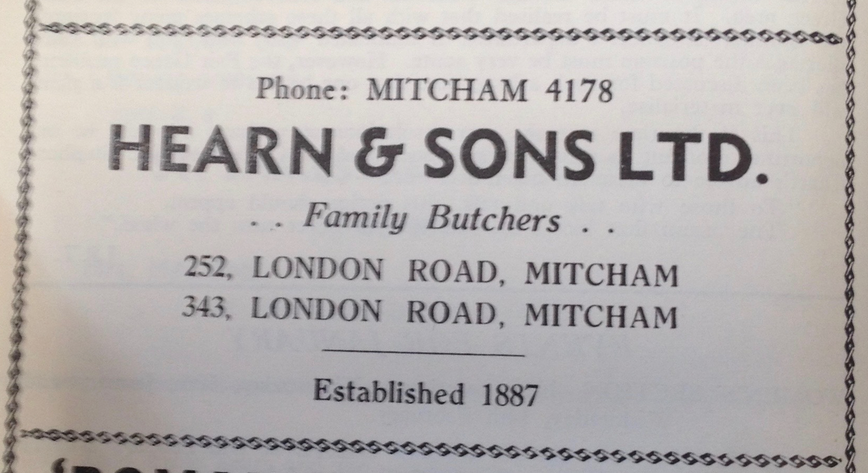
Hearn & Sons, butchers, 252 London Road

Hearn & Sons Butchers
252 London Road,
Mitcham,
CR4 3HD

Ad from 1962 issue of the South Warder, the journal of the South Mitcham Residents’ Association

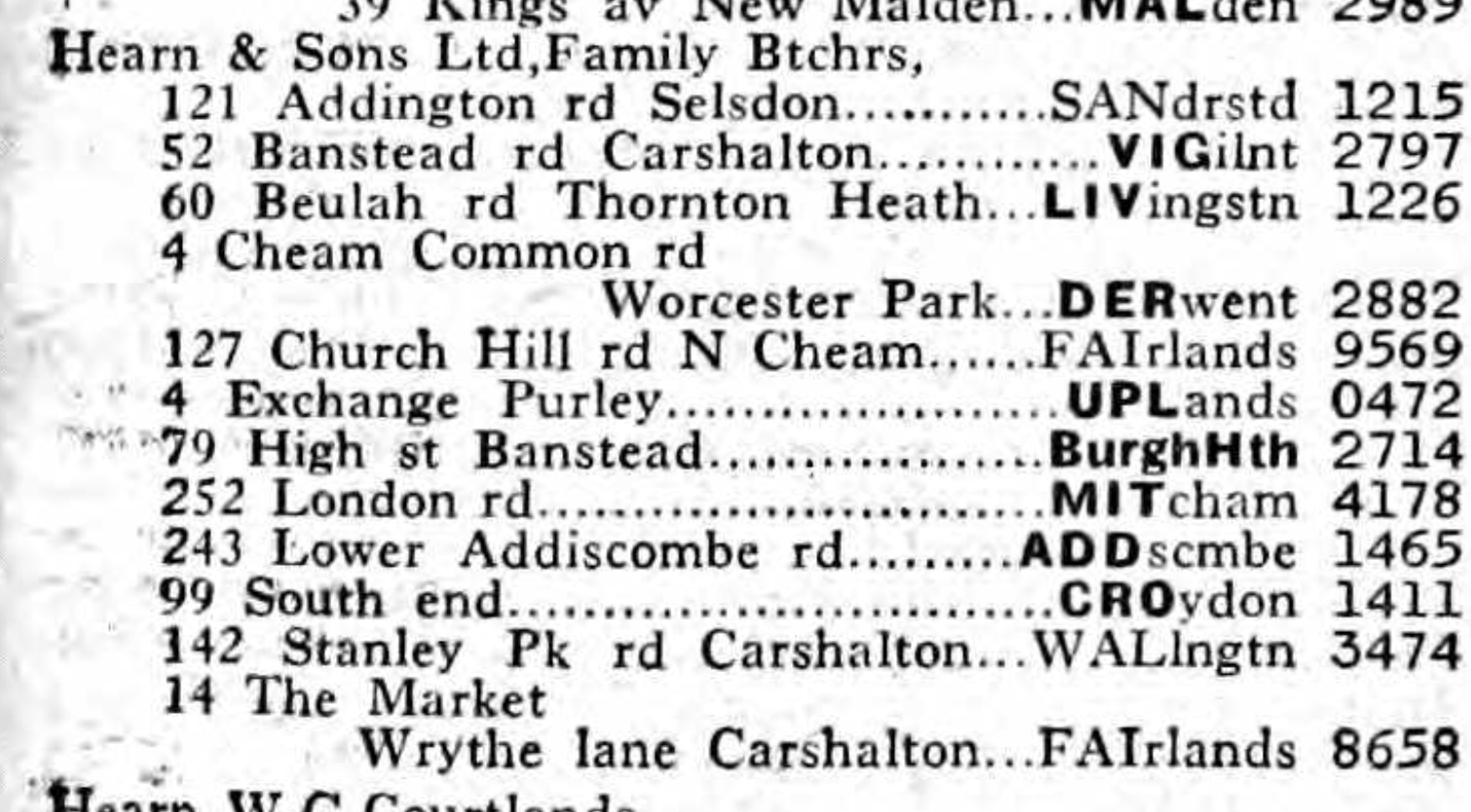
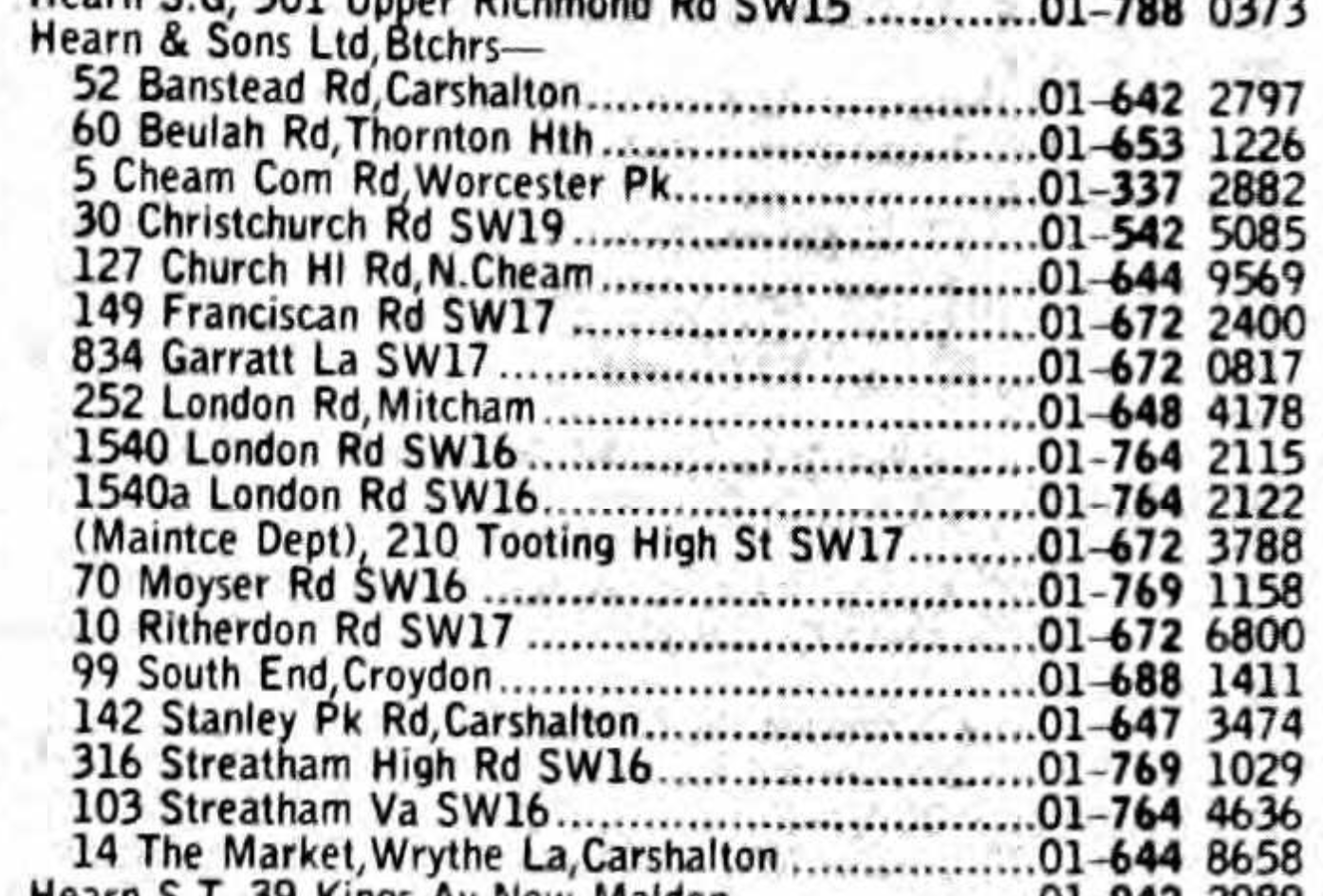
This was a branch of the firm of butchers, as shown in these telephone book entries:

1971 phone book entry

1954 phone book entry

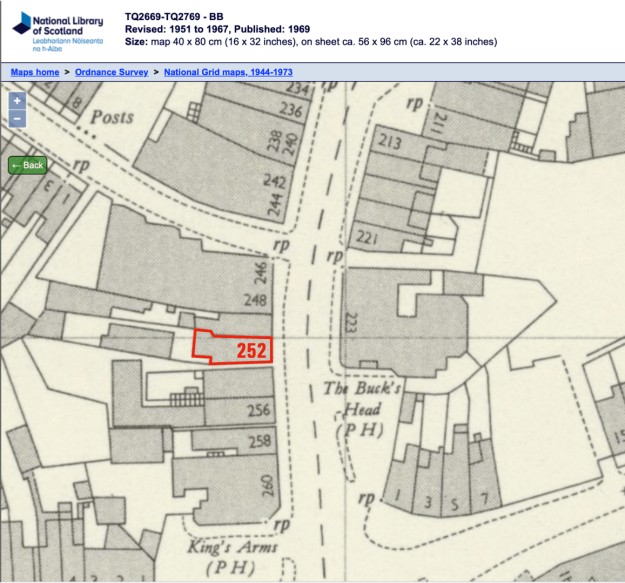
1951 OS map reproduced by permission of the National Library of Scotland, reuse CC-BY (NLS)

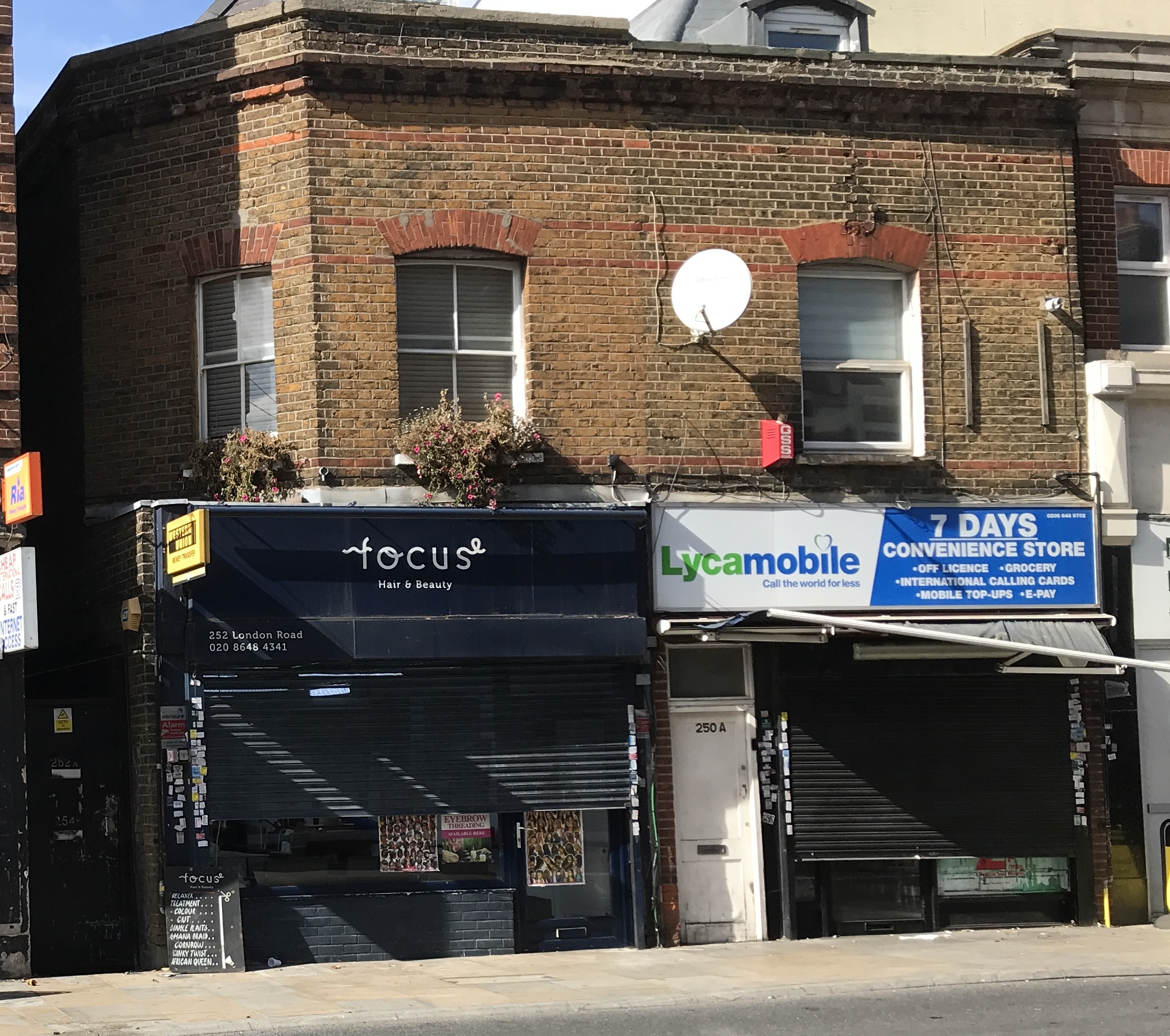
This photo, taken in September 2022, shows no. 252 on the left, next to the alleyway.

There is an undated photo of this part of London on Merton Memories. The view shows a shop with a canopy over the pavement, the next shop is Paine’s off-licence, and then Woolworths. Note the crowd of people waiting outside.

The following is from Tim Pearson, who posted this as a comment on the Mitcham Notes YouTube channel, and is reproduced here with his permission:

Hearn & Sons Butchers – Boy in a Mans World

Sometime in 1975, me and Mungo (Steve) went for a walk to look for a job, as everyone else had paper rounds or worked on the milk, so we thought we would try the butcher shops in Mitcham. The nearest one was the little butcher shop next door to the Bull, Mungo went in first as we were going to take turns and I was gonna ask at the next shop. Mungo drew a blank so it was up to me next, we stopped at Hearns and I meekly went through the door and spoke to the manager, asked and he said come in on Saturday. Result!!!

Saturday Boy

So, that Saturday morning at 8 o’clock, there I was getting thrown the butcher’s coat and an apron and got to work, bloody hell did I work hard. There was a lot to do on the Saturday, when I first arrived in the morning I’d have to get the meat out of the fridges as the shop men were dressing the front window, I would also be running round putting fresh sawdust on floor, putting out the blind and such jobs like that.

Once the shop was set for the day, it was time for a cup of tea and some breakfast, we had a single burner and a massive frying pan, and being in the butcher shop, what do you fancy for breakfast? Anything you like! Bacon, eggs, sausage, steak always a favourite. Then crack on with getting the orders ready, when that was done I would load the trade bike up and be on my way.

Orders and Deliveries

I used to deliver to half a dozen regular places at least, The White Hart, where I have my first-ever beer. Glebelands old peoples home. 12 Imperial Gardens. 351a London Rd, just past the White Hart. 14 Albert Rd, who always used to order the smallest 1/2 shoulder of lamb, and in the shop they called her Mrs ‘half shoulder of mouse’. Fred Grays Yard always had a nice big joint of beef, normally an Aitch Bone. 6 Downe Rd, 12 Biggin Ave, next door to Steve Stroud, who had painted on his back garden gate “Beware of Mrs Stroud” Probably quite appropriate.

Fish and chips or a wimpy for lunch.

So there you go, some of my day at the butcher’s shop and how I signed up. Yeah was quite an experience, young boy working with men for the first time, but always a laugh.

Butchers

The managers name was Ken Wright, someone I tracked down recently and turned up on his doorstep one day, we sat out in the sun talking shop for an hour, was great to see him again.

There were two old shop men, one called Bert Huddy, who lived in Rutter Gardens and drove a Bren gun carrier up through Italy in the war, tea breaks were always so funny, he was like uncle Albert with the war stories, and he was always singing Al Jolson’s Mammy. Ernie, I can’t remember his last name but used to drive an Austin and he was a miserable old sod.

Then there was Bernie Taylor, he was older…35 ish, a more experienced butcher who used to work mainly on the blocks out the back, he could tear down a hind quarter into joints quicker than quick, he was a great butcher and funny man.

Also out the back were two young butchers. Keith Badham, he knew how to sling a boning knife, and Clive Jones who was quite a funny bloke, and myself on a Saturday. All for 2 pounds and a big bag of meat for my mum. I thought it was a good deal, but was a lot of graft.

Work

When I came back from doing the round, and sorted the cash, I’d have to go and do the stock and clean the fridges with one of the butchers. We had a big big scale and a steelyard, and every Saturday used to take every bit of meat out of the fridge one at a time, weigh it, log it and restock it.

Fridges needed cleaning as well so I’d stack all the stock at one end, sweep out, then wash it and bleach it with bucket and brooms, throw fresh sawdust down and move all the stock back. And that’s all before lunchtime! In between time that there was always a chicken or 2 to be trussed, which was obviously my job.

After lunch, the shop was starting to wind down as most of the trade had been done before 2 o’clock, I had already scrubbed two of the blocks earlier and the shop men were clearing the trays and the green strips from the front fridge out the back to the kitchen, where I was washing up, plenty of soap, plenty of bleach, lovely smells clean.

Also, in the afternoon 3 of us would go to the night safe at the Nat West with the weeks takings, always tooled up, a trussing needle being my choice, but thankfully never needed.

As time went on and the shop was getting clear, I`d pull in the blind, sweep the shop and put fresh sawdust down, we pulled the shutters down at 3:30 and I`d wander home with my big bag of meat, the manager really always looked after us and I’d have a joint of beef, pork or whatever was going, and a load of sausages, bacon, ham, eggs, there were always a few chops in there too, happy days!

This also appears on Tim Pearson’s website.