Tag Archives: 1963

Smith Meters, Ltd.

Rowan Road

Electric and Gas Meters

Source:
Borough of Mitcham List of Factories,
Town Clerk’s Department,
July 1963.
Available at Merton Heritage and Local Studies Centre at Morden Library.
Reference L2 (670) MIT
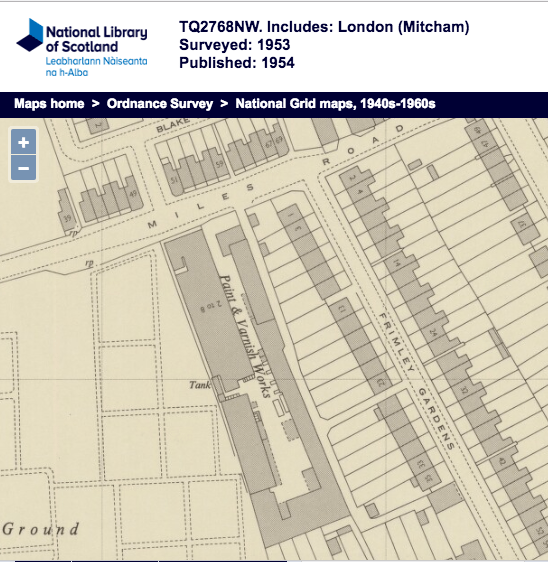

Norwood News – Friday 20 January 1961, via British Newspaper Archive

U.G.I. METERS DIVISION
(Proprietors: Smith Meters Ltd.),
Rowan-rd.,
Streatham Vale,
S W 16.
CLERICAL—FEMALE
SHORTHAND TYPISTS
CLERK TYPISTS
SUM LOCK OPERATOR
HOLLERITH PUNCH OPERATOR
HOLLERITH VERIFIER

Hours: 8.45 am. to 5.30 p.m.
Monday to Thursday.
8.45 a.m. to 5 p m. Friday.

Please apply :
PERSONNEL OFFICER.
Tel. Pollards 2271.
(Bus Nos. 118 and 130 stop at works.)

News Articles

1968

At Smith Meters Ltd., Rowan Road, the production manager,
Mr. John Allan, said that production had come to a halt.
“The factory is completely stopped,” he said.
“ We employ 2,000 and almost every one is on strike. A very
small number have come to work, and this is insignificant.
“ There were pickets outside this morning, but there was no
bother. This is a national strike,” he added.

Source: Mitcham News and Mercury, 17th May, 1968 page 1

1962

NEW CENTRE FOR THE HAPPY FACTORY

Mr. Norman Smith, chairman of Smith Meters Ltd., Rowan Road, at the opening of the firm’s new dining and recreation centre last week, said: “This building is a sign of the great success the firm has had over its many years.”

The centre incorporates a small hostel, two dining-rooms, a central kitchen and a confectionery kiosk.

A plaque on the first floor landing was unveiled by Mr. R N. D. Bruce, Chairman of the South Eastern Gas Board, who performed the opening ceremony.

Afterwards the 50 guests toured the new block. In the kitchen much interest was shown in the modern equipment, among them automatic potato peelers and mashers, electric dish washers and the latest cooking ranges.

The party, which included Mr. Robert Carr, M P. for Mitcham. Alderman D. Chalkley, Mayor of Mitcham, Mr. T C Battersby, president of tho Institution of Gas Engineers, and members of the Board of United Gas Industries, also toured parts of the main factory.

At the luncheon held in one of the new dining-rooms Mr. Smith said the success of Smith Meters had grown from the fact there was always a happy atmosphere in the factory. “We believe in looking after our staff well, giving them good food and good working conditions.”

He reminded his audience of the early days of the company. “When it was first started,” he said, “there were only a handful of people on the staff. The week’s wages for all the staff were similar to one man’s weekly wage today.”

Mr. Smith paid tribute to those responsible for building the new block. It is a very fine building and the architect and builders should be praised.”

Smith Meters factory in Rowan Road, Mitcham, is one of a large group of factories connected with United Gas Industries Ltd.

The Rowan Road premises are the headquarters of the U.G.I. (Meters) division which controls factories in Belfast, Edinburgh, Exeter, Leicester, Manchester, Kennington and Dunblaine. There is also a factory in New Zealand.

Smith Meters was founded in 1834 and established in Snow Hill, in the City of London, moving to Kennington in 1865. In 1929 an additional factory at Mitcham was built.

The company now employs about 2,300 people, 1,750 of them at the Rowan Road factory.

Among the products made by the division are gas and electricity meters, coin switches, and food processing and catering equipment.

Source: Mitcham News and Mercury, 18th May, 1962 page 15


Maps


Smith Meters was in the Lonesome area of the Mitcham Urban District, as can be seen on this 1933 map.


1933 OS map

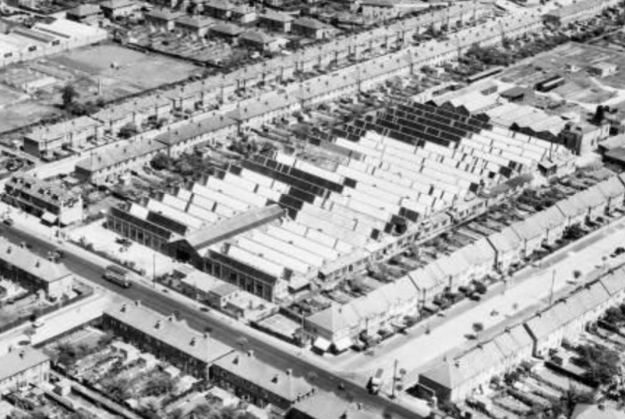
Aerial photos from 1947:
1947 Smith Meters 1

1947 Smith Meters 2

1947 Smith Meters 3

1947 Smith Meters 4


Kenneth Marsh, who served in the RAF at end of WW2, worked for the Department of Energy and eventually was based at the United Gas Industries (UGI) in Rowan Road. He was responsible for certifying the accuracy of gas meters made there and at nearby Smith Meters.

1970s – Ken Marsh’s office at UGI

1970s – testing rigs at UGI

from a 1961 diary


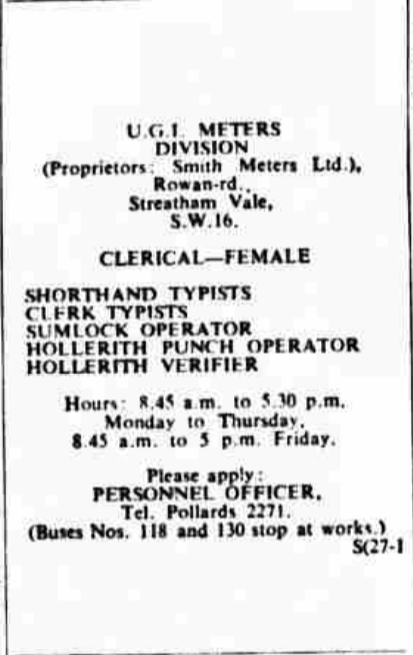
Maps are reproduced with the permission of the National Library of Scotland.
Hepburn Gale and Ross

The ‘Balata Belting Factory’, was on the east side of Church Road north of Lewis Road. It closed in April 1966.

Balata is a latex used as an alternative to rubber.

Listed in the 1963 List of Factories as Barrow, Hepburn and Gale.

1952 OS map

Clip from Merton Memories photo 49435, taken on 10th February 1954, copyright London Borough of Merton. Hawthorne Avenue is on the left, Church Road at the bottom and part of Lewis Road can be seen on the right.

From 2012 planning application in Southwark, the Heritage Statement described this company’s origins:

The Ross part of the company Hepburn, Gale and Ross, had originally been A. Ross and Co, this was the company started in 1829 by Alexander Ross, as a leather works in Grange Road. In 1865 he was joined by Mr Tomlin, a former apprentice from the Wellingborough boot trade, who would later become proprietor of the firm. Tomlin was soon joined by another apprentice from Wellingborough Mr Blott, and under the leadership of all three the company when it was taken over in 1895 had become the largest supplier of leather goods to the British Army. The business was purchased by Mr Posnett, who had two other firms, Hepburn and Gale, and in 1903 all three were amalgamated under the name Hepburn, Gale and Ross, Ltd.


From the minutes of the
Croydon Rural District Council
Roads and Buildings Committee
Volume VIII 1902 – 1903
15th May 1902
page 111

2. Deposited Plans. – The Buildings Sub-Committee reported that they had carefully examined al the plans of new streets and buildings deposited since the last meeting, and on their recommendation, it was Resolved:-
(a) That the undermentioned be approved:

No. 2115, Hepburn & Gale, Factory, Church Road, Mitcham

News Articles

Mitcham News & Mercury, 254th February 1961

THE conveyor belting and hydraulic department of Barrow Hepburn and Gale Ltd., Mitcham, has gone through a difficult time, says the annual statement of the chairman. Mr. George W. Odey.

The competition in conveyor and transmission belting reduced prices to unremunerative levels, he said.

“There has, however, been an improvement in this respect. We have been successful in substantially increasing our export sales and we look for a continued improvement in the coming year.”

Mitcham News & Mercury, 25th February 1966 page 1.

Factory to close in April

Council buy half site for £140,000

Production at the Mitcham factory of Barrow Hepburn and Gale should have ceased by April. Half the factory has already been sold to Merton Council for £140,000 and the other half is up for sale.

Mr George Odey, chairman of Barrow Hepburn and Gale, which is the largest company in the leather trade, tells shareholders this week that one of the great disadvantages of the Mitcham factory is that it was divided by a main street, writes John Heffernan, our City Editor.

He says that for some time past, the local authority has been anxious to acquire the factory on one side of the road.

This part is now been sold, subject to final approval by the council. The other portion of the factory has been placed on offer.

Being transferred

Production is being transferred elsewhere and all employees are being offered the opportunity of transferring.

The factory made conveyor belting under the trademarks of Mitcham, Python, Bulldog, Plyastic and Mitchamatic, and this, together with other productions in 1965, represented an export turnover of £500,000.

Mr E Moore, of the Amalgamated Society of Leather Workers, said he believed two unions were involved, his and the Transport and General Workers Union.

He added: “I have 36 members, all concerned with leather work at the factory. They have all been asked to go to the Bermondsey factory, so theoretically they are not becoming redundant.”

He added : “But there may be some hardship cases that we’ll have to take up and get redundancy payment for. One of our members is 70 years old, unfortunately being over 65 he is not covered by the redundancy scheme. But if he is prepared to travel he’s got a job.”

Mr C H Barlow, General Workers District Official of the Transport and General Workers Union, said his union had 60 members from the factory.

He said: “At the most six of them will go to Bermondsey. For the rest it will be redundancy.”

Mitcham News & Mercury, 4th March 1966 page 1.

Eighty-six employees redundant

Eighty-six employees of the Mitcham factory which is to close in April are being made redundant.

This was the latest news after Barrow Hepburn and Gale announced last week that there would be opportunities for transferring all employees.

Mr C H Barlow, General Workers District Official of the Transport and General Workers Union, said:

“Eighty-six men who make rubber conveyor belting are being made redundant. The question of transferring to Bermondsey applies only to about 36 men on the leather side.”

Barrow, Hepburn and Gale is the largest company in the leather trade and their head office is in Bermondsey.

Mr Barlow recently went to Bermondsey and returned to the Mitcham factory to tell men about the redundancy.

He said : “I have written to the management asking for a meeting to discuss the terms of redundancy payment.”

22nd July 1966 Mitcham News & Mercury page 1

Council buy land

Land belong to Barrow, Hepburn and Gale Limited, at Church Road Mitcham, is being bought by Merton council as a cost of £248,300.

The company, the largest in the leather trade, closed their Mitcham premises in April.


Minutes of meetings held by the Croydon Rural District Council are available on request from the Merton Heritage and Local Studies Centre at Morden Library.


Maps are reproduced with the permission of the National Library of Scotland.