Tag Archives: Beddington Lane Halt

Notes on Mitcham Common by H.G. Winbow

Published in the South Warder, the newsletter of the South Ward Residents Association in August 1962.

Recently the question arose about the origin of the footpath near the Garden Village from Cranmer Bridge to Mitcham Junction. This path is on the site of the old road and when the London and Portsmouth Railway was constructed across the Common in 1863, the present Cranmer Road was realigned, owing to the sharp curve made to approach the junction of the Wimbledon/West Croydon line which was constructed in 1844.

Recently cars appeared to be using this footpath as a short cut from Willow Lane to Cranmer Bridge, and it is satisfactory to note that the Conservators agreed to the Preservation Society’s request to erect posts here.

Walking round the Common, you notice several old cart tracks, one just the other side of the bridge at Mitcham Junction led to a farm near the railway, this is now known as Aspen Gardens. Further on we come to the concrete road, which is called Drakes Road but nobody seems to know how this road got its name, except that it was the entry to the gravel pits which were worked here for many years.

A short distance from here we see another rough track across the Common, this is called Arneys Lane. At one time this went across the fields to some old cottages near the River Wandle. This track now stops at the footpath which runs along the rear of the houses; the footpath is believed to be on the site of the Surrey Iron Railway branch to Hackbridge.

Not far from here is the “Goat Inn”. Beyond here this part of the Common is called Mill Green and is maintained by Beddington and Wallington Borough Council. But opposite this inn there is another track which follows the southern boundary of the Common. This track ends at the railway, but there is a footbridge here, so one can continue the walk on to Beddington Lane Halt. This is one of the best parts of the Common, right away from any roads.

Some years ago a small area was added, so one can now walk through the avenue of trees to the footpath to Beddington Lane, a very pleasant walk in the summer. From here there is no need to follow the road to the Windmill House, but walk across the Common past the one-island pond, and across the Croydon Road to Commonside East,

Proceeding westwards, we come to the new factory of Tower Creameries, this is on the site of the old workhouse which was built about 1790 and for many years was used by the Woodite Rubber Company’s works. Sections of the first Atlantic submarine cable was supposed to have been made here.

Just near here we see two old cart tracks crossing the recently reclaimed part of the Common, these were used as the entrance to Sherwood Farm.
Crossing Manor Road we come to the rough road which runs along the Common to Commonside East; many years ago some wooden cottages stood here, which might explain how this road came into existence.

Owing to building development on the boundary of the Common, these old cart tracks present a problem. As they are all on Common land the question of keeping them in repair is a difficult point.

Further along Commonside East there is a small pond, known as “Pinnocks Pond”. Years ago opposite here there was a small cottage and market gardens, owned by a Mr. Walsh and later by a Mr. Pinnock; this explains how the pond became known by this name. The road from here across the Common to the “Blue House”, now called Cedars Avenue, was called the New Road by the old inhabitants. The end of this road, of course, brings us to the roundabout and the old wooden cottages, shown on old maps as “The Blue Houses”. It has been said that employees of the Surrey Iron Railway stabled their horses here. This could be true because these cottages are not far from the site of the old iron road.

The old “Ravensbury Arms” was the same as these cottages, the present public house was built in 1906. But a shorter walk can be made by taking the footpath from Beddington Lane over the Common and following the railway, this brings us out via the Golf Club House to Carshalton Road.

This is a nice walk, but I would not advise this way in wet weather as this part of the Common is very rough, owing to the extensive gravel digging that took place here before the Common was controlled by the Conservators. Along this path is where the new footbridge over the West Croydon line has been erected by the Golf Club and which is open to the public.
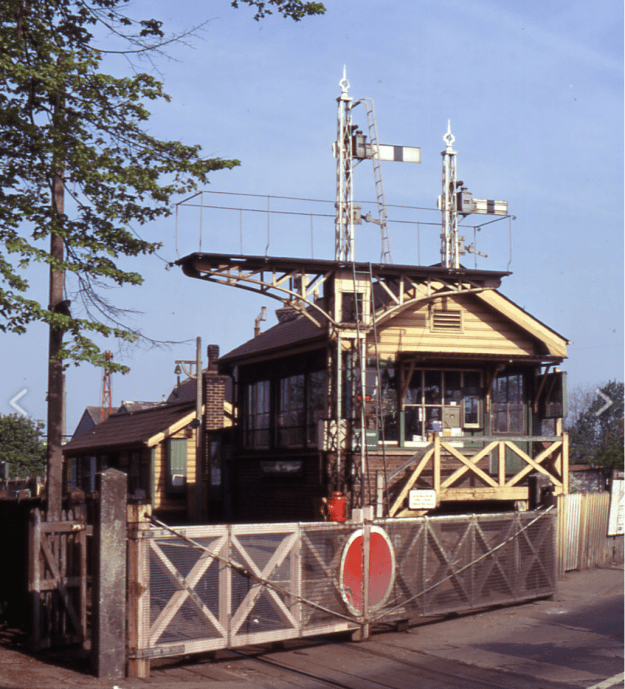
Beddington Lane Halt

Train station on the Wimbledon to West Croydon line that has now been replaced by the Beddington Lane tram stop.

Clip of photo taken by Eric Montague in 1974. Reproduced by kind permission of the Merton Historical Society. Image reference mhs-em-mc-40

View of the station from the Common, looking to the south west. Clip of photo taken by Eric Montague in 1966. Reproduced by kind permission of the Merton Historical Society.

1953 OS map, reproduced by permission of the National Library of Scotland

This station opened in 1855 and closed in 1997, after which it was demolished for the tramlink. For more details about the station visit the Disused Stations website.

The line was electrified in 1930, according to this article from the Surrey Mirror, Friday 4th June 1929:

TWENTY-MINUTE SERVICE BETWEEN LONDON AND WINDSOR.

The directors of the Southern Railway have sanctioned an expenditure of £597.000 on further extensions to their suburban electrified system, already the largest in the world. new areas for electrification are three: (a) Hounslow Junction and Whitton Junction to Windsor; Hartford to Gravesend; Wimbledon to West Croydon. It is hoped that most, if not all, of the work will completed in time for the summer service of 1930. Principal works on the Wimbledon to West Croydon route are the construction of a halt at Waddon Marsh between Beddington-lane Halt and West Croydon, and the linking of certain sidings to form an independent goods line between West Croydon and Beddington-lane. The new developments will provide for service of trains in each direction every twenty minutes during business periods and every thirty minutes other times. With the addition of these extensions the Southern Railway suburban electrified system will increased to track miles.

A not particularly busy station, in 1953 six hundred people walked from Pollards Hill, across the Common, to the station for an outing to the seaside.

The Advertiser Thursday August 20 1953

Sutton & Epsom Advertiser – Thursday 20 August 1953. Image © Reach PLC. Image created courtesy of THE BRITISH LIBRARY BOARD.

Pollards Hill moves to Bognor-for a day

Special train takes 600 to the sea

A DAY by the sea — a holiday event which is as popular now as it was fifty years ago. There is something about the seaside which makes the average Englishman rise at the crack of dawn eat a hasty breakfast, gather his family about him and head for the nearest stretch of coastline The fact that thousands of other people have done exactly the same thing and are all heading for the same seaside resort— be it Brighton Southend Hove Westcliff— does not deter him in the least.

One of the largest annual outings organised in East Surrey is that of the Pollards Hill Estate Tenants’ Association. On Sunday morning the Mitcham housing estate became almost deserted as 600 people left their homes and walked across Mitcham Common to Beddington Lane halt where they boarded a special 12-coach train and set off for Bognor.

Everything had been planned with military precision. The 600 walked across the common in parties of 50 and were seen across the busy Croydon Road by a police patrol.

During the one-and-a-half hour journey to Bognor every one of the 363 children in the party was given a shilling. The shillings were carried to the train in a mysterious black bag by Mr W Stephens, the association’s treasurer. They had been supplied by an obliging gas company.

A total of 3,500 half-price amusements tickets were also given to the children.

Headquarters tent

At Bognor a tent was erected on the beach as a headquarters; over it flew a P.H.E.T.A. flag Throughout the day two nurses from the Mitcham Red Cross detachment were on duty to treat minor casualties among the Mitcham party.

Everyone had lorgotten that the tide would come in, and the tent was saved at the last moment as the waves lapped up to the guy ropes just after lunch Eventually the headquarters party were squeezed off the beach on to the promenade Twenty-two officials including the association’s president and chairman Mr T Fitzgibbons and Mr T Shanley spent part of their day on duty looking after the party.

The people of Pollards Hill occupied a long stretch of the Bognor seafront and before long the braver ones were occupying the sea The remainder preferred sand castles and donkey rides or deck chairs and newspapers according to their age groups.

After they had spent eight hours in the resort the Mitcham party left Bognor at 6.28 pm. “A really successful outing” commented Mr Fitzgibbons as the people left the train at Beddington Lane Halt. “It certainly was,” echoed Mr Shanley.