Tag Archives: Croydon

Roman Coin Hoard in Croydon

In 1903 a Roman Coin Hoard was found in Croydon.
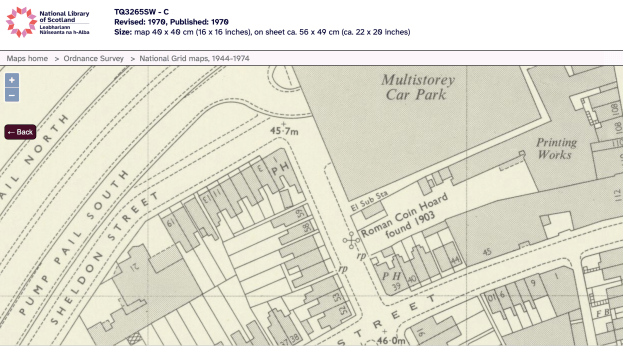
1970 OS map

Croydon Times – Wednesday 11 March 1903

REMARKABLE DISCOVERY IN WANDLE ROAD.

A HOARD OF OLD ROMAN COINS.

On Monday, Corporation workmen employed in digging a drain trench in Wandle-road made a remarkable discovery. One of the men felt his pick strike upon something hard and on looking closer saw that the implement had come into contact with and smashed an earthenware jar. Further investigation showed that at the spot two antique pots or jars, evidently of Roman manufacture, had been buried, and seeing that they were only two feet below the surface, it seems remarkable that they should have remained hid for so many centuries. Unfortunately both utensils were smashed, but experts have been able to “reconstruct” them, and to prove that they are jars of a conventional Roman pattern.

This collision between pick and pot was only the beginning of discoveries. Peering into the hole the workmen saw a large quantity of metal discs, covered thickly with verdigris. A handful of the discs were examined, and it was then seen that they were coins of some kind—evidently of a remote period. The Town Hall authorities were at once communicated with, and the remainder of the coins were got out in the presence of an official and conveyed to Katharine-street, together with the remnants of the pots. There some of the coins were cleaned with acid and it was then seen that they were pieces of copper coinage. The vast majority consisted of coins of a size not quite so large as a half-penny. They are by no means perfect as to shape, but have been preserved to a quite astonishing degree. When cleaned, indeed, the coins look as though they had just been minted—excepting, of course, that advances have been made in the art of minting since they were struck.

Under the direction of Mr. S. Jacobs (Acting Town Clerk) the green encrusted coins were counted—a by no means enviable job—and it was found that they numbered over 3,600. They remain at the Town Hall pending a decision as to what is to be done with them.

The collection of coins, which had undoubtedly been placed in the pots over 1,500 years ago, includes about thirty different varieties, all bronze, but the small coin alluded to is in a majority of nearly a hundred to one. They are stated by an expert to be coinage of the reign of the Roman Emperor Constantius, who died in A.D. 361. On the obverse of the coin—known as a sesterce, and equivalent to a little over a penny—is a remarkably fine profile likeness of the emperor, a gentleman of classic features and commanding mien and the lettering is as follows:—”D.N. Constantius. P.F., A.V.G.” On the reverse is this inscription:—”Fil. Temp. Reparatio,” this being an abbreviation of the Latin Filium temporum reparatio, which may be rendered roughly into English as “O happy times of restoration.” In the centre is depicted a Roman oared galley containing two figures, one representing the Emperor, and the other, who is steering, Victory.

The Emperor Constantius was one of the three sons of the great Constantine, founder of Constantinople. Upon the death of their father the brothers became the rulers of different parts of the Empire, one becoming King of the then Roman Colony of Britain. Constantine, who ruled over a great part of Europe, seems to have been of a greedy disposition. He coveted his brother’s kingdom of Britain, forced a quarrel upon him, crossed the sea and conquered and slew him, and, as was the free and easy usage of those times, reigned in his stead.

One can, of course, only speculate as to how the large hoard of coins of a relatively small value came to be buried in a place that in the course of many centuries, has become a thoroughfare in a great and populous town. Had the original owner had the gift of prescience, perhaps, he would have selected a more secluded place for the bestowal of his treasure, or, as the case may have been, plunder. At all events he could hardly have foreseen that Mother Earth would have been so safe a bank and that his money was kept in security, although earning no interest, until the year 1903, then no doubt, a very remote date in his view. The intrinsic value of the coins, as we have said, is trifling, but the remarkable find is full of interest to archaeologists, numismatics, and others whose delight is to delve into the past or to treasure memorials of vanished peoples and civilizations. We understand that arrangements will be made to give the public an opportunity of inspecting the unearthed treasure of some Roman colonist or British worthy of the fourth century.

1877 : Proposed 100 acres of Mitcham Common for sewage

PROPOSED DRAINAGE OF MITCHAM, WALLINGTON, ETC.

Mr. Edridge said he wished make a remark respecting the Rural Sanitary Authority, although he did not wish to raise discussion. He was aware, that the members of the Authority bad recently experienced a great deal of trouble, still the subject involved in the question he was about to put was of such great importance to Croydon that he did not hesitate to put it. If the reply were in the affirmative he thought the fact was one which ought to come under the knowledge of the Board of Health, and they should take measures to further the interests of the district over which they had jurisdiction. He asked whether it was true that the Authority were in correspondence with the proper parties to whom it was necessary to apply in order to obtain a hundred acres of land at Mitcham Common for the purposes of sewage irrigation.

The Chairman said such thing had transpired, but there were 108 persons whose consent had to be asked before the Authority could obtain the land.

Mr. Randolph said it was true a resolution had been passed for the Authority to see on what terms they could purchase a hundred acres of Mitcham Common, but there were some difficulties in the way.

Mr. Edridge presumed that the Authority would not have taken such step except after a proper amount of consideration, and with the expectation that their action would lead to some result. He was therefore sure they would forgive him for having asked the question he had; and he thanked them for having given him the information he required.

Mr. Lindsey said the Authority had not given to the subject so much consideration it required ; but the thing had arisen because the Rural Board were driven up into a corner to find some mode of draining their district. It was therefore suggested at the last meeting that they might apply for a hundred acres of Mitcham Common. There had previously been some idea of making use of thirty acres of land, to carry out the intermittent filtration process; but it was thought it would not answer their purpose and expectations ; consequently they wanted to carry put the sewage irrigation system, and thought facilities for doing so would be gained if they could obtain a piece of land on Mitcham Common. It was true that they had applied, but they hardly expected to obtain the quantity of land they required, as it was necessary that the commoners must satisfied and agree before there could be any hope of obtaining the land.

Mr. Allen said the subject was one to be discussed by the Rural Sanitary Board, and not by the Board Guardians. Mr. Edridge, if he wished to speak upon the matter, ought to have come fully charged at the last meeting of the Authority; but, as the subject had been broached, he might well mention that Croydon applied for some land on the same common a few years ago, but the application was rejected. This was the only reason that could see for opposing the present application of the Rural Authority. But what could it matter to the people of Croydon, who had their parks and open spaces. The nuisance of 60,000 inhabitants was sent to Beddington, but instead being injurious to the health of the population, it was actually beneficial. He could not, therefore, understand why Mr. Edridge should come there to oppose the Authority. No doubt he came with the best intentions, but he had come at the wrong time. If he could wait till next week that would the proper time to bring the subject forward. Although there were 108 land owners to consult as to Mitcham Common, yet at present no benefit was derived from that land, but rather the reverse, as Gipsies caused a great nuisance there, and brought all sorts of diseases into the neighbourhood, at well a lot of donkeys and horses that ran all over the place. People like the Gipsies made extra work for the magistrates; yet when the Authority applied for a hundred acres of land for the drainage of the rural district they met with all sorts of obstacles from persons who ought to help instead of hindering them. There were 500 or 600 acres there suitable for irrigation, and of no use to the Inhabitants their present state. He therefore thought that Croydon ought not to offer opposition, although it might very well connect itself with Mr. Bazalgette’s scheme for taking sewage to the sea. Under all circumstances he thought it was most untimely to bring forward the subject, the Board of Guardians had nothing to do with it.

Mr, Edridge said his object was to ask question which interested Croydon generally, and to which he knew they would give him answer: but he should not have ventured to ask that question except a meeting of the Guardians, because, although had the honour of being an ex-officio member of the Board, was not member of the Rural Sanitary Authority, and was much obliged for the information that had been afforded. Mr. Allen said the Rural Sanitary Authority would glad to see Mr. Edridge at the right time if he had anything to say upon the matter referred to. This terminated the public business of the meeting.

Source: Croydon Advertiser and East Surrey Reporter – Saturday 17 February 1877 from the British Newspaper Archive (subscription required)