Tag Archives: 1891

Bailey Road

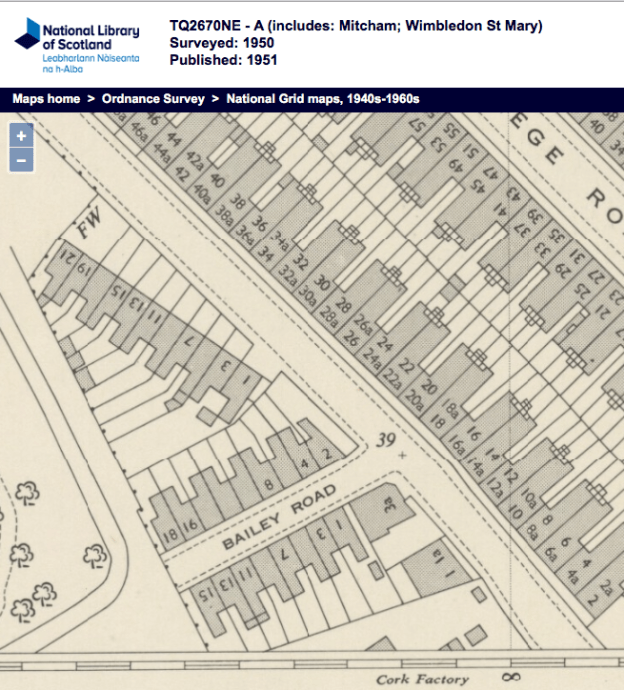
Bailey Road no longer exists. It was off the south side of Byegrove Road.

It is shown on this 1950 OS map, with houses numbered odd on the south side, and even on the north. Just south off this map is the cork factory of Walter Mays Ltd.

1950 OS map

Occupants in the 1925 street directory

North Side

2,Mrs HEATHER
4,Herbert SILENCE
6,William Edwin LANG
8,George Herbert PORTER
10,John POTTER
12,Henry LUFFMAN
14,James Frederick SKELTON
16,John STANFORD
18,Frederick Samuel BATHO

South Side

1,Henry George THORPE
3,Ernest WHITE
5,William Frederick BAKER
7,Mrs. A WARWICK
9,John HARRIGAN
11,Walter MUNT
13,Charles BOYES
15,James George HUGGETT

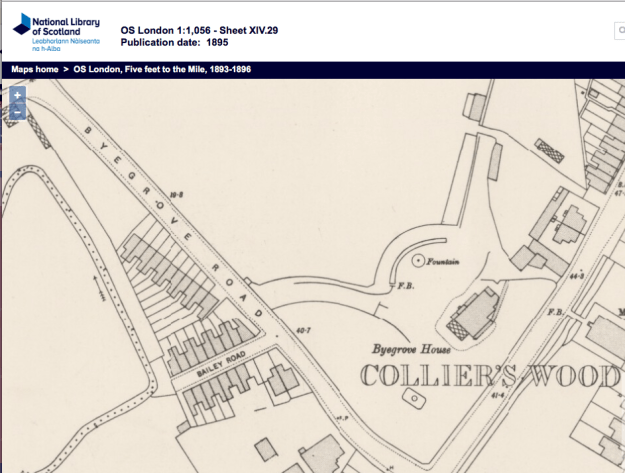
Bailey Road is shown on this 1895 OS map:

1895 OS map

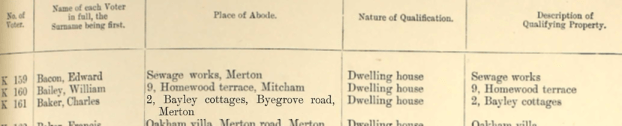
However in the 1891 electoral register, a terrace called Bayley Cottages is shown as in Byegrove Road.

Other entries in the 1891 electoral register Listed as Bayley Cottages, Byegrove Road:

Not numbered:
Edward BOWDERY

Numbered:
2, Charles BAKER
3, John LUFFMAN
7, William PHIPPS

Note the Henry LUFFMAN in the 1925 street directory.

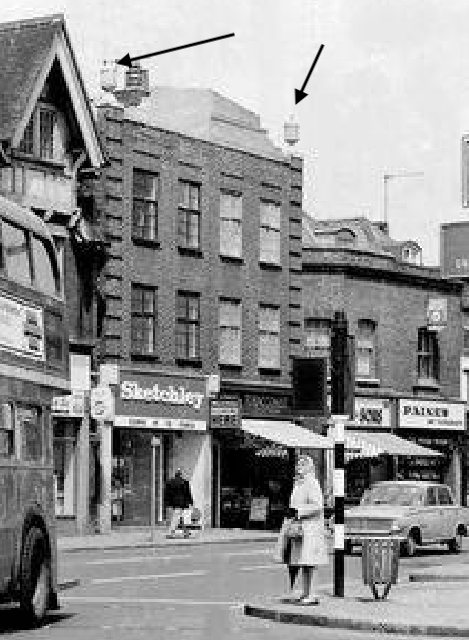
The Merton Historical Society have a photo from Eric Montague’s slide collection of the terrace of houses north of Bailey Road. The photo was taken in 1973 looking south. It shows the blocks of flats where Bailey Road was. It can be found on the Colliers Wood collection of photos, related to his book on Colliers Wood in the Mitcham Histories series.


Maps are reproduced with the permission of the National Library of Scotland.
1891 : Mitcham fruit seller buried with fruit and nuts

A procession of prodigious length passed through Mitcham, consisting of a hearse and feathers, drawn by four plumed horses, the corpse and coffin being borne on men’s shoulders immediately behind, with flowers plentifully strewn on the coffin lid. Behind were two mourning coaches, followed by a long string of vehicles of every conceivable description, from double chaises to donkey-barrows, and every kind of truck and cart in use among the costermongers’ fraternity. Some of the women were passionately weeping, and all the motley crew of this singular funeral cortege were apparently in sincere mourning for the deceased.

The funeral was that of a poor old woman named Hilliard, who kept a small fruit stall in “Buck’s Head” Yard, Mitcham. The deceased had at one time been in a respectable station, and had hit upon the fancy of having a grand funeral. In order to carry out her notion she joined a number of burial clubs, and with the money due to her at death, the whole of the expense of the procession was defrayed.

A singular precaution was taken by this old lady. A quantity of rare old china, which she was afraid her relations would quarrel over, she directed by her will to be buried with her.

And the funeral ended with a peculiar custom, probably dating from remote antiquity, and reminding us of the articles found in ancient graves. After the body had been lowered into the grave, the mourners proceeded to throw in after it apples, walnuts, and other kinds of fruit sold by the deceased during her lifetime.

Source: Pearson’s Weekly – Saturday 21 March 1891 from the British Newspaper Archive (subscription required)