Allen Terrace was the row of 39 houses on the west side of Church Road between Batsworth Road and the footpath opposite Lewis Road.
In the street directory of 1911 it was listed sequentially from 1 from on the corner with Batsworth Road, to 39.
Church Road was renumbered between 1912 and 1915, and so no. 1 Allen Terrace became 165 Church Road and no. 39 became 241 Church Road.

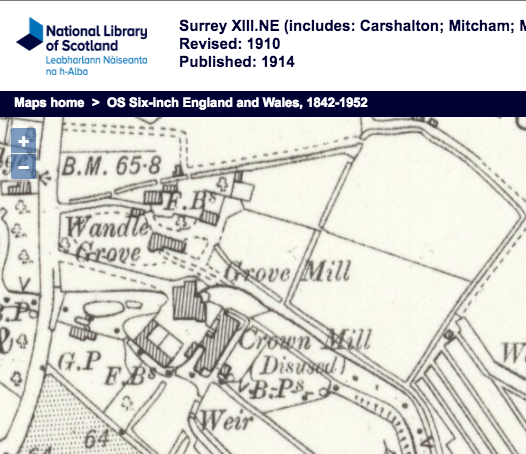
1952 OS map reproduced by permission of the National Library of Scotland, reuse CC-BY.
Occupants in 1905
| No. or name |
Terrace |
Resident |
| 2 |
|
William FORD |
| 3 |
|
Michael ROUT |
| 4 |
|
Arthur William CAREY |
| 5 |
|
Alfred BIRCH |
| 7 |
|
William GILBERT |
| 8 |
|
James BRYAN |
| 9 |
|
George BIRCH |
| 10 |
|
Ely STOPHER |
| 11 |
|
Charles WARMAN |
| 12 |
|
Arthur CARTWRIGHT |
| 13 |
|
John HOWE |
| 16 |
|
William THURSTING |
| 17 |
|
Joseph PROCTOR |
| 18 |
|
William OVER |
| 19 |
|
William ROSS |
| 20 |
|
Charles TIMMS |
| 21 |
|
James GIBBS |
| 23 |
|
John TAYLOR |
| 24 |
|
James OXLEY |
| 25 |
|
Benjamin PARSONS |
| 26 |
|
Edward ROGERS |
| 27 |
|
Richard TICKNER |
| 28 |
|
John CURTIS |
| 29 |
|
Cecil Octavius PURDEY |
| 30 |
|
John PINEGAR |
| 31 |
|
James LANGLEY |
| 32 |
|
Charles Henry GARNER |
| 33 |
|
Thomas STRUDWICK |
| 34 |
|
Frederick LANGRIDGE |
| 35 |
|
Matthew Henry BATEMAN |
| 36 |
|
Joseph Henry MANCE |
| 38 |
|
George FRASIER |
| 39 |
|
Walter STRUDWICK |
Occupants listed in street directories
1912
Houses numbered as Allen Terrace.
1, Joseph SIMMONDS, greengrocer
(no other entries)
1915-1916
Houses now renumbered.
165, Joseph SIMMONDS, greengrocer
(no other entries)
241, George BIRCH
1925
165, Mrs Caroline JENNER, grocer
167, Septimus Thomas INGHAM
169, Michael ROUT
171, Charles GARDNER
173, Charles COLE
175, Alec MOUNT
177, Charles Frederick CHALLIS
179, William GIBSON
181, Alfred Henry SHELLEY
183, Mrs Mary KILLICK
185, William SAYERS
187, Thomas THORNTON
189, Arthur Edward PETTIT
191, Walter JACKSON
193, John FRY
195, George THURGOOD
197, (no entry)
199, Harry STRUDWICK
201, Edward ROGERS
203, Edward GIBBS
205, James GIBBS
207, Mrs GREENAWAY
209, James STEVENS
211, James OXLEY
213, Mrs ASPLAND
215, Mrs HUNTINGFORD
217, Frederick PARSONS
219, John CURTIS
221, Harry CRADDOCK
223, Henry James PENEGER
225, Joseph SIMMONDS
227, Mrs GARNER
229, Douglas BISHOP
231, Mark WHEELER
233, Mathew BATEMAN
235, Arthur PARSONS
237, Thomas William SALES
239, Seymour FRASER
241, George BIRCH
The London Picture Archive has a photo of part of the terrace, from no.s 173 to 233, taken in 1977.
A photo Eric Montague took from the flats on the Phipps Bridge Estate in 1967 show the rear of houses from 241Church Road, as highlighted below:

Clip of photo taken by Eric Montague in 1967. Reproduced by kind permission of the Merton Historical Society. Image reference mhs-em-pb-11
Newspaper articles
Croydon Times – Saturday 20 May 1911
HAY ASTRAY.
MITCHAM MAN CHARGED.
Joseph Simmonds, 45, of Allen’s terrace, Mitcham, and George William Taylor, 36, of Ivy Lodge, Sutton-road, Mitcham, were charged with stealing and receiving two trusses of hay from a barn at Hill Farm, Mitcham, the property of Mr. Neighill, value 4s.
— A bailiff, in the employ of the prosecutor, said he was taken by a detective to Simmonds’s house and saw the two trusses of hay. He recognised them as being like those in the barn. The hay was of the same quality, and they were tied up with bands that be had made himself.
Taylor had been employed at the farm for eight years, and had always given satisfaction. He told witness on Saturday morning that he had taken two trusses of hay to Mr. Simmonds as a sample, and he thought it would help him a bit.
— Detective McMullen said that from information received on Saturday, he went to Simmonds’s house. He there saw the hay, and after telling witness that he was making enquiries about the hay, defendant said “That’s right; last Thursday morning a man came to my house and said ‘ I have two trusses of hay for you.’ I said ‘I don’t want them.’ He said ‘You must have them,’ and left them there.” Defendant said he gave nothing for them. On Saturday witness saw Taylor at his home, and told him he would be arrested. He said “Quite right, sir, I took the hay and gave it to Mr. Simmonds. I thought it would do him a bit of good.”
— Simmonds, on oath, said he was a greengrocer, and had been in Mitcham for about 40 years. He knew Taylor, having met him at the P.B.A. Brotherhood at Mitcham. About seven o’clock on Thursday morning Mr. Taylor brought the hay in a van, and said “There are two trusses of hay for you.” Witness replied that he did not want them. He said he must have them and took them out of the cart. After putting them in his stable, witness went on his round. On Friday morning he told his wife he would not touch the hay until he had seen Mr. Taylor. On Saturday the detective came.
— Taylor now pleaded guilty, saying he was very sorry.—The Bench discharged Simmonds. It was stated that Taylor had been in the army, and bore a good character. He was, therefore, also discharged with a caution, the Bench expressing a hope that his employer would take him back.
 Mitcham History Notes