Tag Archives: 1907

1907 : Piggeries at the Holborn Union Workhouse

Shoreditch Observer – Saturday 12 October 1907

The Mitcham Piggeries.

The Mitcham Workhouse Visiting Committee reported that they had carefully considered the question of keeping pigs at that establishment, and having regard to the profits made during the past three years, and the useful employment provided for inmates of the house, they were of opinion that it was desirable to continue to keep pigs, and recommended “That the committee he authorised to re-stock the piggeries forthwith.”

The Rev. G. Smith asked what had become of the pigs which had been destroyed. He was told that they had been buried in the ground under cultivation.

The Chairman said he had been informed that they were buried on the farm and covered with lime.

The Rev. G. Smith considered it very wrong thing to do. They would probably be dug up, and the disease was likely to spread again.

The Chairman said the pigs were unlikely to dug with one or two spade’s deep, and they were covered with lime.

Mr. Herbert-Burns, Chairman of the committee, said the hole was not kept open to put the whole of the pigs in.

Mr. Walmer understood that if a person died from small-pox and was put under the earth the body would he purified, and it would surely purify pigs.

The Clerk ascertained the gross profit, from which they had deducted the amount received outside for the sale of wash. For the year ending Lady-day, 1905, there was loss of £2 6s. 5 1/4d. In 1906 there was profit of £130 15s. 6d. in 1907, the profit received was £194 16s. 10d., making a total of £323 5s. 11d. The actual cost for wash was £82 12s., leaving net profit of £240 13s. 11d. on the three years’ trading.

Mr. Bolton was still the opinion that they ought to discontinue the keeping of the pigs. They should know whether it was intended to rebuild the piggeries and what was to spent re-stocking. For the sake of £6O per year to in for expenditure of £300 to re-build and re-stock was in his opinion not wise course. He was of the opinion that the old pigs did die of swine fever, and did not like the idea of re-stocking the piggeries that had housed the deceased animals.

Mr. Bassett moved that the report should referred back in order that an estimate of the expenditure might prepared. He did not think they should he such had managers as to keep pigs without a profit.

Mr. Warmer considered they ought to get £200 or £250 profit out of the pigs. If he were ten years younger he would get something out of it.

Mr. King seconded the amendment, but considered that special committee should be appointed to deal with the farm.

Alderman Enos Howes said they had the facts that the pigs did not pay. It was an instance of municipal trading. They could not produce the results of private enterprise.

Mr Garrity said he had to confess he went down to Mitcham supporting the abolition of the piggeries. They were told that they ought to be making £200 out of the pigs ; last year they made £194 and the year before that £120 15s. 6 1/4d. Even in their bad year they only lost £2 5s. 6 3/4d. The farthings came before the Committee and were discussed with all solemnity. (Laughter.) Prior the committee meeting he discussed the matter with Ald. Miller, and he learned that a man only a stone’s throw from the workhouse had made a fortune out of pig-keeping. The question of the proper management was not against the piggeries. The cost of new piggeries was of vital importance.

Mr. Walton said it came as surprise to him after what their friends had said about the loss, to hear the report from the clerk. He was in sympathy with the statement that the management needed re-organisation. They were impressed with the cleanliness and good condition of the piggeries, and he doubted if they would have to spend a five pound note to improve them.

Mr. BOUTON said there was a general expression of opinion to pull down the present piggeries and build fresh places with every sanitary convenience. It would he a failure to put fresh pigs into the old stys.

Mr. Berther thought it would be well if they appointed a special committee to consider the whole question.

The amendment was then put and carried. A notice of motion for the appointment of a special committee has been handed in by Mr. Bolton.
W.J. Bush & Co. Ltd.

In 1886, W J Bush and Co, already well established in London, purchased the herbal distillery at Figges Marsh, Mitcham, which had belonged to Messrs Potter and Moore. The copper stills and other equipment were moved to Bush’s newly built works in Batsworth Road where they wished to develop top quality essential oil distillation of peppermint, lavender and camomile.

The distilling of harvested herbs at the Mitcham works was discontinued after 1957, partly because it was no longer economic for the large stills to remain idle for all but the six weeks of each year when the crops were ripe for distilling, and partly as the space was required for the installation of more up-to-date equipment for other processes. The stills were dismantled and sold to H B Carter who re-erected them at his herb farm at Brasted, Kent.

Between 1960 and 1963 W J Bush amalgamated with two other oil distillers, Boake Roberts and Stafford Allen to form Bush, Boake and Allen. The new firm was later absorbed by the Albright and Wilson group which became part of Tenneco International. On rationalisation of the Albright and Wilson group, the Batsworth Road works were closed and demolished in 1977.

Source: Surrey History Centre.


The prospectus is published of W. J. Bush & Co., Limited, with share capital of £250,000, divided into 25,000 five per cent cumulative preference shares of £5 each, and 125,000 ordinary shares of £1 each, and £123,000 four per cent, first mortgage debenture stock.

This Company has been formed to acquire the old-established business of Messrs W. J. Bush & Co., manufacturing chemists, distillers of essential oils, &c.

The Company acquire the freehold warehouses and offices situate in Artillery Lane, London ; the freehold works at Ashgrove, Hackney ; the freehold distillery at Mitcham, Surrey ; and the freehold works at Messina, in Sicily.

The purchase price has been fixed by the vendors at £350,000, payable to £125,000 in ordinary shares and the balance in cash.

Subscriptions are invited for the preference shares and the debenture stock, and the list of applications will close before Tuesday, 23d March, at p.m., for London, and the following morning for the country.

Source: Dundee Advertiser – Saturday 20 March 1897 from the British Newspaper Archive (subscription required)


In 1915 directory listed as lavender and peppermint distillery
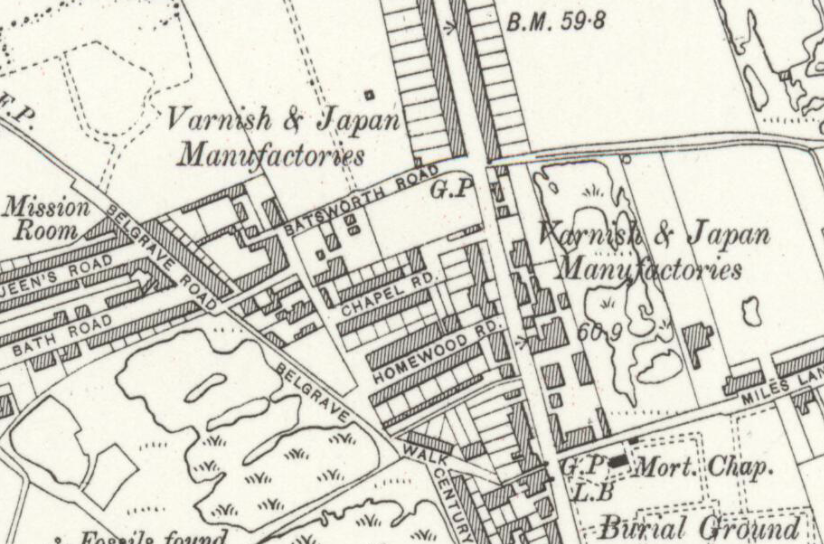
Map, published in 1914:

1914

1914

This 1918 booklet from the company published in New York has prices for its essences and a summary of the amount needed to make a batch, e.g. 1 lb of concentrated pineapple with flavour 2,000 lbs of ‘boiled goods’.


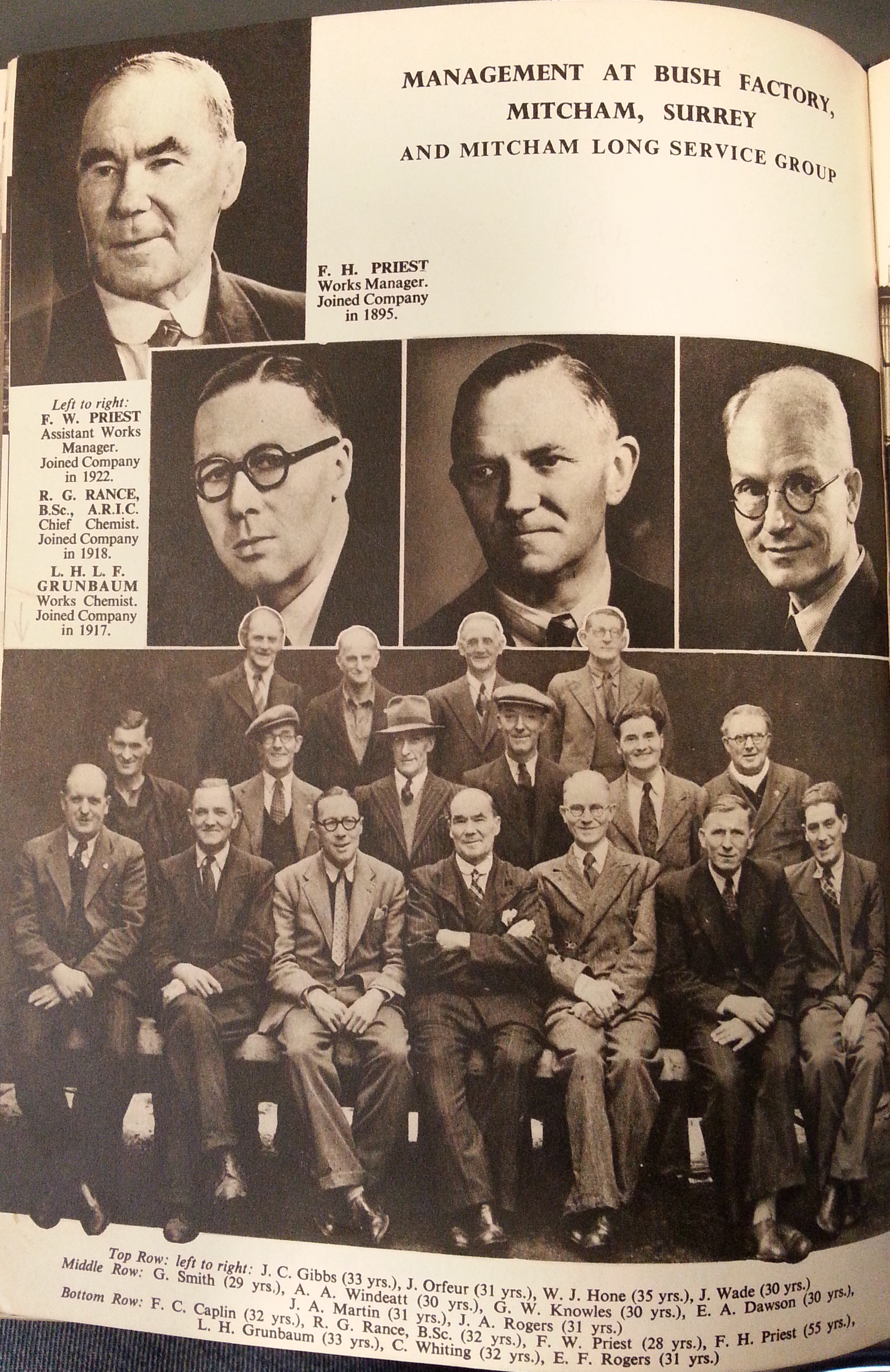
From 1951 booklet of centenary of company:
1951 Mitcham Factory Management1951 FH Priest

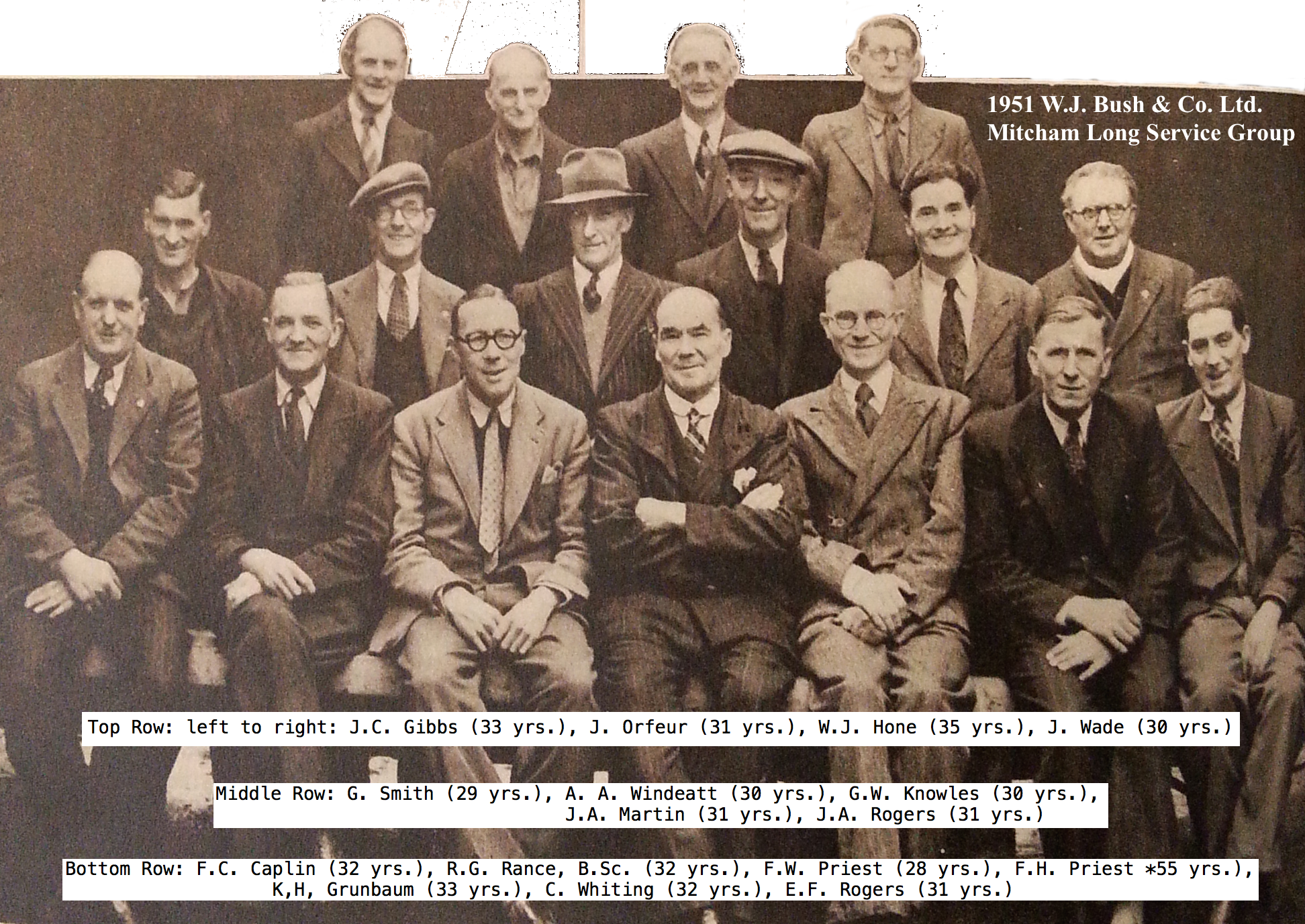
1951 Managers1951 Bush Long Service Group with names
Names are shown with the number of years in service in brackets.

Top Row: left to right: J.C. Gibbs (33 yrs.), J. Orfeur (31 yrs.), W.J. Hone (35 yrs.), J. Wade (30 yrs.)

Middle Row: G. Smith (29 yrs.), A. A. Windeatt (30 yrs.), G.W. Knowles (30 yrs.),J.A. Martin (31 yrs.), J.A. Rogers (31 yrs.)

Bottom Row: F.C. Caplin (32 yrs.), R.G. Rance, B.Sc. (32 yrs.), Frederick William Priest (28 yrs.), Frederick Horace Priest (55 yrs.),K.H. Grunbaum (33 yrs.), C. Whiting (32 yrs.), E.F. Rogers (31 yrs.)


1946 Institution of Engineers Obituaries (from Grace’s Guide)

GEORGE NEILSON KLEE was born in 1903 and received his technical education in mechanical engineering at the Northampton Polytechnic. After the completion of a nine years’ apprenticeship with Messrs. Farrow and Jackson, Ltd., brewers’ engineers, London, in 1928, he was appointed chief draughtsman at the Letchworth works of Messrs. L. Lumley and Company, Ltd., brewery engineers, but two years later he accepted a similar position with Messrs. Multifillers, Ltd. In 1933 he became works engineer at the Mitcham branch of Messrs. W. J. Bush and Company, manufacturing chemists, with responsibility to the works manager for the design and reconstruction of plant and buildings. After holding this position for seven years his services were lent by that firm to the Ministry of Supply and during the next two years he acted as senior mechanical engineer of the propellant planning department at Wrexham, being solely responsible to the chief engineer for the mechanical design of cordite factories. He then returned to Messrs. Bush as chief engineer and was holding this appointment at the time of his death, which occurred on 30th November 1944. Mr. Klee was elected an Associate Member of the Institution in 1936.

From the 1939 Who’s who in Engineering (from Grace’s Guide):

Klee, George Nielson Klee. A.M. I. Mech.E. Engineer, W. J. Bush & Co., Ltd., Mfg. Chemists, Batsworth Road, Mitcham. Private Address: 19 Cockwood Close, N.2. Career: Northampton Polytechnic (Awarded Skinner’s Prize); 1920-24, Apprent., Farrow & Jackson, Brewery Engs.; Farrow & Jackson, Draughtsman; L. Lumley & Co., Chief in D.O.; Is Eng. Consultant to “Bottler and Packer.”

From Ancestry, George Neilson Klee of 19 Cornwood Close, Finchley died 30 Nov 1944 and left £1554 4s. 6d. to his widow Elsie Maud Klee.

Sources:

Ancestry.com. England & Wales, National Probate Calendar (Index of Wills and Administrations), 1858-1966 [database on-line]. Provo, UT, USA: Ancestry.com Operations Inc, 2010.
Original data: Principal Probate Registry. Calendar of the Grants of Probate and Letters of Administration made in the Probate Registries of the High Court of Justice in England. London, England © Crown copyright.

from “The American Perfumer” October 1907 via archive.org

Newspaper Articles

From the Daily Express, 4th March, 1915

CAPTURING TRADE

ENTERPRISE OF A LONDON FIRM OF CHEMISTS.

Lord Knutsford announced yesterday at the quarterly meeting of governors of the London Hospital that home manufacturers had overcome the difficulty which had been experienced in obtaining sufficient salicylate of soda, a drug chiefly used in the cure of rheumatism, and made from one of the by-products of coal tar.

“The whole manufacture of this drug. has been in German hands.” he said. ”and some time ago the staff had to restrict the use of it to urgent cases. Last week they received the first consignment of 56lbs. of the drug from Messrs. Bush and Co., of Bethnal Green, who have put down plant to fight the German monopoly.”

Up to date, Lord Knutsford added, the hospital had treated 2,200 soldiers without in any way reducing the help given to the civilian population. Mr John Lavery, A.R.A., is at work at the hospital on a picture of the wounded.

Note that salicylate of soda is used in making aspirin.