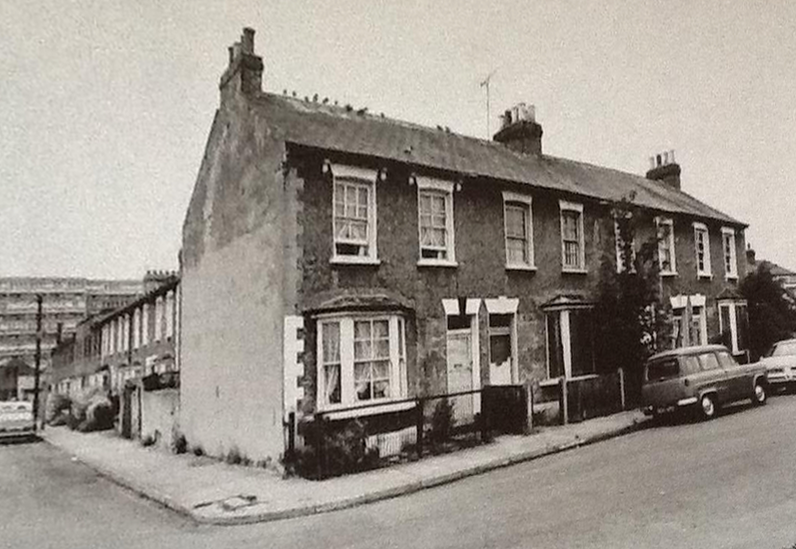
Chapel Road possibly 1965
This photo is looking west, from the Church Road end, at numbers 10 on the left, 8, 6 and 4 on the right. As the new Phipps Bridge development of flats can be seen in the background, this photo is assumed to be after 1965. Note the four chimney pots for each house.
World War 1 Connections
Private Leonard Ralph Bradshaw
Private Frederick Albert Simmonds
Absentee from Military Service, as reported in the Police Gazette – Tuesday 26 September 1916
W.PAYNE, 19 Chapel Road. Age and trade not given. Deserted 7th August 1916 from Wimbledon.
Maps
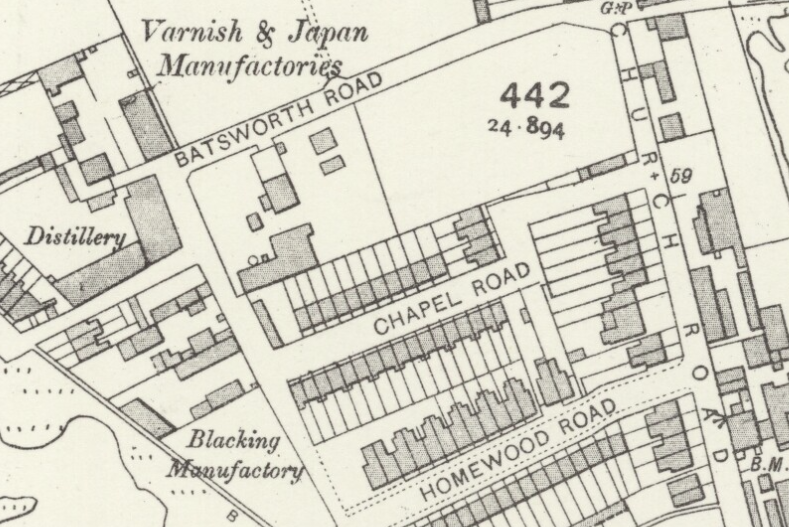
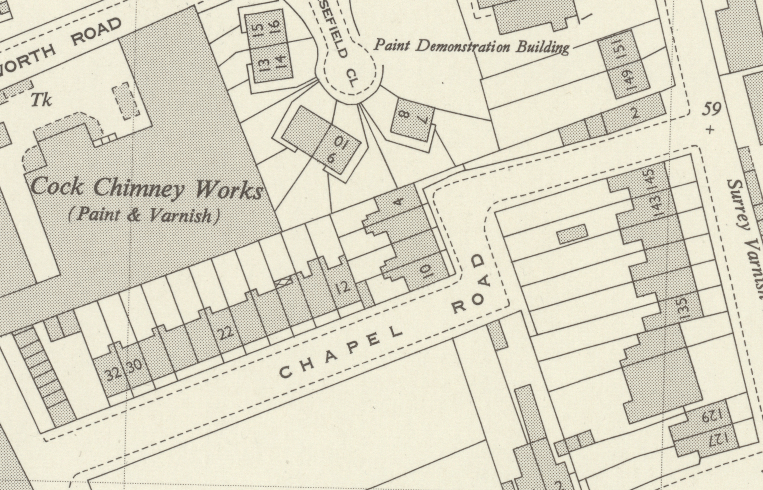
1950 Chapel Road map evens only
News Articles
Croydon Advertiser and East Surrey Reporter – Saturday 17 April 1886
Alleged Theft from a Child.—Yesterday (Friday), before Mr. T. R. Edridge, chairman the Croydon County Bench, a girl named Emily Varnum (14), Chapel-road, Mitcham, described as a nurse, was charged with stealing 5d., from small child, whose name did not transpire.
— Mr. Edridge, without formally going into the case, asked the prisoner what she did with the money.
— She said she only had fourpence, with which she bought cakes and sweets, and gave the other twopence away.
— Mr. Edridge, in discharging the prisoner, warned her to be very careful of her future conduct, and ordered her mother to pay Mrs. Mellor, the other child’s grandmother, the money which had been lost.
Gloucester Citizen – Thursday 13 September 1928
GASWORKER GASSED.
Alfred H. Stokes, 29, of Chapel-road, Mitcham, was excavating in High-street, Tooting, on Wednesday, for the Wandsworth, Wimbledon and Epsom District Gas Company, when an escape of gas rendered him unconscious. He was taken to St. James’s Hospital, where oxygen was administered, and after a time he recovered, and was later allowed to go home.
Surrey Mirror – Friday 24 April 1931
While repairing the pavement in Chapel-road, Mitcham, on Saturday three Mitcham Council workmen felt the ground give under their feet. They were just in time to leap to safety as the surface fell into well 8ft deep, containing 2ft. of water. The well is bricked one side and heavily the other, and appears to connect with an underground watercourse extending about 30ft. under the pavement.
Gloucester Citizen – Friday 11 November 1932
SCRAP OF PAPER CLUE
“TELEPHONE COIN-BOX KING” ALLEGATIONA piece paper dropped by a prisoner was mentioned at Croydon when Percy Wallis (41), of Chapel-road, Mitcham, was charged on remand with conspiring with Thomas Robins, Constantine Ferrari, and others to steal money from telephone coin boxes.
Wallis was described at the last hearing as the “telephone coin box king,” and the master mind behind numerous telephone box raids, but he denied it.
Mr. Gordon Fraser, for the Post Office, said that the losses from telephone coin-boxes were very large indeed. In April two men were convicted at the Old Bailey. While one was on remand he dropped a paper, picked it up quickly, and tried to destroy it. That paper gave Wallis’s telephone number and address. After that observation was kept almost continuously on him.
Wallis was remanded and bail refused.
Source the British Newspaper Archive (subscription required).
1973 : Life is hell for the forgotten residents
Road stopping up order in the London Gazette Publication date:12 May 1988 Issue:51331 Page:5634
Occupants in the 1911 street directory
27,Mrs Bartripp shopkeeper
1915 Electoral Register
Odd numbers, south side
| Skinner, William | 5 | |||
| Ward, Thomas Edward | 7 | |||
| Simmons, Frederick Albert | 9 | |||
| West, George | 11 | |||
| Pinegar, Robert | 13 | |||
| Clark, Thomas | 17 | |||
| Lambert, Charles | 19 | |||
| Homewood, William | 21 | |||
| Elliott, George Henry | 23 | |||
| Franklin, William | 25 | |||
| Howe, John | 27 | |||
| Pearce, Arthur | 29 | |||
| Ferrier, Thomas Arthur | 33 | |||
| Stagg, William | 35 | |||
| Salter, Henry | 37 |
Even numbers, north side
| Whale, Charles Frederick | 4 | |||
| Forgham, James | 6 | |||
| Hawkins, Thomas | 8 | |||
| Skilling, John | 10 | |||
| Arnold, Thomas John | 12 | |||
| Jardine, Thomas | 14 | |||
| Winter, James | 16 | |||
| Marshall, Robert | 18 | |||
| Thompson, Thomas | 22 | |||
| Thurtle, Arthur | 24 | |||
| Halestrap, Henry William | 26 | |||
| Davis, John | 28 | |||
| Bradshaw, Henry | 30 | |||
| Stock, John William | 32 |
Thomas John ARNOLD was secretary of the Greyhound beerhouse ‘slate (Christmas) club, according to the Croydon Express – Saturday 29 December 1906.
1933 Electoral Register
Odd numbers, south side
| Priscilla | SKINNER | 5 | |
| Alfred | MAY | 5 | |
| Christion | MAY | 5 | |
| Mary | WARD | 7 | |
| Thomas | Edward | WARD | 7 |
| John | Henry | WARD | 7 |
| Alice | Maud | WHITE | 9 |
| Moses | Frank | WHITE | 9 |
| Alice | Maude | NYE | 9 |
| Emily | May | SIMMONDS | 9 |
| Alice | WEST | 11 | |
| George | WEST | 11 | |
| Marjorie | Alice | WEST | 11 |
| Annie | PENEGAR | 13 | |
| George | Robert | PENEGAR | 13 |
| William | Robert | PENEGAR | 13 |
| Emily | FROST | 15 | |
| William | Jeremiah Thomas | FROST | 15 |
| Douglas | CLEMENTS | 15 | |
| Amy | Isobel | CLEMENTS | 15 |
| Eliza | CLARK | 17 | |
| Edmund | HOMEWOOD | 17 | |
| Violet | HOMEWOOD | 17 | |
| William | WARREN | 19 | |
| Florence | WARREN | 19 | |
| William | MORLEY | 21 | |
| Mabel | MORLEY | 21 | |
| George | ELLIOTT | 23 | |
| Rose | Mary | ELLIOTT | 23 |
| Joseph | Richard | ELLIOTT | 23 |
| Job | COLLISON | 25 | |
| Mary | Ann | COLLISON | 25 |
| Annie | HOWE | 27 | |
| John | HOWE | 27 | |
| William | HOWE | 27 | |
| Florence | HOWE | 27 | |
| Minnie | PEARCE | 29 | |
| Alfred | Hanson | REEVES | 31 |
| Robert | Thomas | ALEXANDER | 31 |
| Grace | Winifred | ALEXANDER | 31 |
| Alfred | WHEATCROFT | 33 | |
| Emily | WHEATCROFT | 33 | |
| Arthur | Edward | CHAPMAN | 35 |
| Lucy | Alexandra | CHAPMAN | 35 |
| Henry | SALTER | 37 | |
| Maud | Louisa | SALTER | 37 |
| Albert | William | SALTER | 37 |
Even numbers, north side
| Leonard | SIMS | 2 | |
| Charles | Frederick | WHALE | 4 |
| Minnie | WHALE | 4 | |
| Edna | WHALE | 4 | |
| James | FORGHAM | 6 | |
| Sarah | FORGHAM | 6 | |
| Ethel | Evelyn | FORGHAM | 6 |
| James | Harold | FORGHAM | 6 |
| Albert | James | LIDDLE | 8 |
| Nellie | LIDDLE | 8 | |
| Elsie | WALLIS | 10 | |
| Reginald | PUTTEE | 10 | |
| Maud | PUTTEE | 10 | |
| Amelia | Maria | ARNOLD | 12 |
| Thomas | John | ARNOLD | 12 |
| William | James | NORMAN | 12 |
| Mary | JARDINE | 14 | |
| Thomas | JARDINE | 14 | |
| Rhoda | JARDINE | 14 | |
| Cecil | Frank | CRITTENDEN | 16 |
| Edith | Maud | CRITTENDEN | 16 |
| Charles | BLACKBURN | 16 | |
| Annie | BLACKBURN | 16 | |
| Margaret | MARSHALL | 18 | |
| Robert | MARSHALL | 18 | |
| Edward | SMITH | 18 | |
| Doris | May | SMITH | 18 |
| Frank | WALLACE | 20 | |
| Gertrude | WALLACE | 20 | |
| Harry | TANNER | 20 | |
| Rebecca | TANNER | 20 | |
| Lizzie | Bullock | THOMPSON | 22 |
| William | THOMPSON | 22 | |
| Olive | Eunice | THOMPSON | 22 |
| Arthur | THURTLE | 24 | |
| Grace | Lilian | THURTLE | 24 |
| Henry | William | HALESTRAP | 26 |
| Cissie | PRIOR | 26 | |
| Alice | Elizabeth | DAVIS | 28 |
| John | DAVIS | 28 | |
| John | James | DAVIS | 28 |
| Eliza | BRADSHAW | 30 | |
| Henry | BRADSHAW | 30 | |
| Harry | BRADSHAW | 30 | |
| Amy | BRADSHAW | 30 | |
| Emily | Jane | JOHNSON | 32 |
| William | Henry | JOHNSON | 32 |
| Amy | Emily | JOHNSON | 32 |
Maps are reproduced with the permission of the National Library of Scotland.


 Mitcham History Notes