Road that runs south from Tonstall Road, past Leather Close, St Marks Road, Barnard Road to end at Gaston Road.
The road name ‘Lammas’ comes from Lammas Day, as defined in Wikipedia:
Lammas Day (Anglo-Saxon hlaf-mas, “loaf-mass”), also known as Loaf Mass Day, is a Christian holiday celebrated on 1 August.
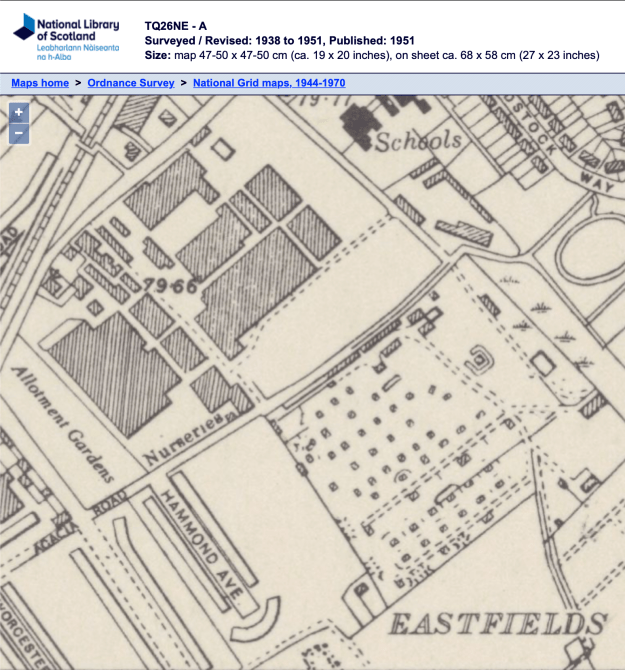
The road isn’t mentioned in the 1925 street directory, and part of it is shown on the 1932 map. Perhaps the houses were built from the end of the 1920s or 1930s.
The 1932 OS map shows the road as between Barnard Road and Gaston Road. The 1952 OS map shows the road in its extent as today.
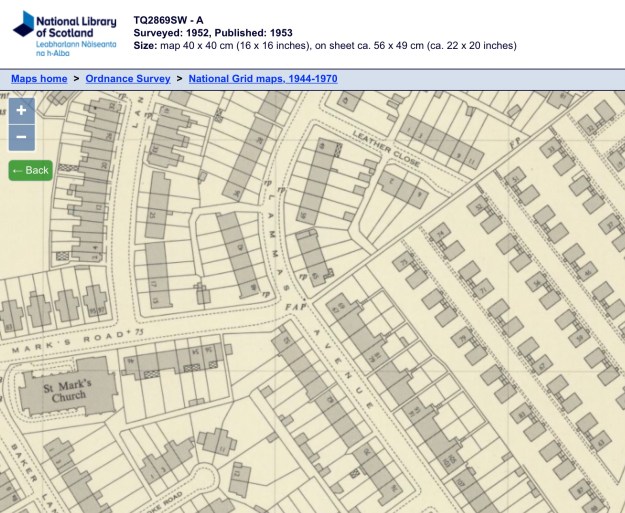
1952 OS map
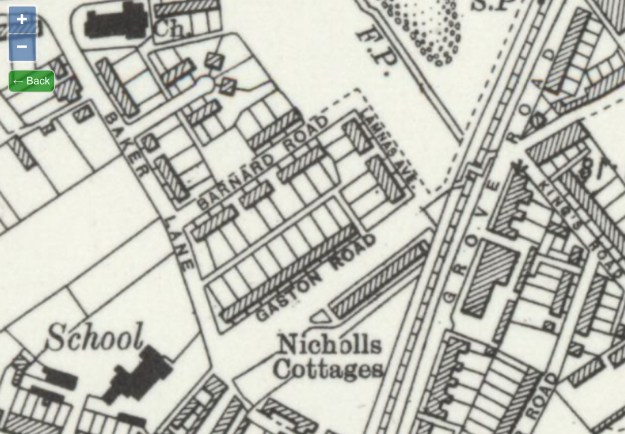
1932 OS map
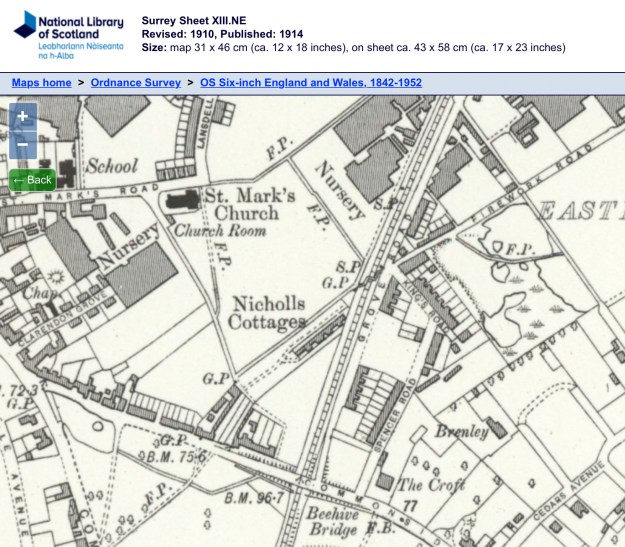
1910 OS map. The footpath (F.P.), that runs to near the footbridge over the railway line, is now the boundary of the rear gardens on the east side of the road with the Laburnum housing estate.
News Articles
The newspaper articles below are via the British Newspaper Archive and are shown most recent first.
Norwood News – Friday 10 February 1961
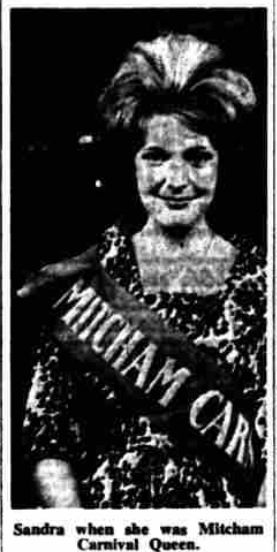
Norwood News – Friday 10 February 1961
Image © Reach PLC. Image created courtesy of THE BRITISH LIBRARY BOARD.
A QUEEN ENTERS FOOTBALL CONTEST
FAIR-HAIRED Sandra Elkins (aged 17), Lammas Avenue, Mitcham, the 1960 Mitcham Carnival Queen, was among late entries for the Crystal Palace Football Queen competition.
Gretta Roadnight, Beulah Hill, Upper Norwood, and Penny Smith, Melrose Avenue, Mitcham, were other new competitors before the contest closed last week. This makes a total of 11 girls who will parade for the right to represent Palace in the area finals during a Supporters’ Club dance at Beckenham Baths tomorrow (Saturday). Judging will tale place at 9.30 p.m. by a panel of celebrities. This will include Kathleen Dale, President of the Surrey Women’s A.A.A. and a former Olympic hurdler; Cecil, her husband, president of Surrey A.A.A, and the Tooting and Mitcham F. C. P.T.I.; international boxer Tony Lewis, Streatham ice-hockey star Bob Ketcher and Ashley Deane, the Tooting model.
Sutton & Epsom Advertiser – Thursday 7th November 1957
PURSE PRESENTED BY MAY QUEEN.
A purse containing a cheque for £15 was handed to Lady Ismay for the Church of England Children’s Society by the May Queen of Mitcham on Monday. The May Queen, Grace Dadswell, of Lammas Avenue, went up to the Albert Hall for the ceremony, when many societies handed over money to the society’s fund for waifs and strays
Croydon Times – Saturday 12 August 1939
HAWKER TELLS P.C. HE IS “LIKE HITLER”
Constable Did Not Agree
“You are like Hitler” is what a Mitcham hawker was alleged to have said to a policeman who stopped him for being drunk in charge of a barrow.
At Croydon County Police Court, on Tuesday, the Clerk asked the constable: “You do not agree, do you, that you are like Hitler?”
“No sir,” – replied the officer.
The constable, Thomas Redfern said he saw the defendant, William George Norman (59), Marian-road, Mitcham, zig-zagging about Lammas-avenue, Mitcham, on Saturday night, with a barrow. After turning into another road, he fell to the ground. He was taken into custody, and at the police station a doctor was called at defendant’s request.
Norman told the Court he was sorry, and said such a thing would not happen again. He was fined 2s. 6d. and told to pay 7s. 6d. doctor’s fee.
Birmingham Mail – Thursday 4th May 1939
GAS EXPLOSION
THREE MEN BURNED IN SCHOOL MISHAP
Three men were burnt and a fourth gassed in an explosion at a new Surrey County Council school at Aragon Road, Morden, to-day. The four men, all employees of Wandsworth Gas Company, were connecting a three-inch main in a cellar meter room under the school. An electric light bulb burst and caused the explosion. Edward Roberts (aged 17), of Lammas Avenue, Mitcham, is in Sutton Hospital with burns to his face and arms. H. Driver and D. Morris were treated at St. Anthony’s Hospital, Cheam, for burns and then sent home. The fourth man, C. Weston, was given artificial respiration by ambulance men and also sent home. The gas supply was not connected, there was no fire and comparatively little damage was done to the building.
Shepton Mallet Journal – Friday 10th March 1939
TWO BABIES TOTAL 5 lb. 4 oz.
Two tiny babies, one a boy weighing 2 lb, 13 oz. and the other girl weighing 2 lb. 7 oz., have been born in the Longley Road Maternity Home, Tooting, London, S.W. Both babies are being kept in electrically heated cots and fed from a specially made miniature bottle. They are the smallest babies to have been born in the home, and their progress is stated to have been most satisfactory.
Mrs. Ella Seward, of Lammas Avenue, Mitcham, Surrey, mother of the boy, the wife of a window cleaner.
Mrs. Sani Coinage, of Woodbury Road, Tooting, mother of the girl, was formerly of Greek nationality. She met her husband, a non-commissioned officer in the Royal Sussex Regiment when he was stationed in Cyprus.
From the Sutton & Epsom Advertiser, Thursday 4th July, 1935.
COCKROACH PLAGUE.
SLIPPER AND FLAT-IRON ATTACK AT MITCHAM.
“Charge of the Night Brigade.”
Cockroaches an inch and a half long and as thick as a man’s finger have been making raids on houses in Lammas-avenue, Mitcham, every night for weeks past. Some are smaller, but size is not important; it is the thousands of the plague that matter.
The cockroaches assemble in the street after dusk enter the front gardens, soon run up the stucco fronts of the houses and do their best to enter. They also attack the houses from the rear. The nightly visitation has become such a menace that the residents have had to turn out with electric torches and swat the pests with slippers, flat-irons, mallets and anything else that would do the job with dispatch. It has been a messy and nasty business and the hunters are getting tired of the “sport”. Sometimes they don’t get to bed before two in the morning.
Mr. A. J. Martin, of 109, told the Advertiser “The cockroaches, for the most part, come from somewhere at the back of Lammas-avenue. But many hundreds come up through crevices in the street between the concrete roadway and the kerb. The drain heads are often crowded with them. No window can be left open and we are almost stifled by the heat. Bands of us twenty strong, attack the beastly things and they keep us busy for hours Mr. George Hoare, of 105 has had to protect the open windows at the top of his flat with wire screens, “If we open the front door at night the cockroaches are up the stairs in a jiffy.” he said. “I have had to line the door jambs to keep them out.” While the Advertiser man was talking to a neighbour. Mr. C. J. Shepherd, of 107, was burning a bucketful of the insects in his back garden.
COUNCILLORS ON THE SPOT.
On Thursday night Councillors Dalton and East visited the plague spot and saw for themselves that the householders had not exaggerated the nuisance “I have never seen anything like it.” Mr. Dalton told the Advertiser. The fronts of a number of the houses seemed to be black with cockroaches, and they were running over the pavement in all directions. We saw them popping up through the concrete too. I understand that the Medical Officer of Health and the Sanitary Department are taking every possible action to put an end to a nuisance that may also be a serious menace to health. Dr. Till and Mr. C. G. Rabbetts have paid several visits to Lammas-avenue when the cockroaches have been on the warpath, and on Saturday night they poured paraffin into the street crevices. But the plague will have to be attacked at the source. Meanwhile the Public Health Committee are considering the matter and the steps to be taken to stamp out the plague. The harassed householders see the humorous side as well. They call their nightly hunt “The charge of the Night Brigade.”
Late Night News.
Miss Violet Reed was bitten on the leg by a cockroach while standing at the garden gate of her home at the end of Lammas-avenue on Saturday night.
Maps are reproduced with the permission of the National Library of Scotland, reuse CC-BY.


 Mitcham History Notes