Tag Archives: 1963

Robertson’s Pickle and Sauce Works Ltd

“Zalmo” Pickle Works
22 Lewis Road

1937 ad

1937 ad

In 2013, a long lost recipe for piccalilli was discovered.

Its closure in March 1969 was reported in the local newspaper, which referred to it as having been started 44 years previously, i.e. 1925.

Another small firm closes

Rising rates, inability to compete with giant supermarket and manufacturing concerns and wholesale business methods have driven another small firm to the wall.

A 44-year-old Mitcham factory, Robertson’s Pickle and Sauce Works Ltd., Lewis Road, have closed down and the owners have put the property up for sale.

A director, Mr Cyril Robertson, said this week:

“Most of my customers were small grocers – and with the advent of the supermarket they have been forced out of business. So I go down the drain too.

“Rates have risen over the past 12 years, from £56 a year to over £700.

“I can no longer get bottles for my produce – all the glass manufacturing is in the hands of four large concerns and they are only interested in mass production.”

Staff have reduced over the years, and when Robertson’s finally closed its doors in March only nine were declared redundant.

From a lifetime of working for himself in a £50,000 a year business Mr Robertson is now looking for a job.

“I’m too young to retire,” he said. “I’m only 62.”

People from the south coast and up as far as Reading will remember Robertson’s pickles, he added.

“They were the finest in the country – but then I suppose eating habits have changed too. People go out and eat more often – or just buy fish fingers to cook at home.”

Source: Mitcham News & Mercury, 6th June, 1969, page 1.

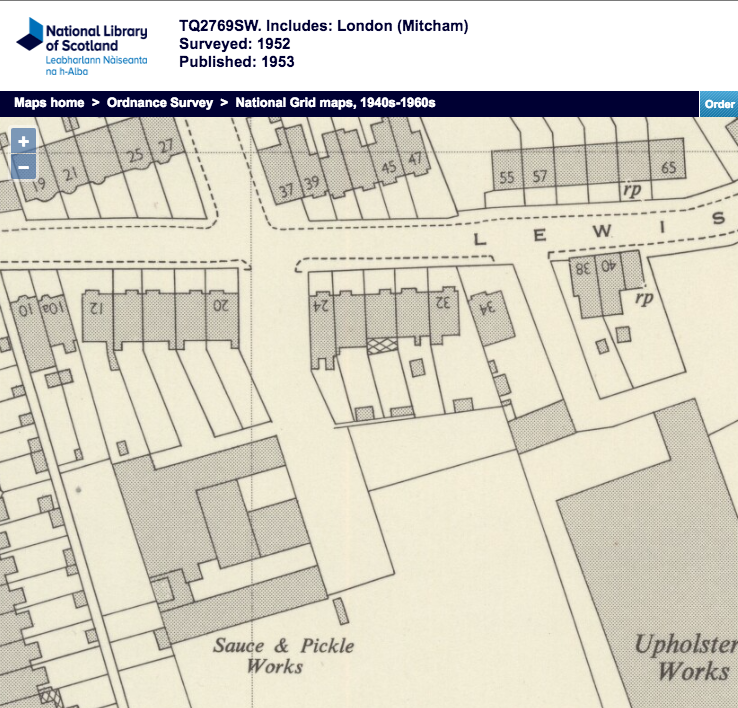
This 1952 OS map shows the pickle factory.
This aerial photo shows the factory in relation to nearby factories and houses.
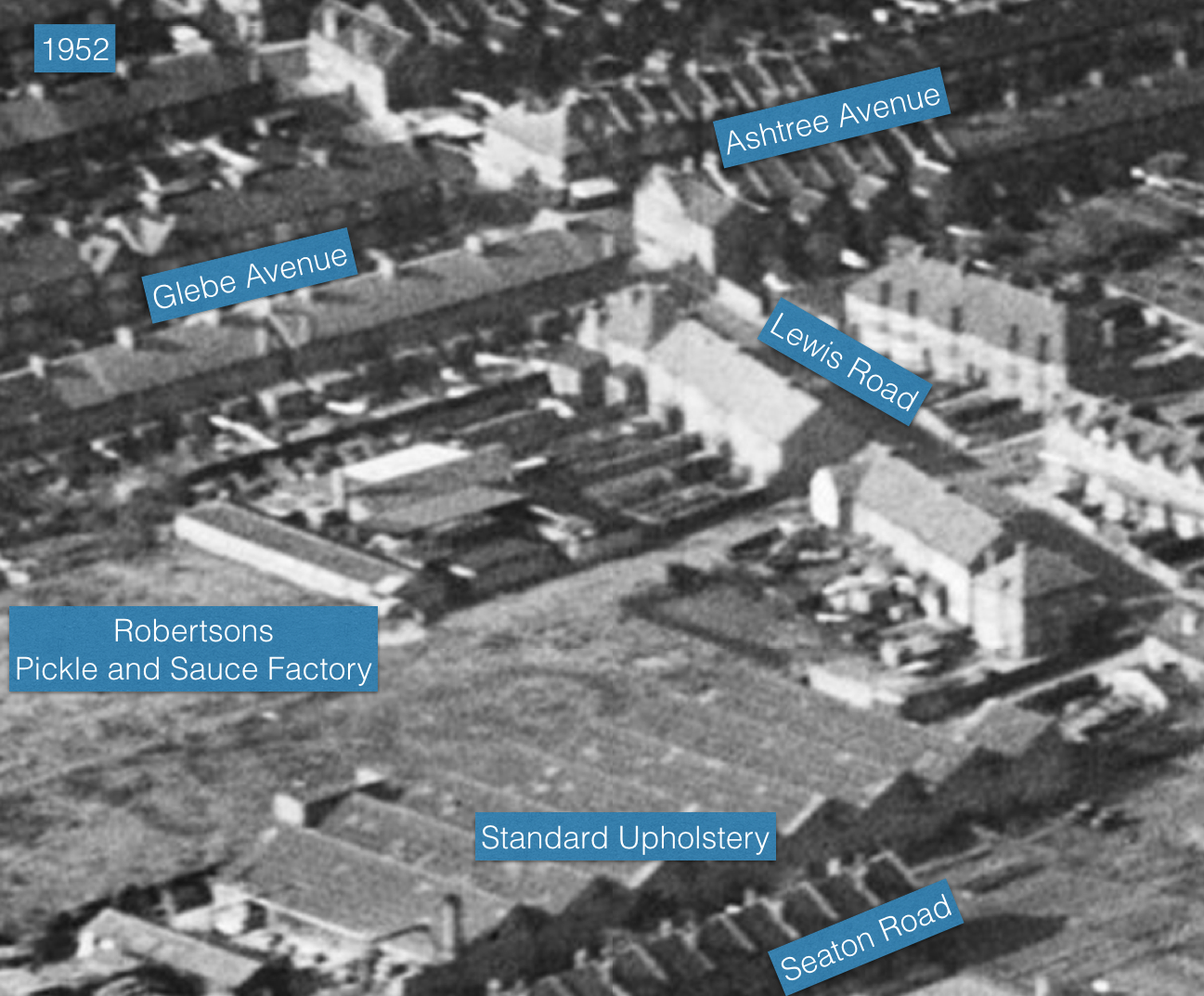
1952

1952

After closure, a planning application was filed to use the site for the production of plastics. This gives the size of the single-storey works at 7,000 square feet.

From the minutes of the
Town Planning and Development Committee
31st July 1969

497. LEWIS ROAD, MITCHAM — MER. 595/69 — Robertson’s Pickle and Sauce Works Limited — (Section 43 Determination)

— The Borough Surveyor submitted an application for a determination under Section 43 of the Town Country Planning Act, 1962, as to whether the proposed use of Robertson’s Pickle and Sauce Works for the moulding of reinforced plastics involving the use of polyester resins and fibreglass would constitute or involve development requiring planning permission. He explained that the premises (of single-storey construction comprising approximately 7,000 square feet floor area) were situated at the rear of Nos. 12-20, Lewis Road, fronting an access road leading to the Lewis Road recreation ground; stated that they had been used for a considerable number of years for the pickling of vegetables and the making of sauces; and reported that, since the proposed use and the last use both fell within Class IV of the Town and Country Planning (Use Classes) Order, 1963, it was clear that express planning permission would not be required.

Resolved — That the Council determine and the applicant be informed that the use, as described, would not constitute or involve development requiring planning permission.

Source: Minutes of Proceedings of the Council and committees, London Borough of Merton, Volume 6 1969-70, page 355


1944 film footage by Bruce Robertson of V1 bomb damage in nearby Glebe Avenue.


Minutes of meetings held by the London Borough of Merton are available on request from the Merton Heritage and Local Studies Centre at Morden Library.


Maps are reproduced with the permission of the National Library of Scotland.

Mitcham Foundry and Engineering Ltd.

Based at the James Estate, corner of Bond Road and Western Road.

From the Mitcham and Tooting Advertiser, 18th August 1955

THE MITCHAM INDUSTRIALIST WHO BEAT THE NAVY EXPERTS
He solved U-boat secret

When the Navy captured a German U-boat during the early part of the war, an underwater metal cutter with an entirely unknown type of valve was discovered inside it.

Admiralty experts were stumped. They wanted to use similar valves on equipment in our own submarines, but did not know how they were made. Naval engineers started to draw up plans and meanwhile one of the small valves was sent to the Mitcham Foundry and Engineering Company.

Mr. Robert Badcoe, one of the two partners at the foundry, studied the valve carefully. He decided, after a lot of thought, that he could make one, and set about it.

The valve took 64 operations and contained 13 different threads, but it was soon completed and sent back to the Admiralty. A few days later blueprints arrived at Mitcham telling Mr. Badcoe how the valve could be made!

Work at the foundry ranges from the manufacture of cheese and sweet moulds to the building of underwater television equipment and secret components for Harwell, the atomic research centre.

Originally a workhouse, and, in the first world war a hospital, the foundry lies back from the Western Road near Mitcham Fair Green.

At a very early age, Mr. Badcoe, who now lives in Worcester Park, was apprenticed to a Tooting firm of carburettor manufacturers. Steadily he built up an extensive knowledge of the motoring and light engineering trade.

For a number of years he acted as a second mechanic to a Maserati motor racing team in this country.

Later, when the firm closed, Mr. Badcoe decided to take over the foundry at Mitcham and with his father-in-law, Mr. George Langlands, as a partner, gradually built up the business.

Mr. Badcoe, now nearing 60, is a man who believes in facing emergencies only when they arise and his 35 hand-picked and skilled men follow in his footsteps. They still refuse to wear protective clothing for their faces and hands although they are continually dealing with white hot molten metal.

When the war started the factory immediately began to manufacture shells, aeroplane parts, fire-fighting apparatus and metal air valves for frogmen’s breathing units.

The firm once received an order from the Air Ministry for thousands of aircraft parts for which over 80 tons of lead had to be used.

It was stored on the floor of one of the workshops, and a few days later, when workmen reached the bottom of the pile, they found that the weight had caused it to sink about four feet into the ground.

A big order which the foundry is dealing with at present is a speciality and they have often been called upon to make such things as jewellers’ lathes for Hatton Garden merchants.

Mr. Badcoe and his team are now working on a special type of outboard propellor unit for a Commonwealth Government.

Each unit is made up of hundreds of different parts and often the men have had to make their own jigs and fixtures.

(photo) Mr. Badcoe’s son, Christopher, places a finished unit among the other equipment for an important contract.

Note that some online company check websites show this company as number 00245458 at 174 London Road, CR4 3LD, the engineering works at the rear of the Swan.


James Estate
132 Western Road

Castings, Engineering.

Source:
Borough of Mitcham List of Factories,
Town Clerk’s Department,
July 1963.
Available at Merton Heritage and Local Studies Centre at Morden Library.
Reference L2 (670) MIT