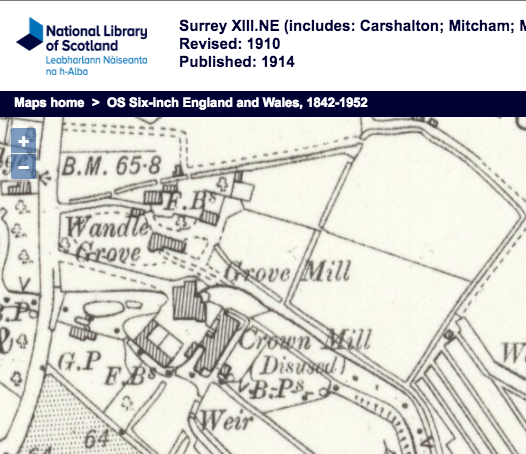
Lyxhayr was the brand name of artificial horse hair that was manufactured at Grove Mills, on the Wandle in Mitcham.
First manufactured in 1903 by a company called ‘The Patent Horse Hair Co. Ltd.’, ‘lyxhayr’ was a curled fibre of vegetable origin for many upholstery filling applications. Developed by a chemist called Mr Holmes, the process was patented.
As well as hair from horses, wool or cotton fibre, called ‘flock’, was used in filling mattresses and furniture. Sometimes, hog hair was mixed in with the horse hair to reduce cost. Animal hair however was not hygienic, and the company’s advertisement in 1907 said that the Public Analyst for Hackney, Dr Leo Taylor, had found that the hair contained almost the same amount of bacteria as London sewage.
Being made from vegetable, this artificial horse hair was free of bacteria.
In 1905 the company changed its name to Lyxhayr Ltd. and Mr W. A. Dickinson was its Managing Director. Mattresses made with lyxhayr were popular with hospitals but cheaper, less hygienic ones were still being sold.
Mr Dickinson was one of those who lobbied parliament leading to the Rag Flock Act of 1911, which was the first attempt to regulate the abuses.
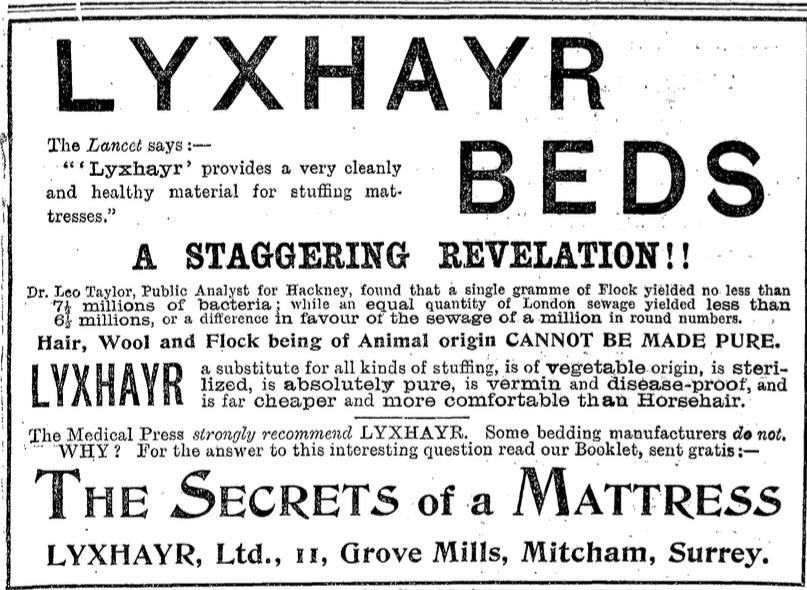
1907 ad
Listed in the 1938 commercial directory as
Mitcham Fibre Mills Ltd., horse hair substitute manufacturers, Grove Mills, London Road. Trading As “Lyxhayr, Mitcham;” Telephone Number 0807.
News Articles
These are from the British Newspaper Archive.
Sutton & Epsom Advertiser – Thursday 22 September 1949
Memories of the Wandle and old friends who fought in her defence
Sir,—Mention of the late Benjamin Slater in “The Advertiser” recalls to mind the many happy hours I spent with him in his old-world garden after his retirement from his long service at Hall Place. Occasionally we were joined by the late Sir T. Cato Worsfold, always ready to chat with his head gardener. I happen to be Mr. Slater’s only grandson.
I entered the office of Lyxhayr Manufacturers, Ltd., predecessors of the present Mitcham Hair and Fibre Mills, Ltd., and worked under the then managing director, the late Mr. W. A. Dickinson, who was not a native or resident of Mitcham but had been in business at the mill for a great number of years. He loved the Wandle and the adjoining Watermeads and Happy Valley and he took an active part when Watermeads was handed over to the National Trust. He was, I believe, one of the original members of the local Watermeads committee and worked hard in its interests. Mr. Dickinson would search every book likely to contain any reference to the Wandle and he left some interesting records. Normally a quiet business man, he sailed straight into action, up or down the Wandle, with all guns blazing, whenever the Wandle was threatened either by abstraction or diversion of the water or pollution. In the early fights with Croydon Corporation he was always to be found shoulder to shoulder with the other riparian owners on the river.
Ill-health forced him to retire in 1932. On the day he left his office, the last he saw of the Wandle which ran under his office window, I accepted his keys and took over his duties with a feeling that I and the Wandle had lost a good friend. He retained his interest in the river until the last.
Working in the mills at the time of my entry was the late George Hill, then getting on in years. Hill was a well known and respected old inhabitant of Mitcham who lived in one of the old cottages (recently pulled down) adjoining the police station on the Causeway. He died in 1922. Practically all his long life had been spent working in the mill. He was there before the advent of Lyxhayr when it was used as a felt mill, owned or managed by the late W. W. Thompson, but as a boy he worked for a time in the garden of Wandle House. Hill, in common with Benjamin Slater and so many old Mitchamites, retained his love of gardening and in his later days as a faithful old servant of the mills he spent the greater part of his working time cultivating the kitchen garden at the rear of the mill for Mr. Dickinson. Hill’s especial pride being a fine asparagus bed which Dickinson duly did justice to. It was from Hill’s association with Wandle House that the information was obtained by Mr. Dickinson about McKray’s Mill.
I have no doubt I could obtain further information about the mill and the activities of McKray or McCrae (the latter, I think, is more likely to be the correct way of spelling). Fortunately we still have with us people who know more about the river and its mills than I do. Perhaps Col. Bidder, that old river stalwart, can help me, or maybe Mr. H. Gorden Holder of Deeds Mill can elicit some information about the mill in question from his uncle, Mr. Stanley Holder.
E. B. HEDGER.
Grove Mills, Mitcham.
Western Chronicle – Friday 5 February 1909
1909 fire
At one o’clock on Saturday morning a fire broke out the Grove Mills, Mitcham, an artificial horsehair manufactory. The fire brigades from Croydon, Sutton, and Mitcham attended, but the four-storey brick building was completely gutted. The damage is estimated at from £5,000 to £6,000.
Pearson’s Weekly – Thursday 4 January 1906
A VALUABLE addition has been made to the list of hygienic articles by the introduction of Lyxhayr. A substitute for horsehair, Lyxhayr is a natural, vegetable, woody fibre, which has been chemically and mechanically treated. As a stuffing for beds and chairs, where the maximum of health and cleanliness is desired, it is gaining great appreciation. Full particulars of Lyxhayr can be obtained from the selling agents, Messrs. Dollery and Palmer, 110 Cannon Street, London, E.C.
 Mitcham History Notes