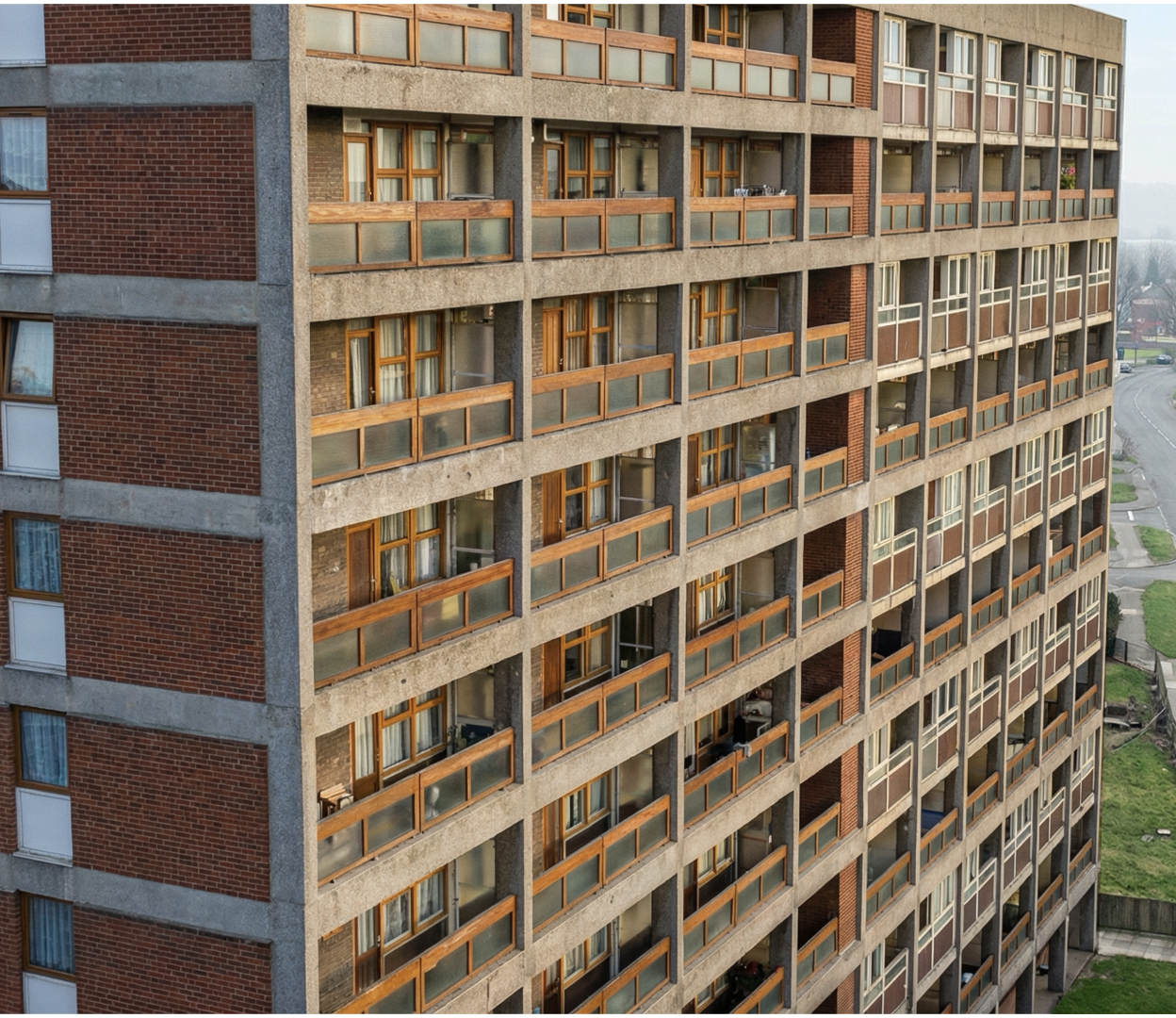
Tag Archives: Phipps Bridge Estate

Calor Gas Explosion of 1970

“It was like the Blitz all over again”, said one of the nearby residents when on the evening of Thursday 24th September, 1970, the Calor gas bottle storage depot in Church Road, Mitcham, caught fire. Gas bottles flew through the air raining chunks of hot metal onto houses and streets. The explosion was heard as far away as Battersea.

The following are from two issues of the local newspaper reporting the fire and the decision by the company not to store gas bottles at their depot any more.

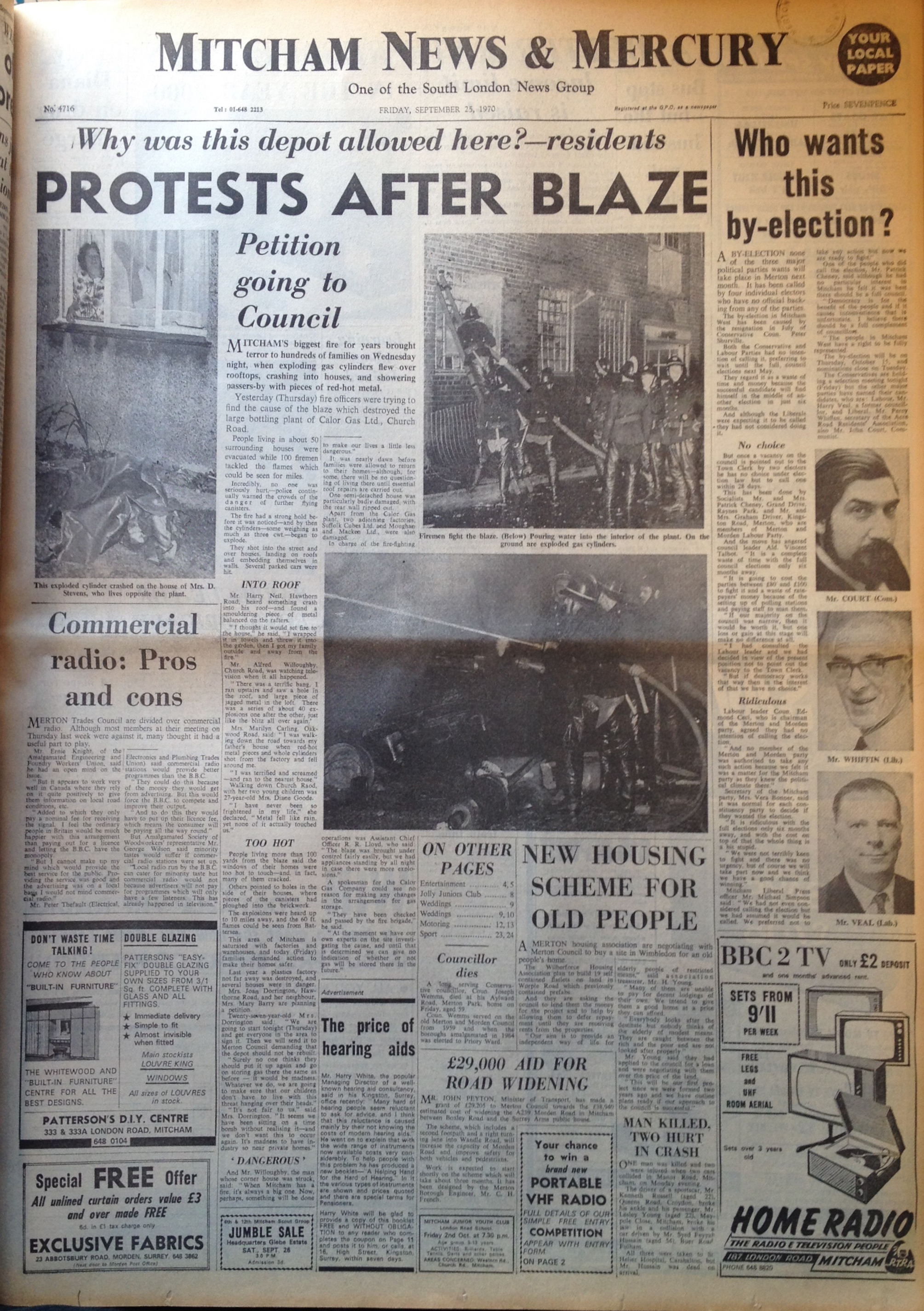
25th September 1970, page 1, Mitcham News & Mercury

From the Mitcham News in Mercury, Friday 25th of September, 1970.

Protests after a blaze

Why was this depot allowed here, say the residents.

Mitcham’s biggest fire for years brought terror to hundreds of families on Wednesday night
when exploding gas cylinders flew over rooftops, crashing into houses and showering passers-by
with pieces of red-hot metal. Yesterday Thursday, fire officers were trying to find the cause of the blaze which destroyed a large bottling plant of Calor Gas Limited, Church Road. People living in about 50 surrounding houses were evacuated while 100 firemen tackled the flames which could be seen for miles. Incredibly no one was seriously hurt.
Police continually warned the crowds of the danger of further flying canisters. The fire had a strong hold before it was noticed and by then the cylinders, some weighing as much as 300 weight, began to explode. They shot into the street over houses, landing on roofs and embedding themselves in walls. Several parked cars were hit. Mr Harry Neil, Hawthorne Road, heard something crash into his roof and he found a smouldering piece of metal balanced on the rafters.
I thought it would set fire to the house, he said. I wrapped it in towels and threw it into the garden.
Then I got my family outside and away from the fire. Mr Alfred Willoughby, Church Road, was watching television when it all happened. There was a terrific bang. I ran upstairs and I saw a hole in the roof and a large piece of jagged metal in the loft. There was a series of about 40 explosions, one after the other, just like the Blitz,
all over again. Mrs Marilyn Carlin, Oakwood Road, said, I was walking down the road towards my father’s
house when red-hot metal pieces and whole cylinders shot from the factory and fell around
me. I rang the notify and screamed and rang to the nearest house. Walking down Church Road with her two young children was 27-year-old Mrs Diane Goode. I had never been so frightened in my life, she declared. Metal fell like rain, yet none of it actually touched us. People living more than 100 yards from the blaze said the windows of their homes were
too hot to touch and, in fact, many of them cracked. Others pointed to holes in the side of their houses where pieces of the canisters had ploughed into the brickwork. The explosions were heard up to ten miles away and the 60-foot flames could be seen from Battersea. This area of Mitcham is saturated with factories and warehouses and today, Friday, families demand inaction to make their homes safer. Last year, a plastics factory not far away was destroyed and several houses were in danger. Mrs Joan Dorrington, Hawthorn Road, and her neighbour, Mrs Mary Berry, are planning a
petition. 27-year-old Mrs Dorrington said, We are going to start tonight, Thursday, and get everyone in the area to sign it. Then we will send it to Merton Council demanding that the depot should not be rebuilt. Surely no one thinks they should put it up again and go on storing gas there the same as before. It would be madness. Whatever we do, we are going to make sure that our children don’t have to live with this threat hanging over their heads.
It’s not fair to us, said Mrs Dorrington. It seems we have been sitting on a time bomb without realising it, and we don’t want this to occur again. It’s madness to have industry so near private homes. And Mr Willoughby, the man whose corner house was struck, said, When Mitcham has a fire, it’s always a big one.
Now perhaps something will be done to make our lives a little less dangerous.
It was nearly dawn before families were allowed to return to their homes, although for some
there will be no questioning of living there until essential roof repairs are carried out.
One semi-detached house was particularly badly damaged with the rear wall ripped out.
Apart from the Calor Gas plant, two adjoining factories, Suffolk Cubes Limited and Moughan Macken Limited, were also damaged. In charge of the firefighting operations was Assistant Chief Officer R. R. Lloyd, who said,
The blaze was brought under control fairly easily, but we had appliances standing by
all night in case there were more explosions. A spokesman for the Calor Gas company could see no reason for making any changes to the arrangements for gas storage. They have been checked and passed by the fire brigade, he said.
At the moment we have our own experts on the site investigating the cause, and until that is determined we can give no indication whether or not gas will be stored there in the future.

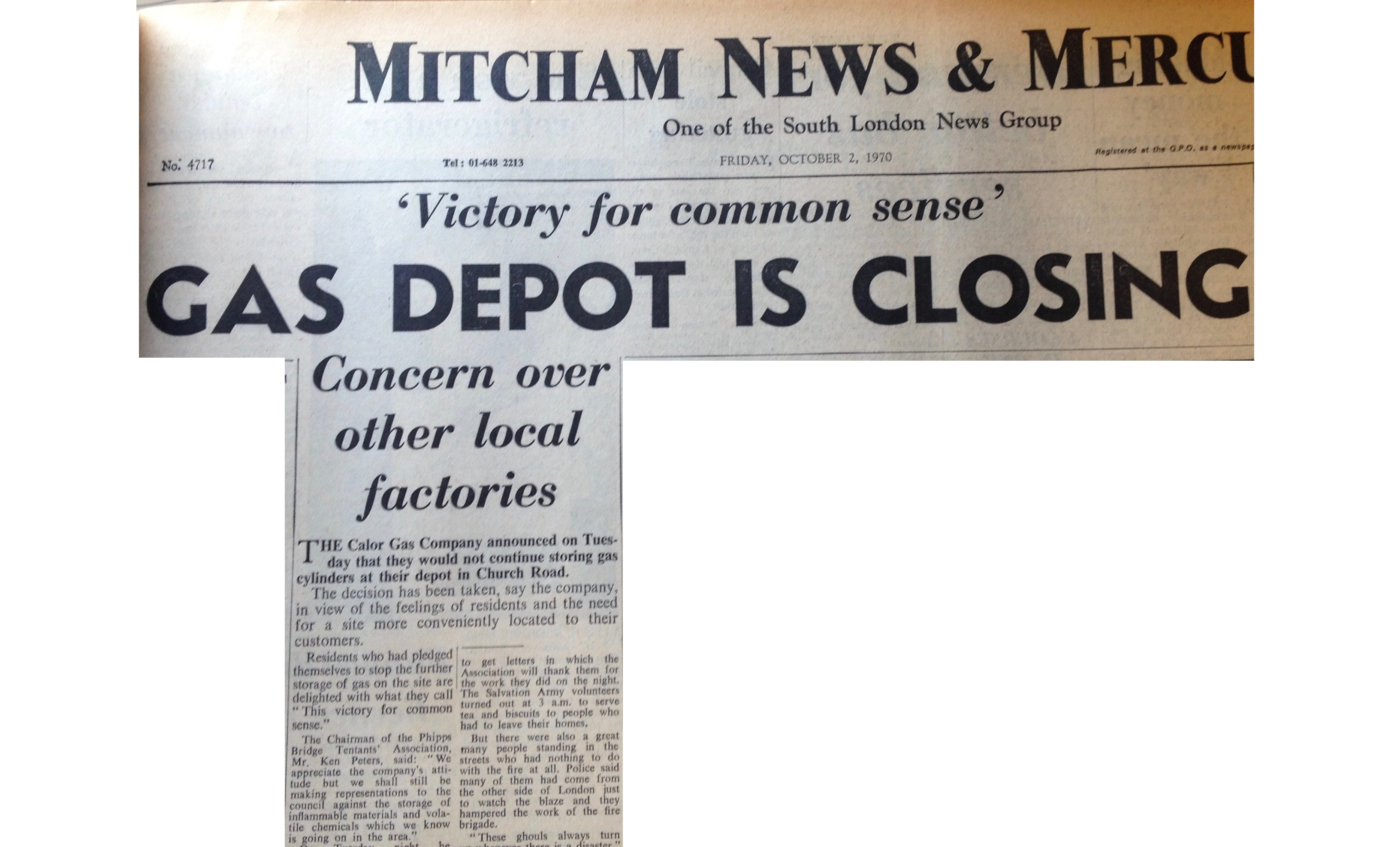
2nd October 1970 issue of the Mitcham News and Mercury, page 1

Mitcham News and Mercury, Friday October 2nd 1970.

Gas Depot is closing.
Victory for common sense.

The Calor Gas company announced on Tuesday that they would not continue storing gas cylinders
at their depot in Church Road.
The decision has been taken, say the company, in view of the feelings of residents and the
need for a site more conveniently located to their customers.
Residents who pledge themselves to stop the further storage of gas on the site are delighted
with what they call this victory for common sense. The chairman of the Phipps Bridge Tennis Association, Mr. Ken Peters, said, We appreciate the company’s attitude, but we should still be making representations
to the council against the storage of inflammable materials and volatile chemicals which we
know is going on in the area. On Tuesday night he addressed the first committee meeting of the new Mitcham Community Association. All the association’s members live near the site of the fire and first met on Sunday morning
outside the new Bath Tavern on the Phipps Bridge Estate. Among the crowd of 200 were several people who claimed they would be prepared to lie down in front of lorries in order to stop more gas containers being brought into the
area. This will no longer be necessary, but there is still an intense feeling of anger at the
council for having allowed firms in the area to use or store inflammable materials.
A map was produced showing a further 15 companies in the area, all of which the association
considered to be possible fire risks. But their main concern was that there should be so many factories in the area in the first place. Mr. Peters explained, The former Mitcham Council designated this
area for residential purposes and their plans included the destruction of the factories
and the building of houses and flats. When the London Borough Merton was formed in 1965, these plans were handed over to the new council together with a surplus on the housing revenue account with which to carry
them out. But what has in fact happened is that the factories are still standing, the Phipps Bridge
Estate was never finished and though they want to build a car parking woman and world
Mitcham has been left high and dry. The association are now to ask for an interview with the Mayor to discuss what will be done to prevent another fire. A great part of their dissatisfaction with the council stems from the fact that they
claim they have been ignored by their councillors. Councillor H.T. Sims, who lives in Baron Grove, said on Wednesday,
I really haven’t had a chance to go and see the people. I suppose I should have done, but I shall be getting in touch with them soon. MPs on the other hand have shown more interest in the disaster.
Mr. Robert Carr and Miss Janet Fuokes have visited the site and spent some time talking
to the people whose homes were damaged. Mr. Carr promised the right to the Home Secretary, expressing their feelings.
The police, the fire brigade and the Salvation Army are also to get letters in which
the association will thank them for the work they did on the night. The Salvation Army volunteers turned out at 3am to serve tea and biscuits to the people who had to leave their homes.
But there are also a great many people standing in the streets who had nothing to do with
the fire at all. Police said that many of them had come from the other side of London just to watch the
blaze and they hampered the work of the fire brigade. These ghouls always turn up whenever there is a disaster, said one policeman. They always seem to be the same kind of people and they are invariably a nuisance.
I rather fancy many of them hope to see bodies being dragged from the fire.
But although no one was hurt at this time, the association are worried about what may
happen on Guy Fawkes night. It only needs someone to throw a firework in the wrong direction for the whole lot to
go up, said one member. It was suggested that maybe a firework display could be staged in Ravensbury Park and Mrs.
L. Oxley, who keeps a shop in Oakwood Avenue and sells fireworks, gave parents a few tips
on safety measures. The best system, she said, is for children to order the fireworks beforehand and then
the parents can collect them on the day. The trouble comes when older boys buy them for their younger brothers.
A full report on the circumstances of the fire was presented to the Town Planning and
Development Committee last night Thursday. In the meantime, the Town Clerk, Mr. Sidney Austin, gave his assurance that the site had been leased by Calor gas on condition that they comply with the most stringent safety
precautions. All of these had been adhered to, he said, and in fact the company even instituted a
few of their own. They know better than anyone else for precautions needed in storing these containers, and this
was their first accident in 35 years. The site will probably now be used for storing some innocuous material.

A video is available on the YouTube channel where thses reports are read and includes colour photos by Eric Montague:

Comments from that video:

I was one of the first crew of 4 from Mitcham fire station on scene, our other engine had been sent to a big fire at Richmond just a few minutes before this call came in, our leading fireman called for more machines twice on the radio before leaving the cab. Myself and another fireman had taken a hose up the side alley to spray the cylinders to cool them, we pulled a wooden pallet to try and protect ourselves as the cylinders exploded, we couldn’t get out !! The driver and leading fireman, dealt with 2 serious house fires on their own. My pal and I eventually managed to get out of the alley and as a canteen wagon had just arrived we went to it, we were knackered, a divisional officer came up to us whilst we were drinking our tea and called us lazy B’s, needless to say my pal told him we were from Mitcham, he apologised and went red. I had only been at the station for a few weeks and in the job for about 4 months but it wasn’t the first ‘big job’ I’d been on in that time at Mitcham. The area had lots of old factories besides this site, there were Pains fireworks, Pye records, A big paint factory and a Victorian workhouse with industry in it plus several more places I can’t remember. This brought back memories, thank you.

My cousin, who worked on the site, helped the firemen to find their way around the place, in the morning we were told that some canisters were found over a quarter of a mile away…

Remember this so well. Living in Mount Road, we wasn’t far from the site. Dad woke me up and told me to go and find out what was going on. Outside lots of people running, not away but towards the fire. So we all watched from the junction with Church Road..

The stupid thing is that the cylinders have an overpressure release valve to prevent explosions. But most of them don’t work.

Growing up in Mitcham in the 1950s And 1960s

The following has been kindly provided by Jeff Brooks, which is his own account of growing up in Mitcham in the 1950s And 1960s.

I was born in The Woodlands Maternity Home in Devonshire Road, Colliers Wood, in July 1952. The Home was opened in 1924 and, in 1938, the staff comprised a Matron, two Sisters, two Staff Nurses and three Pupil Midwives. It closed in 1971 . The site is now occupied by The Woodlands House Care and Nursing Home. Apparently, I was born on a boarded-over bath as the “ birthing “ beds were all in use ! Seven years after the end of World War II, these were often grey and difficult times in Mitcham and the rest of the UK – food rationing did not end until 1954.

Just five months after I was born,” The Great Smog of London “ enveloped Mitcham and many other parts of the metropolis. The “ pea-souper ” lasted from Friday 9th. December until Tuesday 13th. December. Contemporaneous figures estimated the number of people killed as a result of the smog at c. 4,000 but more recent estimates give the number at c. 10,000 – c. 12,000. Many others suffered respiratory problems. I ( understandably ) do not remember this event but was probably coughing in my pram. The Clean Air Act of 1956 introduced measures to reduce air pollution and to increase the use of smokeless fuels but it took a number of years for these to have significant effect.

My family home during the 1950s and 1960s was at 94, London Road, Mitcham, opposite Figges Marsh, between Crusoe Road and Pitcairn Road. The three storeyed Edwardian house ( originally 14, Sibthorp Terrace / Villas before re-numbering in the 1930s ), had been rented by my mother’s family, the McKenzies, for many years. Indeed, my mother had been born in the house in 1920. The top floor and part of the middle floor were always sub-let to a variety of lodgers. I can clearly recall being entrusted to walk to the agents, Leonard, Davey and Hart, at The Fair Green, to pay the monthly rent, holding very tightly on to the old pound and, maybe, ten shilling, notes. A visit to Leonard, Davey and Hart was like stepping back into the Victorian era – dark wood panelling, an oppressive atmosphere and a single clerk in the outer office sitting behind a sturdy wooden desk laden with ledgers. This clerk only had one arm ( I always supposed that the other had been lost in WW II ) and he had difficulty in tearing the rent receipt off at the perforated edge. I wondered whether to offer to help him but was too scared to ask and I left the office as quickly as I could and returned to the twentieth century.

Originally, the terrace of houses covered the whole space between Crusoe and Pitcairn Roads but those at the northern end were destroyed by enemy bombs during World War II and replaced by new housing, as were the houses between Pitcairn Road and Swains Road. A resident of 9, Pitcairn Road, was killed as a result of enemy action on 25th. September 1940. Opposite the McKenzie house, on Figges Marsh, was an air raid shelter which was not demolished until the 1970s.

The house next door to 94, number 96, housed the local doctor’s surgery on the ground floor. The entrance was in Crusoe Road. In the 1910/11 Street Directory the surgery of the house ( then 15, Sibthorpe Terrace and named “ Oakdene “ ) was occupied by Williams Wm. Archelaus, Physician and Surgeon. Doctors that I recall in the 1960s are Dr. Canning and Dr. Stroud. There was no appointment system in those days – it was first come, first served. The long, narrow waiting room had two rows of chairs facing each other. On arrival, a patient took the first chair available. When a bell rang, signifying a doctor’s availability, the patient at the front of the seated queue entered the surgery and everyone else, coughing and spluttering, shuffled along one seat. A perfect environment for the spreading of germs !

My earliest memory is of falling off my tricycle on a path on Figges Marsh when I was, probably, about three years old. I have vague memories of milk and, maybe, bread being delivered by horse-drawn carts. Certainly, Youngs Brewery beer was delivered to The Gorringe Park Arms pub just a couple of hundred yards away at Tooting Junction by dray horses at the time. Most daily beer deliveries by horse stopped in 1997, although pubs in and around Wandsworth continued to be served by horse-drawn carts until the Brewery closed in 2006. As I was growing up, I often wondered why Tooting Junction was so-called as it was not a railway junction. Some years later, I learnt that it was once a junction with a separate line to Wimbledon via Merton Abbey Station in addition to the line via Haydons Road. The station was renamed as Tooting in 1934 but the term , “ the Junction “, remained in use by the local community.

Shopping was “ up the Junction “, some shops on the Mitcham side of the border ( which runs along the course of the River Graveney ) and some on the Tooting side. The first supermarket in the vicinity was Victor Value, in Mitcham Road, Tooting which opened in the late 1950s. Victor Value stores were predominantly based in C2 ( skilled working class) and D ( working class ) categories of the demographic classification used in the UK. The company sold its outlets to Tesco in 1968. Much of our family’s shopping was undertaken in Genery’s Store in Grenfell Road, Mitcham – my parents’ first home, after their marriage in 1940, was in the first floor flat above the shop. As a youngster I was allowed by Rose Genery to operate, under supervision, the ham slicing machine behind the counter. Little reference to Health and Safety ! Rose also allowed me to take a biscuit, usually a Bourbon, from the sack of mixed biscuits on the floor.

In line with the majority of the adult population at the time, both of my parents were smokers. I was regularly sent to Ward’s on the corner of London Road and Arnold Road ( later managed by the unforgettably named Harry Bender ) or Baker’s on London Road near to the turning for Finborough Road for 20 Kensitas cigarettes ( and a couple of packets of Trebor Mints ) for my mother and a half an ounce of Old Holborn and a packet of Rizla papers for my father. No age restrictions then on purchases. Maybe, if I had been good, I could also purchase a bar of Crunchie or Fry’s Five Boys chocolate for me.

My father, Ray, was a Vitreous Enameller, working in the Stewart and Gray factory in Swains Road (sometimes known as Lane) . He worked long shifts ( 6.00 am – 6.00pm ) and , sometimes, night shifts ( 6.00pm – 6.00 am ). An early memory of mine is of rushing down to the factory on my Mobil scooter to meet him from a day shift and being allowed to stamp his card, 6.01 pm, in the clocking in/out machine. At weekends he was able to take me around the site, showing me the furnaces, the wind tunnel, the Paint Shop and the Frit Shop ( frit is a mixture of fused materials, such as silica, used in enamel making ). I was also able to watch him lean over a huge vat of acid ( don’t know what acid it was ! ) and lower a string bag of dirty old pennies in and see them emerge shining bright and golden. Magic! I don’t recall a lot of Health and Safety in operation at the time! Stewart and Gray relocated to Wellingborough in Northamptonshire in the late 1960s.

As with most women at the time, my mother, Dorothy, did not work during the 1950s and early 1960s , apart from a few hours on a Saturday afternoon in the tea bar at the local amateur football club, Tooting and Mitcham United in Sandy Lane. I believe that for each shift at the ground (probably 1.15pm- 4.15pm ) she was paid 7/6d. ( 37 1/2p ), which she considered to be her “ pin money “. I fondly remember, especially on cold afternoons, going in to the tea bar, with my good friend, Richard, to get a crafty free hot blackcurrant juice and, if lucky, a couple of Rich Tea or Ginger Nut biscuits. Later in the 1960s, my mother worked part-time in Pascall’s Sweet Factory and the Royal Arsenal Co-operative Society’s bakery, both factories in Streatham Road, and J F Renshaw and Co. Ltd., in Locks Lane. Fond memories of misshapen sweets from Pascall’s, hot bread from the RACS bakery and macaroons and, sometimes, petit fours from Renshaws. I also had a spell, as a “ Saturday boy “, cleaning the floors and ovens, in the RACS bakery in 1967/68. I recall that my first wage packet for an 8-hour day ( 8.00am – 4.00pm ) was 29/6d. ( £1-47 ½ p ) and being affronted to learn that I had to pay a few pence in National Insurance contributions. My wages were collected from the Pay Office where, just a few years earlier, in 1962, an RACS employee had been shot and killed in an armed robbery ( George Thatcher was convicted of murder and sentenced to hang but this was commuted to life imprisonment and he served 18 years in prison ). None of the factories where my mother and I worked survived to the present day.

My mother’s Saturday afternoons at Sandy Lane engendered in me a life-long passion for the football club and I spent many hours on the terraces during the 1960s. I was considered to be too young to attend the big FA Cup matches of the 1958/59 season ( Pathe News highlights of the win against Bournemouth and Boscombe Athletic and the draw against First Division Nottingham Forest are available on YouTube), but my older brother, Graham, was there and my mother was in the tea bar serving the thousands ( 14,300 for the Forest game ) of spectators. The club was formed by the amalgamation in 1932 of Tooting Town FC (founded in 1887) and Mitcham Wanderers FC (founded in 1912). The ground had previously been part of a market garden and Tooting Town FC acquired some onions on purchase – these were dug up and sold for 7/6d, (37 1/2p ) – it has been recorded that this item was recorded on the 1922/23 Club balance sheet as the first contribution to the Ground Improvement Fund ! As the merged club’s ground had previously been occupied by Tooting Town the new united name had “ Tooting “ preceding “Mitcham” despite being located in Mitcham and M preceding T in the alphabet ! The, previously mentioned, Harry Bender displayed posters of the club’s forthcoming matches in his shop and, not being a follower of football, generously gave the season ticket he received for the advertisement to me ! The club relocated from Sandy Lane to Bishopsford Road in 2002 and four of the streets on the housing development built on the old site were named after famous Tooting and Mitcham United players – Hasty Close, Slade Way, Pearson Way and Stepney Close. The move saw the club formally leave Mitcham, as the new location is just over the border (along the course of the River Wandle) into Morden. I have written two books about the club – “Tooting On the Move – A Farewell to Sandy Lane, Home of Tooting and Mitcham United FC from 1922 – 2002” ( published in 2002 , currently out of print ), and “ We Woz Robbed In ‘59 – A Record of Tooting and Mitcham United FC’s Epic 1958/59 Season, set to a background of social events of the time “ ( published in 2018 , still available, cover price £10-00 – contact me on brooksjeff18@aol.com for details ).

My education began at Bond Road School in 1957 – no nursery or pre-school for me. The Primary School Head Teacher was the memorably named Miss Crang. Her counterpart in the Junior School was Mr. Shelton, who would “ slipper “ ( one step down from a caning ) children, including me on occasions, for misdemeanours. Other teachers I recall were Miss Clarke, Mrs. Singer and Mr. Ebenezer ( known as “ the bald-headed geezer “ ). Although The Clean Air Act was on the statute book , I can recall walking home along London Road in thick, unpleasant smogs, feeling my way along the fences of houses to ensure that I did not stray into the road ( the last London smog took place in December 1962 ) and being instructed by my mother to close the front door quickly to keep the smelly, yellow wisps of smog out of the house. Even so, some always seemed to penetrate into the hallway. Walks home were usually more pleasant, especially in the Summer months, with the floral displays at Tamworth Farm Recreation Ground ( more commonly known as just “The Rec. “ ). As I walked past Monarch Parade I tried, with little success, to envisage The Holborn Industrial Schools which had been built on the site in 1856 as part of the Mitcham Workhouse complex and which my mother remembered and had described to me. The buildings were demolished in the early 1930s. Opposite the Schools was St. George’s Pond – this must have been drained at about the same time as the Schools were demolished. On this site, Mitcham Public Library was built and opened in May 1933. I have special memories of the separate Children’s Library on the Armfield Crescent side of the Library, where my passionate and life-long love of books and literature began.

One day in 1961, Routemaster buses were being introduced on the 220 route through Mitcham to West Croydon ( they had been used on other routes in London since 1956). This was an exciting event and I waited to get one, letting plenty of “ ordinary “ buses pass. I arrived at school late and was, I am sure, suitably reprimanded. The 220 diesel bus had replaced the 630 trolleybus in July 1960. Other buses I could get along London Road were the 44, the 64, the 77, the 80 and the 88. If I chose to walk home, I could use my bus fare in Mayhew’s, near the London Road entrance/exit to Bond Road School, and choose a liquorice sweet from the “ penny tray “.

One of my proudest memories of Bond Road School is of being selected for the 1962/63 school football team. I recall being taken to Tring’s Sports Shop in Monarch Parade to be measured up for the kit – white shirts, black shorts. I am sure that a team photograph was taken but, alas, I do not have a copy. Matches against local schools were played on midweek afternoons and I was always pleased when my class’s lesson was interrupted for the names of the boys ( sadly, no girls’ teams in those days ) who were playing to be called out. The first halves of matches were played in front of few spectators ( maybe some Mums and Dads ) but, by the time the second half commenced, the school day had ended and the touchlines were packed with noisy children, lustily chanting “ 2-4-6-8, Who do we appreciate ? , B-O-N-D, Bond ! “. I still have my hand-written record of matches played that season – victories versus The Star School, St. Peter’s and St. Paul’s, Links Road, St. Mark’s and a draw and a loss to Fortescue Road. It is likely that the number of matches played was lower than most seasons due to “ The Great Freeze” of 1963 ( ice and snow in London from 26th December 1962 until 6th March 1963 ). In the Mitcham Schools Cup competition, Bond Road lost to Pollard’s Hill – this was a big disappointment to me as the Final was always played at the Sandy Lane ground of Tooting and Mitcham United FC with its large grandstand and banks of concrete terracing. My regret must have been somewhat assuaged as the Borough’s Annual Sports Day was also held at the ground and I do recall running in a race there. I must have done OK at Bond Road School as I passed the 11-Plus examination in 1963 and moved to Mitcham County Grammar School for Boys on Commonside East.

I enjoyed my time at the Grammar School, despite having to wear short trousers for the first term and a cap until the age of 16 ! In retrospect, it seemed to operate more like a public ( ie. private ! ) school than a state school. There was a big emphasis on academic achievement, discipline and hierarchy. Teachers were known as Masters, often wearing gowns, and fellow pupils addressed by surname only. In addition to Masters, discipline was enforced by Prefects and by Senior Prefects who, like Masters, were also entitled to wear gowns ( I made it to Prefect status, with gold braid around the edges of my blazer, but never attained the Senior level ). Hair length and adherence to the uniform policy were strictly monitored. Nicknames were prevalent – Masters such as “ Boggy “ Marsh, “ Hum “ Harper, “ Slag “ Dixon, “ Taffy “ Greenall, “ Spike “ Richards and “ Scruff “ Purbrick as well as the Headmaster, “Crippen” ( after the notorious murderer ) Bingham. Mr. Boagey needed no nickname. All the teachers were male and addressed as “ Sir “ – until Frau Schmidt arrived to teach German ! I clearly remember “ Crippen “ ordering me to get my hair cut when it was just touching my collar and, obediently, going to the barbers’ straight after school.

I represented the school at Athletics and Tennis but the real accolade was to be picked for the Rugby Team and I was proud to be selected and to wear the green and lavender hooped shirts. Sadly for me, football was not formally played at the school but every break-time saw a tennis ball being kicked around in the playground and every lunchtime saw a few informal, and fiercely contested, kick-abouts on Mitcham Common near The Three Kings’ Piece. However, there was one football match which took place near The Mill House on the Common in March 1969 – Staff v School ! I was selected for the School team. A report was included in the 1969 edition of the Yearbook, “ The Mitchamian “, written by teacher, “ Syd “ Perks ( “Syd “ was more like “ one of the boys “ than a Master ). The report details a 2-1 victory for the Staff under the headline “ Staff Pulverise School “. Apparently, “ at the final whistle three cheers were given by the dejected school team for the winners “ but I don’t remember this ! One sporting activity I didn’t enjoy was cross-country running on the Common. The agony was often slightly ameliorated by surreptitious calls at a friend’s house on Commonside East for a quick and refreshing lemonade or orange juice ! And, at least, the final stretch was downhill along the Beehive Bridge.

Our rugby matches were played on the Playing Fields in London Road, near (then) Mitcham Station and (now) Mitcham Tram Stop, behind Baron, Fenning and Gedge Courts. This was a fair walk from Commonside East, down Cold Blows, past the Cricket Green and along London Road. At the time, the school also used the facilities now occupied by The Toby Carvery at Park Place, Commonside West for athletics, cricket and tennis. This was still known as “The News of The World Sports Ground”, which had been built in 1924, but vacated by the newspaper group in the early 1960s. A common sight at school rugby matches was the Headmaster, C R Bingham, driving his blue Rover across the grass at the Playing Fields and parking right by the pitch where the First XV were playing. In 1968 Mr. Bingham was replaced as Headmaster by Mr. B F Atherton. This heralded a more liberal regime. Hair became longer and some boys even sported beards ( sadly, I was still at the “ bum fluff “ stage ).

As my friends and I grew into our teenage years and we got a bit bolder, we began to socialise in the Mitcham area. Initially, some tentative forays inside Leo’s Milk Bar on London Road near The Cricket Green and, then, The Three Kings’ pub or, more regularly, The King’s Head ( more commonly known as The Burn Bullock ) pub by The Cricket Green where pints of Double Diamond were bravely supped. In the upstairs bar on a Friday evening, “Aunty Marjorie” ( a friend of my mother’s family and not a real aunt to any of us ) would belt out tunes on the “ old Joanna “ accompanied by the Grammar School boys ! There were also trips to “ the pictures “ ( first girlfriend time ), mostly to the Tooting Granada – there were four other cinemas in Tooting ( the Astoria, the Classic, the Mayfair and the Vogue ), or the Majestic at The Fair Green in Mitcham . Live music in the area at the time was rare , although The Granada had hosted many famous singers and bands in the 1950s and the early 1960s – Frank Sinatra ( his UK debut ), Johnny Ray, The Andrews Sisters, Pat Boone, Guy Mitchell, Cliff Richard and The Drifters (pre-Shadows days ), The Beatles, The Rolling Stones, Jerry Lee Lewis, Buddy Holly and The Crickets, Gene Vincent (his UK debut), Dusty Springfield, James Brown, Roy Orbison, The Kinks, The Who, The Jimi Hendrix Experience and many more. The last concert at the historic venue was given by The Bee Gees in April 1968. Jerry Lee Lewis also ventured into Mitcham headlining two shows at The Majestic on 14th. May 1962, supported by Johnny Kidd and The Pirates, The Viscounts, Vince Eager, The Echoes, Mark Eden, Danny Storm and Buddy Britten. My cousin, Barbara, was at The Beatles show at The Granada in 1963 but my first taste of live music was a trip to The Royal Albert Hall in 1969 to see Simon and Garfunkel.

We also made occasional forays to the Top Rank Suite in Croydon and The Bali Hai Discotheque in the Streatham Ice Rink in a ( largely vain ) attempt to meet girls. Slightly more successful were Monday Ballroom Dancing nights at the, more sedate but exotically named , Palais de Danse in London Road near Mitcham Station. Ballroom dancing even though this was, supposedly, “ The Swinging Sixties “ ! I regularly attended the St. Mark’s Youth Club in St. Mark’s Road for table tennis etc., followed by “ six of chips “ , ( 6d., 2 ½ p ), worth of chips, with a bit of “ crackling “, from Hutton’s Fish and Chip Shop at The Fair Green.
I left the Grammar School in July 1969 after completing my “ A “ Levels. This was also the end for the School ( established in 1922 ) as it then merged with Eastfields School on Grove Road, Mitcham on the old Mizen’s Nursery site, next to Pain’s Firework Factory ( which had relocated to Salisbury in 1966 ). The site in Commonside East was occupied by the St. Thomas of Canterbury Roman Catholic Primary School. Famous Old Boys of the Grammar School include the athlete Brian Hewson, who won the gold medal in the 1500 metres at the European Championship in Stockholm in 1958 and represented Great Britain in the 1956 and 1960 Olympic Games and Alan Simpson ( who, sadly, died in 2017 ) of scriptwriting fame with Ray Galton ( “ Hancock “ and “ Steptoe and Son “ ). In 2012, I proposed to the Comedy Society of Great Britain that a plaque be erected at the site where Alan and Ray met in 1948 – the Milford Sanatorium, near Godalming, in Surrey, where they were both recovering from tuberculosis. The blue plaque was unveiled by Paul Merton, with Alan and Ray in attendance, on 1st. July 2013.

So, the decade of the 1960s came to an end – a much different world and a much different Mitcham from the start of the 1950s decade. World events during this period included the on-going Cold War and the proliferation of nuclear weapons, the Cuban Missile Crisis, the wars in Korea and Vietnam, the assassination of J F Kennedy, the discovery of DNA, the launch into space of the Soviet satellite Sputnik and Neil Armstrong’s first steps on the Moon. In Europe, the Treaty of Rome was signed in 1956 ( without UK participation ), forming The Common Market.

In the UK, 1951 saw The Festival of Britain on London’s South Bank as well as the defection of the Communist spies, Guy Burgess and Donald McLean, to the Soviet Union. In 1956 the repercussions of the Suez Crisis, and its links to the themes of imperialism and decolonisation, were a big topic of debate . Race riots took place in London’s Notting Hill and in Nottingham in 1958. The 1960s was a period of much liberalism – the relaxation of censorship laws (after the unsuccessful trial of D H Lawrence’s book, “Lady Chatterley’s Lover “, for obscenity ), the repeal of the death penalty and the decriminalisation of homosexual acts between consenting adults. There were many societal changes in the fields of youth culture ( eg Teddy Boys ), fashion, music, class, consumerism, employment, industrial relations, immigration, race relations etc. The Profumo Affair in 1963 encapsulated many of the changes and another Communist spy, Kim Philby, defected to the Soviet Union that year. And, of course, England won the World Cup in 1966 ! In politics, the 1950s started with a Labour Government, under the leadership of Clement Attlee, and the end of the 1960s also saw a Labour Government in power, under the leadership of Harold Wilson. In the intervening years, the country had seen 13 years of Conservative government, under the leadership of Winston Churchill, Anthony Eden, Harold MacMillan and Alec Douglas Home.

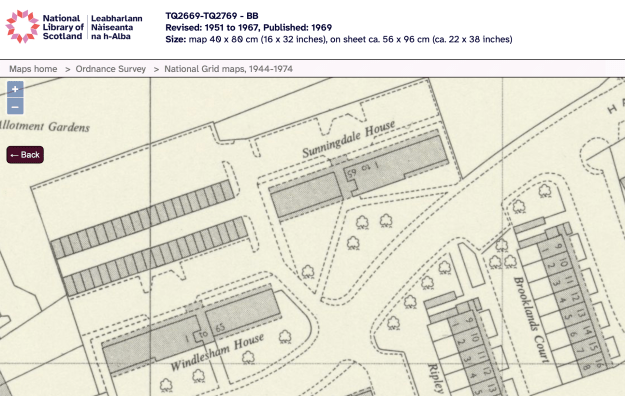
And Mitcham saw changes too. Its status changed from being a Municipal Borough of North East Surrey to being a constituent part of The London Borough of Merton in 1965, a result of the Local Government Act of 1963. Many old buildings were demolished, often being replaced by new housing developments, such as the Phipps Bridge Estate. The gas works in Western Road closed in 1960. The Majestic Cinema on the corner of St. Mark’s Road had shown its last films, “ Pit of Darkness “ starring William Franklyn and “ What A Whopper “ starring Adam Faith, in November 1961. The building then housed the Alpha Bingo Club. And the seemingly interminable debate about the traffic at the Fair Green continued !

Jeff Brooks
January 2022