This biography has been kindly provided by a descendant of William Slater.
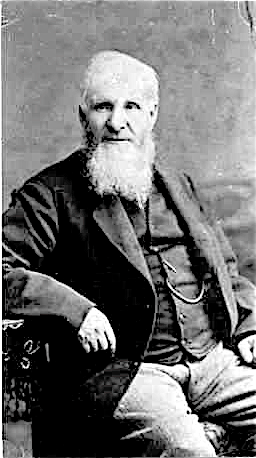
born 1832 – died 1894
WILLIAM HENRY SLATER, the eldest son of Daniel and Elizabeth Slater was born 1832 in Mitcham, Surrey, England.
William’s father, Daniel Slater was described as ‘being from’ Blackfriars, London, and his mother was ‘from Mitcham’, Surrey. William’s father Daniel married Elizabeth Betsy Summers in 1831.
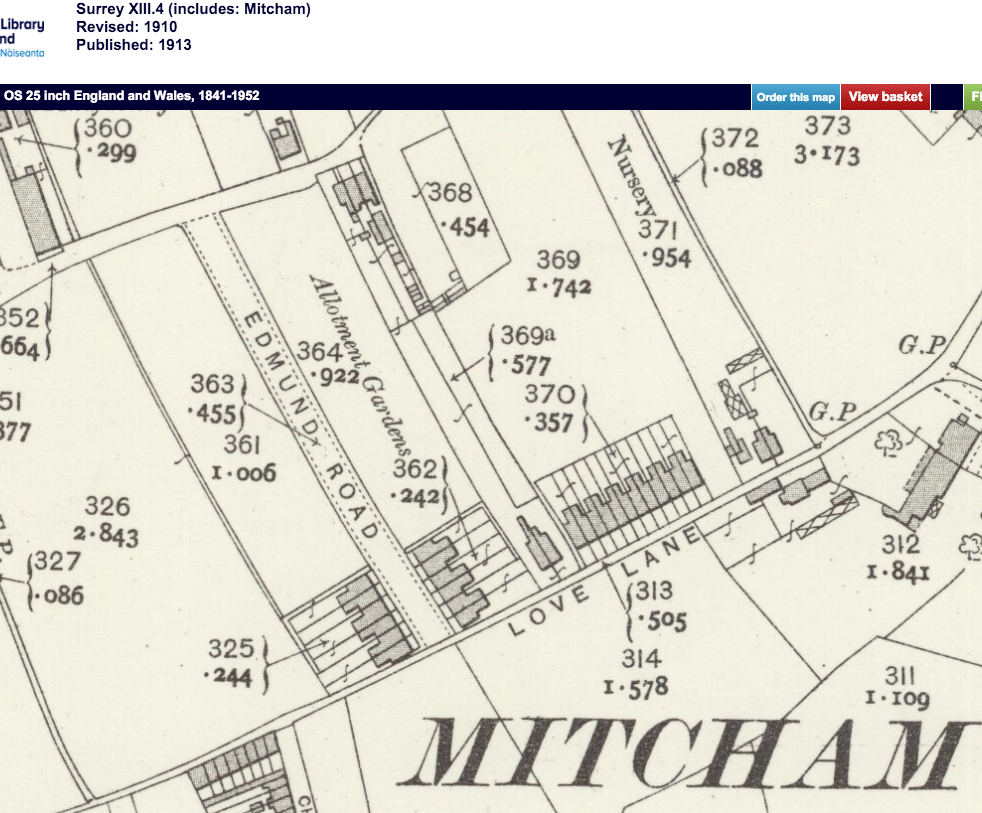
The 1846 English Tithe Commutation Survey showed that William’s father, Daniel Slater rented two plots of land, totalling approximately one acre. One of his plots of land was in Love Lane, Mitcham, Surrey where he had a cottage and raised his large family.
Thirteen of the children have been identified but it is assumed that there were many more children who probably did not survive childhood.
The 1851 English Census for Mitcham, Surrey, recorded that both Daniel and his eighteen year old son William were gardeners. ‘Gardener’ was the general term used for growers of physic herbs, either as smallholders, or workers on major herb farms. William and his younger brother Benjamin both worked for James Moore, of Potter and Moore – the best known of all of Mitcham’s herb growers. It was here that William learnt his craft.
In the August of 1857 William married Harriet Bewsey. He was 25. The following year on 18 April 1858 William and Harriet had a daughter also called Harriet. But by September of the same year William had emigrated from England to Australia arriving in December of 1858 on the Roxburgh Castle.
William’s wife Harriet committed suicide in 1859 a year after the daughter was born. An inquest was held, and the newspaper report at the time can be read here. The daughter, Harriet Elizabeth Slater is recorded on the 1861 census at the age of 3 living with her grandparents Daniel & Elizabeth Slater.
At around the age of 26 William made the decision to leave England and he left Plymouth, England in the September of 1858 aboard the Roxburgh Castle arriving in Melbourne in the December of the same year.
‘The Times’ of 28 Feb. 1853 reported the arrival off Portland of the ‘Roxburgh Castle’, on Saturday 26 Feb., ‘with 70 passengers and a large freight of gold’ from her maiden voyage to Port Phillip, Melbourne, Australia. Unfortunately, many years later the Roxburgh Castle was lost on the Goodwin Sands (ran aground) on 5 January 1872 on her way out to Melbourne.
William spent some years in the gold fields before returning to Melbourne to settle at Air Hill as it was then known and he was instrumental in changing the name of Air Hill to Mitcham, its present name. The then heavily timbered land on the south bank of the Koonung Creek, a few miles out of Melbourne was chosen to set up his physic garden and the access to this land was by two dirt tracks, now known as Surrey and Springfield Roads.
He became one of the founding fathers of the township of Mitcham, now a suburb in the City of Whitehorse. With pride (or a sense of humour!) here he built a single story house with a corrugated iron roof which he named ‘Mitcham Grove’ – inspired no doubt by the memory of banker Henry Hoare’s grand house on the banks of the River Wandle back home in Mitcham, Surrey.
A colour painting of Mitcham Grove can be found on the Merton Memories website.
Daniel (William’s brother) arrived in Melbourne in 1875 but with his early demise at the age of 27 in 1876 and also that of son William Slater Jnr. at the age of 31 in 1897, there was no one to take on the business when William retired two years before his death in 1894.
William’s second and third children were born in Australia before his second marriage. Elizabeth Rose Slater was born in 1859 but only lived 4 weeks. Mary was born in 1861. In 1864, at the age of 32 William married Mary Ann Cresswell. The delay in his second marriage could have been due to many reasons, he may have been away working in the gold fields or indeed the news of Harriet’s death in 1859 may have taken some time to reach him. After the birth of his first daughter Harriet born 1858 in Mitcham, Surrey and the two daughters mentioned above, William had 2 other children, William Henry in 1866 and Elizabeth Rockcliffe in 1869.
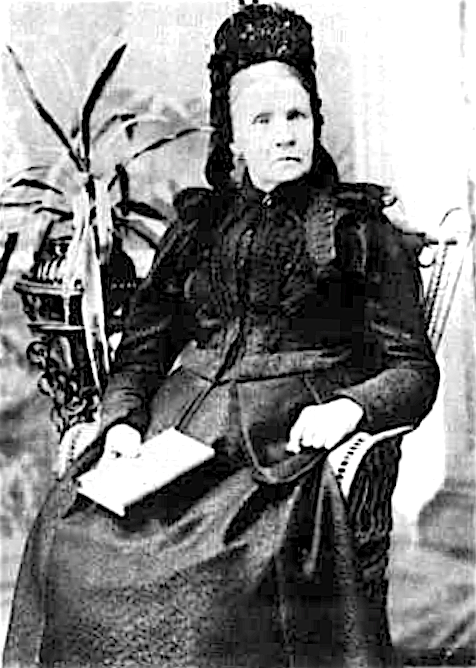
Mary Ann Slater nee Cresswell
About 1862 William Slater began growing medicinal herbs. His first peppermint and lavender root stocks were obtained from England. With the help of a £25 Government Grant for establishing a new industry, he soon had nine acres of peppermint and one acre of lavender under cultivation. The venture became a financial success and in 1865 he exhibited a collection of essential oils in Dublin for which he gained a medal and a certificate. In 1866 he received a medal in Melbourne and another in Paris in 1867. Also, in 1866 at the Melbourne Exhibition he exhibited a sample of opium, which, after analysis, was considered equal to anything produced elsewhere. At the Melbourne Centennial International Exhibition of 1888 he gained a ‘First’ for his essential oils because his lavender oil was considered to be ‘inferior only to the Mitcham (England) oil and superior to the French oil.’ His peppermint oil was equally successful.
As a practical distiller of oils he joined Mr Bosisto, a chemist of Richmond in the production of eucalyptus oil. Later William started his own distilling business and produced ‘Eucalyptus Amygdalina Oil’, better known as ‘Possum Brand’. (AMYGDALE, pronounced amidal, is French for tonsil.) Its successful use at the Melbourne Hospital for medical purposes led to it being regularly exported to London until his death in 1894. A more recent family story related that some oil was also sent to the USA, for the manufacture of paint.
The evidence William gave to the 1890 Royal Commission on Vegetable Products, Perfume Plants and Essential Oils was detailed and valuable and with that unselfishness which was characteristic of him, said “I believe there would be room for a dozen people to start the same line, and more than that.” As the orchard continued to expand it was often used for University Field Days. ‘The Slaters’ welcomed all visitors to ‘Mitcham Grove’, but William gave a special welcome to the young students from the College for whom he would ‘unfold his vast store of practical knowledge, both in the fields amongst his herbs, and in the laboratory among his preparations.’ These field days were continued by William’s descendants until the orchard was subdivided for building blocks, in the early to mid-twentieth century.
Unfortunately herbs grown for medicinal purposes were unprofitable due to local prejudice and a preference for German herbs. As a result William planted fruit trees which became even more profitable when he began to dry the fruit for the markets. His great Grandson, Harry Pearce, who in 1924 owned the orchard, planted cherry trees and it was this fruit that was sold to MacRobertson’s chocolate factory to manufacture ‘Cherry Ripe’ chocolate bars.
William Henry retired two years before his death at his home in Barnes Road, Blackburn on 23 May 1894 aged 62 years after being ill for six months. The cause of his death was stomach cancer. Mary Ann, his wife, died 12 August 1912, aged 83 years (as inscribed on the tombstone) but later evidence revealed that she was in her 81st year
The obituary written for the Australian Journal of Pharmacy, June 1894, pgs 272-3, describe Mr Slater as being a retiring contented and happy man with a homely disposition who loved his work. It also stated ‘although he never craved for wealth or fame in the pursuit of his business, he still acquired a reputation in his own particular line, and at the same time gained modest competency.’
William Slater’s Herb List:
Southernwood poor beards Rue croup, sciatica Insects comfrey sprains and bruises Hyssop debility, rheumatism Danzie worms, fevers, lumbago Mullein throats, lungs, catarrh Chamomile tonic the system, cramps, the hair Wormwood stomachs upsets, nerves Lavender faintness, nerves, headaches Horehound chests, asthma tonic Elder skin sores, boils etc. Feverfew insect bites Lemon balm aches of teeth, eyes, heart Spearmint giddiness, weak stomachs Sage sore throats, liver, kidneys Strawberry leaves eczema, blood disorders Mint indigestion, palpitations, headaches
 Mitcham History Notes