Draper who, in 1910, was at no. 2 and 4 High street, Mitcham.
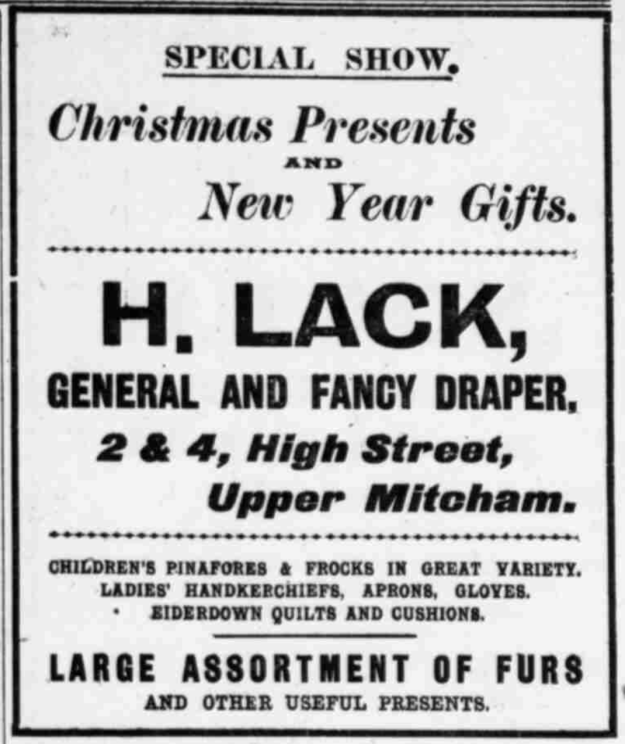
Mitcham Advertiser – Friday 16 December 1910
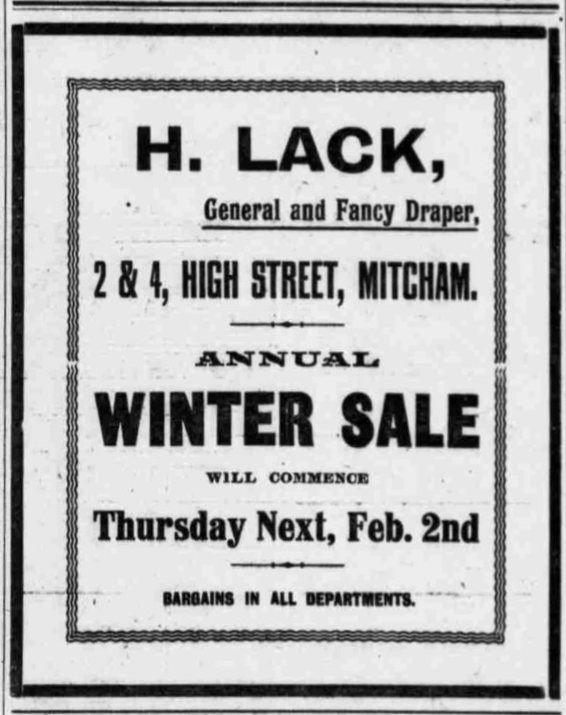
27th January 1911, Mitcham Advertiser
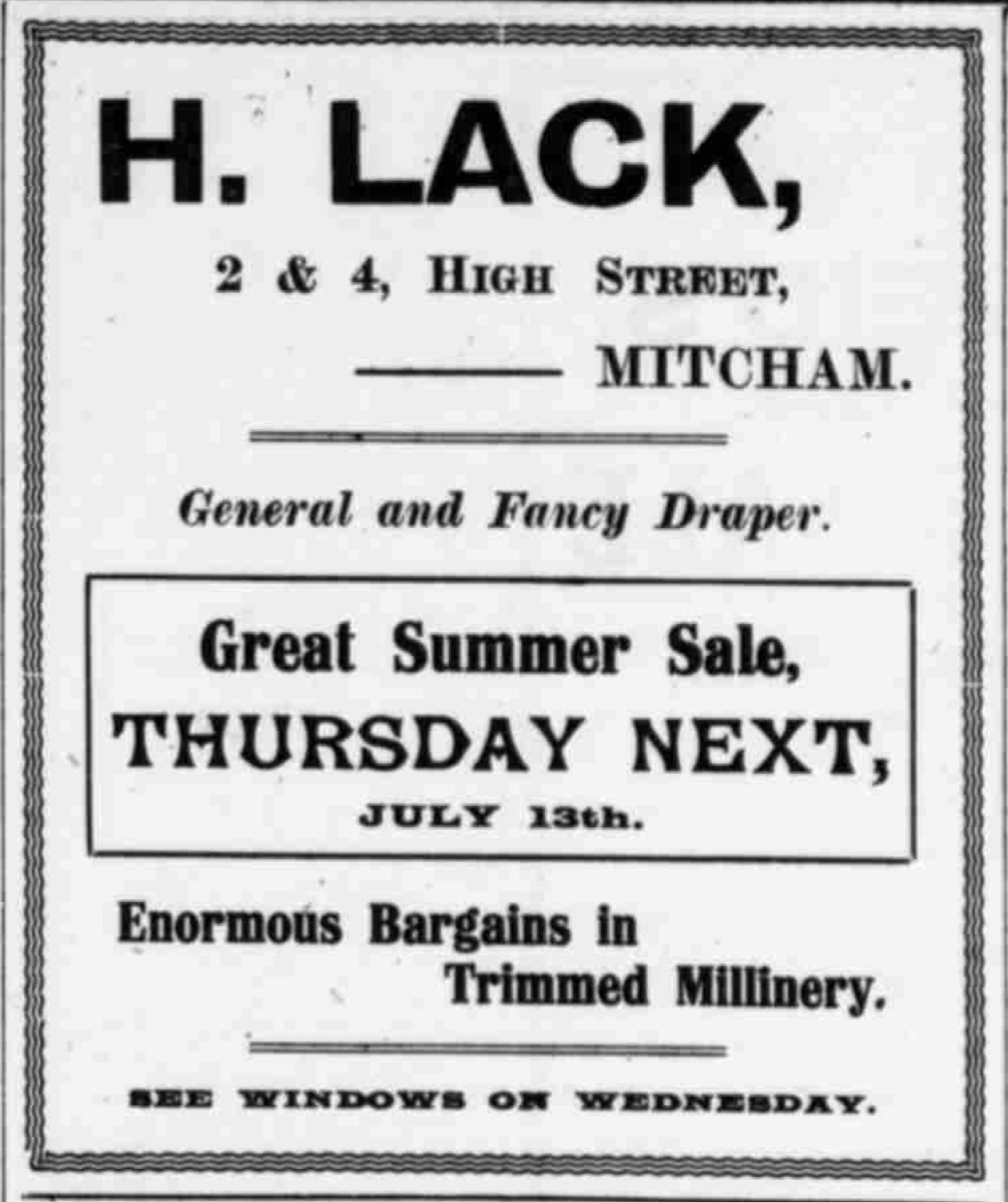
Mitcham Advertiser – Friday 07 July 1911
This shop was next to the King’s Arms pub, as shown in the 1912 street directory, which lists entries going south.
… here is Sibthorp Road
George Joseph DALE, newsagent
William BARTER, grocer
STANSFELD & Co. Ltd., brewers and wine merchants
Walter MARTIN, butcher
John CUMMINGS, greengrocer
Mrs H. LACK, draper
The King’s Arms P.H., H. & E.F. MOORE
See also the comments below by a descendant of the family and the entry on Wikipedia Lack Brothers
This postcard from the early 1900s shows shops with awnings, the nearest to the Kings Arms is likely to be the draper shop of Mrs Lack.
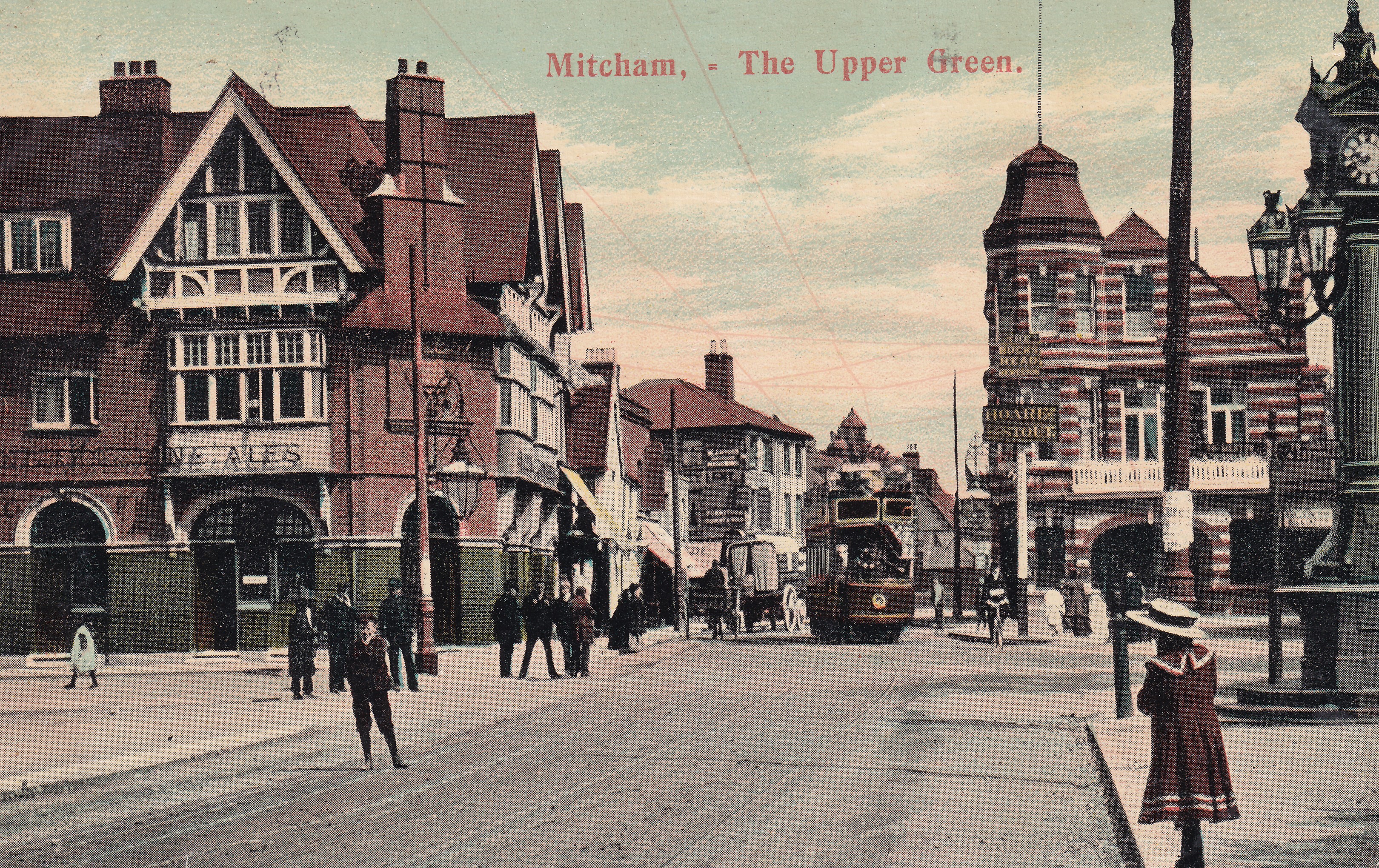
Postmarked 28th Feb 1907
Mitcham Advertiser – Friday 27 April 1917
A “SPECIAL’S” WEDDING. SERGT. C. LACK AND MISS E. M. RICHENS MARRIED.
Great interest was taken in the wedding at St. Mark’s Church, Mitcham, on Wednesday, of Mr. Charles Lack, younger son of – Mrs. H. Lack, High-street, and of the late Mr. G. A. Lack, and Miss Emily May Richens, elder daughter of Mrs. F. Richens, Newton House, and of the late Mr. John Richens of Tooley-street. The church was filled with spectators.
Mr. Lack was born in Mitcham, is one of the most successful business men in the town, and his social qualities have won him the esteem of all classes. For ten years he has been hon. treasurer of the Tooting, Balham, Merton, and Mitcham Horticultural Society; for 15 years he was a member of the choir of St. Mark’s, and he is now a sidesman; he is hon. secretary of the East Ward Naval and Military Pensions Committee; and since the war began he has been a zealous member of the Mitcham Special Constabulary, of which he is now a sergeant. On several occasions Mr. Lack has been pressed to try tor Municipal honours, but declined, The bride’s family have been domiciled in Mitcham for 30 years, and has always held a high position in the esteem of the inhabitants, and the bride herself has won the particular regard of the people of St. Mark’s, in which parish she has been a constant worker. She has also taken a great and active interest in the military hospital.
Among the congregation were Coun. E. J Mizen (People’s Warden), Coun, Ernest Mizen, Mr Taylor, a former Warden, Mrs. Edward and Mrs. Ernest Mizen, Miss E. Mizen, and Mrs. C. Rutter. Thirty members of the Special Constabulary in uniform formed a guard of honour, and in the church lined the central aisle on both sides. The sergeants present were Sergts, Dale, Cooper, Freeman, Rutter, Billington and McCaul. At the door was the veteran Special Constable Merrick, glowing with Army medals. The service was fully choral, and was conducted by the Rev. James Bevan, of All Saints’, Beddington Corner, a former curate of St. Mark’s, assisted by the Rev. W. K. Roberts, Vicar of St. Mark’s and the Rev. E. J. Baker, Vicar of St. Barnabas. The organist was Mr, J. Hopton. A brief address was delivered at the close of the service by the Rev. James Bevan, and the Rev, W. K. Roberts gave the benediction. Afterwards all joined in singing a verse of the National Anthem. The bride was escorted to the altar by Mr. Tom Richens, her eldest brother, and she was given away by her mother. She was beautifully attired in grey crepe de Chine, trimmed with amethyst bead em- broidery. She wore a grey silk hat, and carried a shower bouquet of liIies and orchids. Her going away dress was a Russian blue coat and skirt, with black and gold hat. There were no bridesmaids.
The Best man was Capt. S. James, King’s Royal Rifles, From the porch to St. Mark’s-road the “Specials” were drawn up in a double line, and when the bride and bridegroom appeared at the church steps they formed an arcade of their truncheons. The Culvers, Carshalton, was lent by Mr and Mrs George Mizen for the reception. Mrs. Richens acted as hostess to about fifty guests, Later in the afternoon Mr. and Mrs. Lack left for Cornwall. On returning to Mitcham they will reside at Home Close, St. Mark’s-road. One of the handsomest of the many beautiful wedding gifts was a canteen of cutlery from the Special Constabulary. From the Horticultural Society was received a beautiful silver rose bowl. Another gift of special interest was a handsome brass and copper paper stand presented by the lady assistants at the High-street establishment.
Note that Home Close, is number 26 St Marks Road, the current home of the Royal British Legion, on the corner with Chalkley Close.
Mitcham Advertiser – Thursday 29 July 1926
DEATH OF MRS. HANNAH LACK.
In Business in Mitcham Fifty Years.A link with the old village of Mitcham was severed this week by the death of Mrs. Hannah Lack, who was in business as a draper in London-road for fifty years.
She passed away in her 82nd year on Thursday, July 22nd, at The Culvers, Carshalton, the residence of her son-in-law and daughter, Mr. and Mrs. George Mizen.
No Mitcham resident was held in greater esteem than Mrs. Lack. She came to the village, as it then was, 67 years ago and lived in the same house and conducted the same business in the High-street section of London-road, near the Fair Green, until she retired during the war. She was the widow of Mr. George Albert Lack, who died in 1878.
Mrs. Lack was a fine business woman and during her regime the shop flourished exceedingly. In later years she was assisted by her son, Mr. Charles Lack, who took over the business entirely when his mother retired. To the great regret of all the older residents the business ceased to be a few months ago.
THE FUNERAL.
The funeral took place on Tuesday afternoon at Mitcham churchyard. The Rev. W. K. Roberts, Vicar of St. Mark’s, conducted the service. There was a large attendance of the older residents and tradespeople.
The chief mourners were Mr. and Mrs. Joseph Lack (son and daughter-in-law), Mr. and Mrs. Charles Lack, Home Close, Mitcham (son and daughter-in-law), Mr. and Mrs. George Mizen, The Culvers, Carshalton (son-in-law and daughter), Douglas Lack and Lewis Mizen (grandsons), Mr. W. T. Lack and Mr. Percy Martin (nephews), Mr. Stanley Lack and Mr. Charles Lack (great nephews).
Others present at the church and at the graveside were Mr. and Mrs. Stanley Schneider, Mrs. Avery, Mrs. Heasman, Miss Howell, Mr. Ernest Ghinn, Mr. Ernest Ghinn, jun., Mr. Percy Ghinn, Mr. and Mrs. Arthur Tibbitts, Mr. and Mrs. Frederick Mizen, Mr. W. Barton, Mr. H. H. Dance and Mr. J. Cummings.
The exceptional number of floral tributes included wreaths from Mr. and Mrs. George Mizen, Mr. and Mrs. Charles Lack, Mr. and Mrs. Joseph Lack and family, Lewis, Hubert and Howard (grandchildren), Will, Edie and family, Agnes and family, Mona and Charles Lack, Stanley and Cousie, Miss F. Bowhill and Miss G. Chippendale, Mr. and Mrs. Warr, Beatrice and Bertha, Mrs. Sweet and family, Lil and Harry, Gladys and Fred, Mr. and Mrs. Woonton, Mr. and Mrs. Arthur Tibbitts, Mr. and Mrs. H. C. Millen, Auntie Byford, Mrs. and Miss Dale, Mr. and Mrs. Sidney Miller, Mrs. George Miller, sen., Mrs. Hicks and family, Rosie, Fanny, Stanley and Cissie, Edie and Fred, Mary Howell, Mr. and Mrs. George Lack.