Tag Archives: 1902

Hepburn Gale and Ross

The ‘Balata Belting Factory’, was on the east side of Church Road north of Lewis Road. It closed in April 1966.

Balata is a latex used as an alternative to rubber.

Listed in the 1963 List of Factories as Barrow, Hepburn and Gale.

1952 OS map
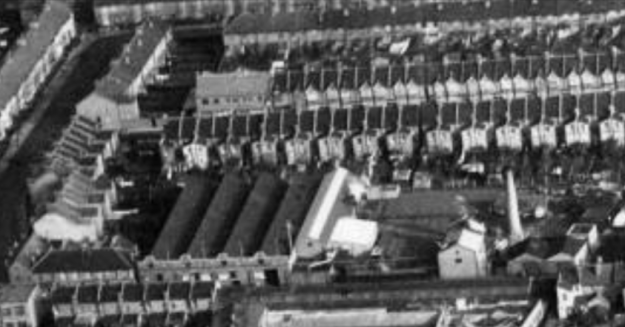
Clip from Merton Memories photo 49435, taken on 10th February 1954, copyright London Borough of Merton. Hawthorne Avenue is on the left, Church Road at the bottom and part of Lewis Road can be seen on the right.

From 2012 planning application in Southwark, the Heritage Statement described this company’s origins:

The Ross part of the company Hepburn, Gale and Ross, had originally been A. Ross and Co, this was the company started in 1829 by Alexander Ross, as a leather works in Grange Road. In 1865 he was joined by Mr Tomlin, a former apprentice from the Wellingborough boot trade, who would later become proprietor of the firm. Tomlin was soon joined by another apprentice from Wellingborough Mr Blott, and under the leadership of all three the company when it was taken over in 1895 had become the largest supplier of leather goods to the British Army. The business was purchased by Mr Posnett, who had two other firms, Hepburn and Gale, and in 1903 all three were amalgamated under the name Hepburn, Gale and Ross, Ltd.


From the minutes of the
Croydon Rural District Council
Roads and Buildings Committee
Volume VIII 1902 – 1903
15th May 1902
page 111

2. Deposited Plans. – The Buildings Sub-Committee reported that they had carefully examined al the plans of new streets and buildings deposited since the last meeting, and on their recommendation, it was Resolved:-
(a) That the undermentioned be approved:

No. 2115, Hepburn & Gale, Factory, Church Road, Mitcham

News Articles

Mitcham News & Mercury, 254th February 1961

THE conveyor belting and hydraulic department of Barrow Hepburn and Gale Ltd., Mitcham, has gone through a difficult time, says the annual statement of the chairman. Mr. George W. Odey.

The competition in conveyor and transmission belting reduced prices to unremunerative levels, he said.

“There has, however, been an improvement in this respect. We have been successful in substantially increasing our export sales and we look for a continued improvement in the coming year.”

Mitcham News & Mercury, 25th February 1966 page 1.

Factory to close in April

Council buy half site for £140,000

Production at the Mitcham factory of Barrow Hepburn and Gale should have ceased by April. Half the factory has already been sold to Merton Council for £140,000 and the other half is up for sale.

Mr George Odey, chairman of Barrow Hepburn and Gale, which is the largest company in the leather trade, tells shareholders this week that one of the great disadvantages of the Mitcham factory is that it was divided by a main street, writes John Heffernan, our City Editor.

He says that for some time past, the local authority has been anxious to acquire the factory on one side of the road.

This part is now been sold, subject to final approval by the council. The other portion of the factory has been placed on offer.

Being transferred

Production is being transferred elsewhere and all employees are being offered the opportunity of transferring.

The factory made conveyor belting under the trademarks of Mitcham, Python, Bulldog, Plyastic and Mitchamatic, and this, together with other productions in 1965, represented an export turnover of £500,000.

Mr E Moore, of the Amalgamated Society of Leather Workers, said he believed two unions were involved, his and the Transport and General Workers Union.

He added: “I have 36 members, all concerned with leather work at the factory. They have all been asked to go to the Bermondsey factory, so theoretically they are not becoming redundant.”

He added : “But there may be some hardship cases that we’ll have to take up and get redundancy payment for. One of our members is 70 years old, unfortunately being over 65 he is not covered by the redundancy scheme. But if he is prepared to travel he’s got a job.”

Mr C H Barlow, General Workers District Official of the Transport and General Workers Union, said his union had 60 members from the factory.

He said: “At the most six of them will go to Bermondsey. For the rest it will be redundancy.”

Mitcham News & Mercury, 4th March 1966 page 1.

Eighty-six employees redundant

Eighty-six employees of the Mitcham factory which is to close in April are being made redundant.

This was the latest news after Barrow Hepburn and Gale announced last week that there would be opportunities for transferring all employees.

Mr C H Barlow, General Workers District Official of the Transport and General Workers Union, said:

“Eighty-six men who make rubber conveyor belting are being made redundant. The question of transferring to Bermondsey applies only to about 36 men on the leather side.”

Barrow, Hepburn and Gale is the largest company in the leather trade and their head office is in Bermondsey.

Mr Barlow recently went to Bermondsey and returned to the Mitcham factory to tell men about the redundancy.

He said : “I have written to the management asking for a meeting to discuss the terms of redundancy payment.”

22nd July 1966 Mitcham News & Mercury page 1

Council buy land

Land belong to Barrow, Hepburn and Gale Limited, at Church Road Mitcham, is being bought by Merton council as a cost of £248,300.

The company, the largest in the leather trade, closed their Mitcham premises in April.


Minutes of meetings held by the Croydon Rural District Council are available on request from the Merton Heritage and Local Studies Centre at Morden Library.


Maps are reproduced with the permission of the National Library of Scotland.
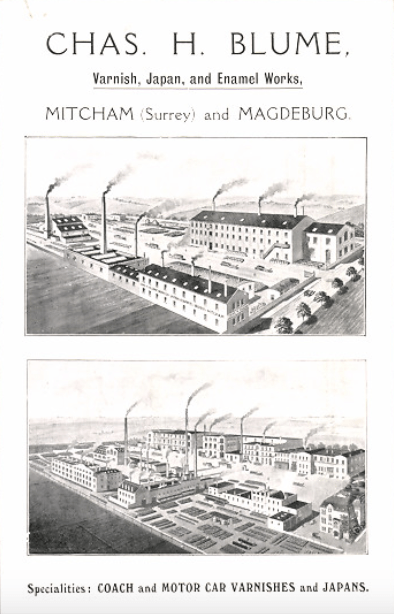
Charles H. Blume

chas-h-blume-postcard

Carl Hans Blume was born 18/10/1847 in Schönebeck, and died 15/02/1919 in Magdeburg, Germany.

After working as an accountant and then salesman with various paint/varnish companies in Magdeburg, he set up a company with a colleague in 1873 called Blume & Knopf. The company quickly grew from modest beginnings to become well-known market leaders for high-quality paints and special varnishes, which were used for coaches, cars, bicycles, sewing machines, paper mills and a wide range of other industrial products. In 1875 he set up on his own, using land bought in Magdeburg, trading as Carl Hans Blume, Lackfabrik, which supplied the German navy, military and state works, railway companies and many other industrial enterprises on a large scale. In addition, he was able to start exporting its products to European countries at an early stage. In the summer of 1893, a first branch factory was erected in Mitcham, followed by a branch office in Paris before the First World War.

After his factory was confiscated in 1916 under the Trading With The Enemy Act, he returned to Germany. The company was run by his eldest son, also called Carl (1878-1921), who had been trained in England, then his second son Hermann (1882-1943) from 1921-43, later by his third son, Paul (1884-1951). The business survived the second world war, but as Magdeburg came under East Germany, it was appropriated in 1948.

Source: University of Magdeburg biography on Carl Blume (in German)

From the 1912 Directory & Chronicle for China, Japan, Corea, Indo-China …
1912-blume-ad

1912-blume-ad-page

1912-blume-enamels-entry

1912-blume-varnishes-entry

Owner of varnish factory in Western Road that was closed down and sold off at auction in 1916.

Blume’s factory mentioned in 1902 Mitcham Parochial minutes.

From the 1910 Cycle and Motorcycle Exhibition on Grace’s Guide

Chas. H Blume.
Mitcham, Surrey.

Stand No. 244.

This firm is famed for brilliant and long wearing enamels, and some very fine samples of cycle stove enamels, black and coloured, mudguards and gear case enamels, silver paint, air drying enamels, etc. One of the firm’s latest lines is the “Marrow Grey” and “Bamboo” rust proof priming ; it should be noted that the use of these rust proof primings does not exclude the use of the ordinary rubber or first coat black enamel, which may still be used as an intermediary coating, but is not necessary ; two coats of finishing for the rust proof metallic priming gives very excellent results and a very fair finish is obtained with one coat of black for the priming ; a point in favour of the priming is that it “carries” or “fills” better than the ordinary black first coat, and is equivalent in bodying up to two coats of ordinary enamel.

We learn that tubes treated with this rust proof priming have been exposed continually to rain and damp for six and eight months without any lifting taking place.

This exhibit is certainly one of the most interesting and instructive in the Hall.


From the minutes of the Mitcham Parish Council
Volume 11 April 1913 to March 1914
Report of the No. 1 Fire Brigade Committee
27th January, 1914

Page 162

                              Western Road,
                              Mitcham, Surrey,
                              17th January, 1914

To Superintendent A. Jenner,
   Mitcham Fire Brigade,
                  Mitcham.

Dear Sir,

Allow me to express to you once more my feelings of indebtedness and sincere recognition for the very prompt effective assistance which you and your men have rendered to us on Thursday last.

As the outbreak occurred at night time the extent of the fire would indeed have been quite disastrous, but for your timely and efficient help.

Please be good enough to convey these sentiments to your men and express to one and all of them my grateful thanks.

                     I remain,
                         Yours faithfully,
                             p. p. CHAS. H. BLUME,
                                K. STRUBE,
                                    Manager.

Page 161

The Superintendent’s Reports were submitted

Jan 15th … Fire at Blume’s Factory … £2 9s. 6d.

The Superintendent reported that an additional fire hydrant is required near Mr. C. Blume’s factory, and the Committee recommend –

That the Croydon Rural District Council be requested to fix the hydrant in Western Road.


Closed down in 1916

under the Trading with the Enemy law, citing Charles H. Blume as an enemy.

See order of London Gazette, 13th June 1916

TRADING WITH THE ENEMY AMENDMENT ACT, 1916.
Orders have been made by the Board of Trade requiring the undermentioned businesses
to be wound up : —

Charles H. Blume, Western Road,
Mitcham, Surrey. Varnish and Enamel Manufacturer.
Controller: John William
Barratt, 19a, Coleman Street, London, E.C.
9 June, 1916.

and 10th October 1916

Final Notice.

In the Matter of the Trading with the Enemy Act 1916, and in the Matter of CHARLES H. BLUME,
an Enemy Subject.

WHEREAS by Order made by the Board of Trade, dated the 9th June, 1916, under the
provisions of the above mentioned Act, the business carried on in the United Kingdom, of the above named Charles H. Blume was ordered to be wound up, notice is hereby given, that any persons claiming to be creditors of the said business carried on by the said Charles H. Blume who have not already sent in their claims are required to send, by prepaid post, to John William Barratt, Chartered Accountant, of 19a, Coleman-street, London, E.C., the Controller appointed by the said order, on or before the 16th day of November, 1916, their Christian and surnames, addresses and descriptions, with full particulars of their debts or claims, or in default thereof they will
be excluded from the benefit of the said order.
—Dated this 10th day of October, 1916.
J.W. BARRATT, Controller.

For details of stock at time of auction, see Western Daily Press – Thursday 20 July 1916 from the British Newspaper Archives (subscription required)

IN the MATTER of the TRADING with the ENEMY AMENDMENT ACT, 1916, and in the MATTER of CHARLES H. BLUME, WESTERN ROAD, MITCHAM, SURREY.

By an Order of the Board Trade, dated 9th June, 1916, under Section 1 the above-mentioned Act, relative to the above firm, I, the undersigned John William Barratt of 19a, Coleman Street, London, E.C., Chartered Accountant, was appointed to control and supervise the carrying out the said order and to conduct the winding up of the firm’s business.

Notice is hereby given that the Creditors the said firm are required before the 25th day of August 1916 to send their Names and Addresses and the particular, of their DEBTS and CLAIMS the names of their Solicitors (if any) to me the undersigned Controller at address aforesaid and required notice writing from are their solicitors or personally to come in and prove their said Debts or Claims at time and place as may be specified in such notice or in default thereof they will be excluded from the benefit of any distribution made before Debts are so proved.

Any property or business effects of the said firm should delivered to me and all Debts due to the said firm should paid to me forthwith. J. W. BARRATT, Controller. Dated this 20th day of July, 1916.

Auction of stock in 1916
Birmingham Daily Post – Wednesday 04 October 1916

Re Chas H. BLUME. VARNISH MANUFACTURER, MITCHAM. SURREY. By Order J. W. Barrett. Esq., F.C-A., the Controller appointed by the Board Trade Messrs, Fuller, Horsey, sons, & Cassell, having Disposed the Freehold Works and the Goodwill of the Business, will Offer for Sale by Auction lots the Premises, Western Road. Mitcham, on FRIDAY, October 13, 1916. 1030 o’clock precisely.

THE STOCK-IN-TRADE, including 16,000 gallons Oil Varnish. 500 gallons Spirit Varnish Polish, and Lacquers, 3,000 gallons Storing and Air-drying Black Enamels and Japans, quantity Coloured Stoving and Air-drying Enamels. 2,600 Boiled. Perilla, and Wood Oils. 8 1/2 tons various Gums 8 tons Resin. 16 tons Pitch. 25cwt. Asphaltum. 2 tons Litharge. 13 tons Dry Colours. 2 tons Lithopona. 500 gallons Benzine. Naphtha Rubber Solvent. Benzole, and Turps; large quantity Orates, Cans &c.

Also the Loose Plant and Utensils, Office Furniture Typewriters. Safes, and numerous other effects.

May be Viewed Two Days Preceding and Morning of Sale, and Catalogues (when ready) may be had of Messrs. Nicholson, Graham and Jones, Solicitors, 24. Coleman Street. EC.; Messrs. J Barratt and Co.. Chartered Accountants. 19a. Coleman Street. E.C, and 75. New Street. Birmingham; or Messrs Fuller, Horsey, and Co.. 11, Billiter Square. E.C.

Bought by Hadfield in 1917, see Surrey History Centre record.


From Grace’s Guide:

HUTCHINGS, Arthur, A.M.I.E.E., Cons. Elec. Engr.; b. 1868; s. of late William Medlin Hutchings (Editor and Publisher of ” The Colliery Guardian ” ). Ed. Privately. Training: Finsbury Tech. Coll. Career: Head of Testing Dept., Elec. Eng. Corpn., Ltd., West Drayton, 1888; Chief Designer, J. G. Stalter & Co., Ltd., London, 1891; Designer, Deptl. Mangr. and Works Lecturer, Crompton & Co., Ltd., Chelmsford, 1894; Mangr., Elec. Windings Dept., Vickers, Ltd., Sheffield, 1905; Mangr., Insulating Varnish Dept., Chas. H. Blume, Mitcham, 1910; Ditto, Jenson & Nicholson, Ltd., Stratford, E., 1916; Asst. Engr. (War Service), Metropolitan Electric Tramways, Ltd., 1917; Commercial and Tech. Mangr. and Director, Acme Electric Traction Co., Ltd., Tottenham, 1919. Address: 15, Penton Place, King’s Cross, London, W.C.I. T. N.: North 2680.


Minutes of meetings held by the Croydon Rural District Council are available on request from the Merton Heritage and Local Studies Centre at Morden Library.