Tag Archives: 1903

Lyxhayr

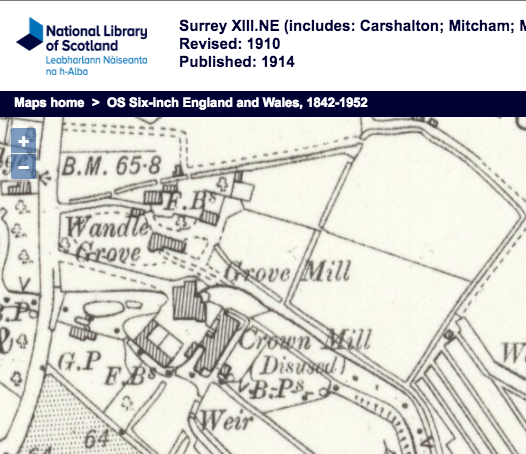
Lyxhayr was the brand name of artificial horse hair that was manufactured at Grove Mills, on the Wandle in Mitcham.
First manufactured in 1903 by a company called ‘The Patent Horse Hair Co. Ltd.’, ‘lyxhayr’ was a curled fibre of vegetable origin for many upholstery filling applications. Developed by a chemist called Mr Holmes, the process was patented.

As well as hair from horses, wool or cotton fibre, called ‘flock’, was used in filling mattresses and furniture. Sometimes, hog hair was mixed in with the horse hair to reduce cost. Animal hair however was not hygienic, and the company’s advertisement in 1907 said that the Public Analyst for Hackney, Dr Leo Taylor, had found that the hair contained almost the same amount of bacteria as London sewage.

Being made from vegetable, this artificial horse hair was free of bacteria.

In 1905 the company changed its name to Lyxhayr Ltd. and Mr W. A. Dickinson was its Managing Director. Mattresses made with lyxhayr were popular with hospitals but cheaper, less hygienic ones were still being sold.

Mr Dickinson was one of those who lobbied parliament leading to the Rag Flock Act of 1911, which was the first attempt to regulate the abuses.
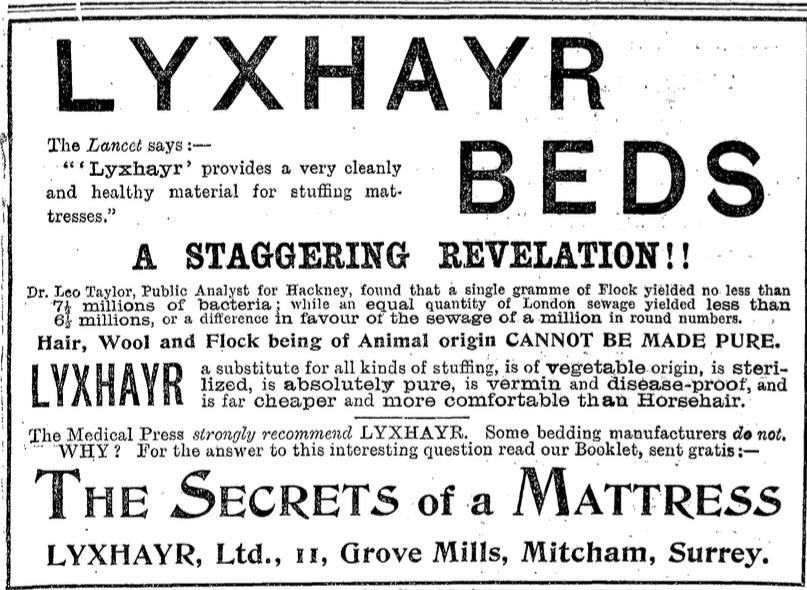
1907 ad

1907 ad

Listed in the 1938 commercial directory as

Mitcham Fibre Mills Ltd., horse hair substitute manufacturers, Grove Mills, London Road. Trading As “Lyxhayr, Mitcham;” Telephone Number 0807.


News Articles
These are from the British Newspaper Archive.

Sutton & Epsom Advertiser – Thursday 22 September 1949

Memories of the Wandle and old friends who fought in her defence

Sir,—Mention of the late Benjamin Slater in “The Advertiser” recalls to mind the many happy hours I spent with him in his old-world garden after his retirement from his long service at Hall Place. Occasionally we were joined by the late Sir T. Cato Worsfold, always ready to chat with his head gardener. I happen to be Mr. Slater’s only grandson.

I entered the office of Lyxhayr Manufacturers, Ltd., predecessors of the present Mitcham Hair and Fibre Mills, Ltd., and worked under the then managing director, the late Mr. W. A. Dickinson, who was not a native or resident of Mitcham but had been in business at the mill for a great number of years. He loved the Wandle and the adjoining Watermeads and Happy Valley and he took an active part when Watermeads was handed over to the National Trust. He was, I believe, one of the original members of the local Watermeads committee and worked hard in its interests. Mr. Dickinson would search every book likely to contain any reference to the Wandle and he left some interesting records. Normally a quiet business man, he sailed straight into action, up or down the Wandle, with all guns blazing, whenever the Wandle was threatened either by abstraction or diversion of the water or pollution. In the early fights with Croydon Corporation he was always to be found shoulder to shoulder with the other riparian owners on the river.

Ill-health forced him to retire in 1932. On the day he left his office, the last he saw of the Wandle which ran under his office window, I accepted his keys and took over his duties with a feeling that I and the Wandle had lost a good friend. He retained his interest in the river until the last.

Working in the mills at the time of my entry was the late George Hill, then getting on in years. Hill was a well known and respected old inhabitant of Mitcham who lived in one of the old cottages (recently pulled down) adjoining the police station on the Causeway. He died in 1922. Practically all his long life had been spent working in the mill. He was there before the advent of Lyxhayr when it was used as a felt mill, owned or managed by the late W. W. Thompson, but as a boy he worked for a time in the garden of Wandle House. Hill, in common with Benjamin Slater and so many old Mitchamites, retained his love of gardening and in his later days as a faithful old servant of the mills he spent the greater part of his working time cultivating the kitchen garden at the rear of the mill for Mr. Dickinson. Hill’s especial pride being a fine asparagus bed which Dickinson duly did justice to. It was from Hill’s association with Wandle House that the information was obtained by Mr. Dickinson about McKray’s Mill.

I have no doubt I could obtain further information about the mill and the activities of McKray or McCrae (the latter, I think, is more likely to be the correct way of spelling). Fortunately we still have with us people who know more about the river and its mills than I do. Perhaps Col. Bidder, that old river stalwart, can help me, or maybe Mr. H. Gorden Holder of Deeds Mill can elicit some information about the mill in question from his uncle, Mr. Stanley Holder.

E. B. HEDGER.
Grove Mills, Mitcham.

Western Chronicle – Friday 5 February 1909
1909 fire

At one o’clock on Saturday morning a fire broke out the Grove Mills, Mitcham, an artificial horsehair manufactory. The fire brigades from Croydon, Sutton, and Mitcham attended, but the four-storey brick building was completely gutted. The damage is estimated at from £5,000 to £6,000.

Pearson’s Weekly – Thursday 4 January 1906

A VALUABLE addition has been made to the list of hygienic articles by the introduction of Lyxhayr. A substitute for horsehair, Lyxhayr is a natural, vegetable, woody fibre, which has been chemically and mechanically treated. As a stuffing for beds and chairs, where the maximum of health and cleanliness is desired, it is gaining great appreciation. Full particulars of Lyxhayr can be obtained from the selling agents, Messrs. Dollery and Palmer, 110 Cannon Street, London, E.C.
Taylor and Kensett

Estates services of Thomas Taylor and Percy Kensett, that may have been in business from 1891 to 1914.

Contents

Ghost sign
Newspaper articles
Kensett the builder
Kensett the Cold Storage Expert
Council Minutes

Ghost sign

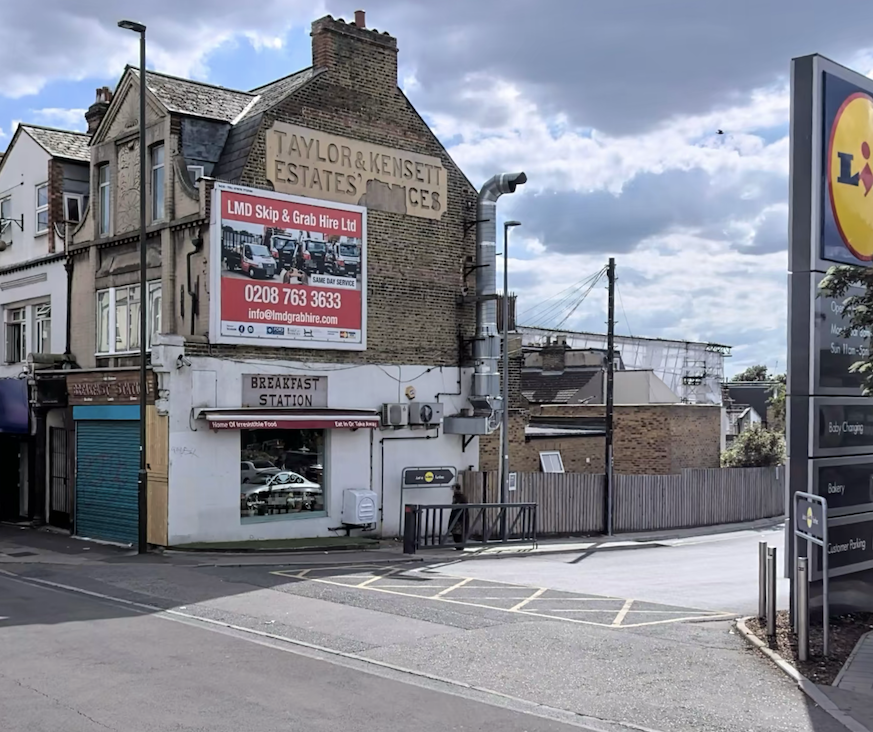
There is a ghost sign, off the west side of London Road, at the entrance to Lidl.

Photo from Apple Maps June 2021

The firm of Taylor & Kensett were listed as builders in local street directories at the beginning of the 20th century, and from council minutes, building applications show:

1899 for 38 houses in Pitcairn Road
1903 for 12 houses in Crusoe Road
1904 for 16 houses in Crusoe Road

Also from Streatham News – Saturday 18 January 1908:-

1908 for houses numbered 67 to 87 in Kenlor Road, Tooting.

The street directories also give their full names, as they are listed separately with ‘see Taylor & Kensett’.

Newspaper articles

Wimbledon News – Saturday 03 November 1900

HOUSES to Let, on new estate; two reception rooms, kitchen and scullery, three bedrooms, and fitted bath and w.c. (h. and c. supply), rent £2 17s. per month inclusive.—Apply, Taylor and Kensett, house agents, Tooting Junction.

Cricket

The firm had its own cricket team.
Clapham Observer – Saturday 29 July 1905

MITCHAM LONSDALE ATHLETIC v. TAYLOR & KENSETT’S.

This match at Figg’s Marsh, on Saturday, ended in a win for the home team by 75 runs. The visitors batted first and scored 21, out of which Elliott claimed 11 not out. Three wickets were down for three runs and things were going well for the home team, whilst with five runs scored three more wickets fell, following which, without any addition to the score, Barker was clean bowled; Stonewall was caught off the next ball, and Percy bringing off a fine left-handed catch in the slips enabled Smith to perform the “hat trick.” The visitors’ bowling was only moderate, the only one to trouble the batsmen being Barker, who took eight wickets for 36, a very good performance considering the big score against his side. Knapp was in Jessopian mood, and profiting by the unaccepted chances he gave, he rattled up 62 runs in double-quick time, his innings including only five singles. Scores:—

TAYLOR & KENSETT’S. MITCHAM LONSDALE.
Gordon, b Cheeseman 0 Sternberg, b Barker 3
Beadle, b Smith 0 Smith (capt.) not out 2
Dumert, b Smith 0 Knapp, c Roberts b Barker 62
Barker, b Smith 0 Courtier (P.), c Elliott b Barker 2
Elliott, not out 11 Cheeseman, l.b.w. b Barker 0
Stonewall, c English b Smith 0 White, b Elliott 5
Page, b Cheeseman 0 Biffa, c & b Barker 0
Roberts, c Percy b Smith 0 Latham, b Barker 4
Pritchard, st. Courtier b Smith 8 English, c Dumert b Barker 12
Wood, c White b Latham 1 Courtier (L.) c Gordon b Barker 0
Hurst, st. Courtier b Latham 0 Percy did not bat
Extras 1 Extras 6
Total 21 Total 96

In a court case reported in the Sutton & Epsom Advertiser – Friday 03 September 1909, the accused said that he had worked for Taylor & Kensett for 18 years, which would be from 1891.

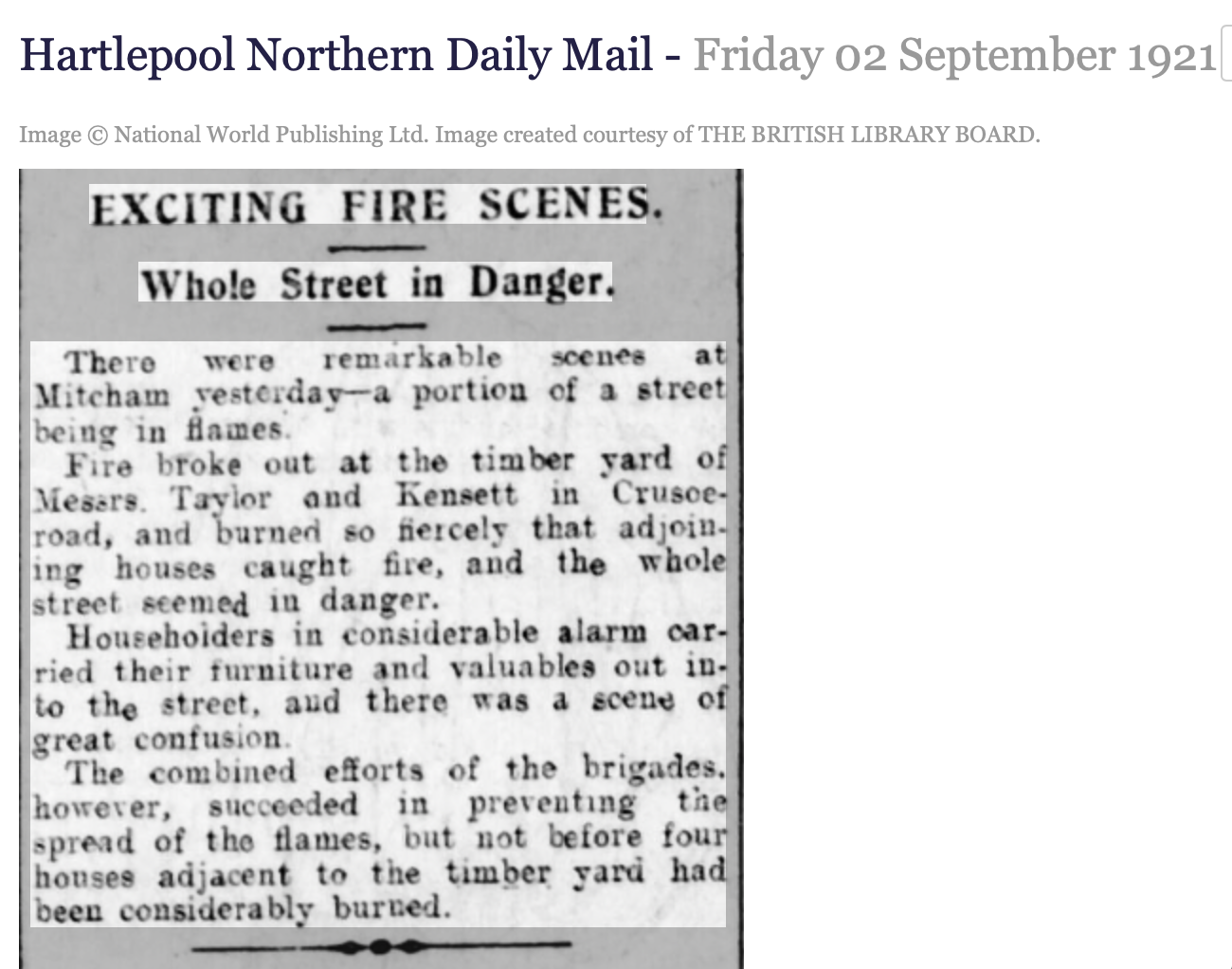
Hartlepool Mail – Friday 02 September 1921

EXCITING FIRE SCENES Whole Street in Danger. There were remarkable scenes at Mitcham yesterday — a portion of a street being in flames. Fire broke out at the timber yard of Messrs. Taylor and Kensett in Crusoe road, and burned fiercely that adjoining houses caught fire, and the whole street seemed in danger. Householders in considerable alarm carried their furniture and valuables out into the street, and there was scene of great confusion. The combined efforts of the brigades, however, succeeded in preventing the spread of the flames, but not before four houses adjacent to the timber yard had been considerably burned.

Kensett the builder

Percy Frank Kensett is listed in the 1900 commercial directory as a builder, with the note ‘see Taylor & Kensett’.

The following was obtained from ancestry and newspaper articles.

Percy Frank Kensett was born in Bibury, near Cirencester, Gloucestershire in 1869.
In the 1901 census he was living in Mitcham, as a builder and an employer, with his unmarried sister Constance M. Kensett, aged 31.

His WW1 pension records shows he served with the King’s Royal Rifle Corps, from 3rd September 1914 until 15th October 1915. His address given on enlistment was Broad Meadow, Coombe Lane, Wimbledon. His age on enlisting was 46 years 120 days. Physically he was 5ft 5 and a half inches tall, 133 lbs in weight with dark hair and hazel eyes. His religion was Church of England. He had previously served in the London Rifle Brigade Lodge of Freemasons from 1900 to 1907. His rank on joining the KRR was of Sergeant.

In 1939 he is listed as a retired architect, living in Northleach, Gloucestershire at The Close, with his sister Constance. He died at 72 in The Close on 18th December, 1940, and left £25,000 (£1,226,000 in 2026 values) to his sister Constance Mary Kensett, who was a spinster.

Kensett the Cold Storage Expert

A patent in 1901 was filed by Percy Frank Kensett and Thomas Taylor for Improvements in and connected with Fastening Devices for the Doors of Cold Stores. See Google Patents.

In the January issue of The Engineer, P.F. Kensett is mentioned on page 192.

In the 1911 census, Percy Frank Kensett, aged 42, is listed as a Cold Storage Expert, and living at 336 Coombe Lane, Wimbledon.

In the 1912 street directory, Taylor & Kensett Limited is listed as insulation contractors.

The 1915 Electoral Register for Wimbledon has Percy Frank Kensett as a qualifying owner to be able to vote in Mitcham West Ward, due to his owning freehold and leasehold houses in 1 to 5 London Road and 2 to 20 Pitcairn Road.


Council Minutes

From the minutes of the Croydon Rural District Council
Volume VIII
1902 to 1903
Highways
17th April 1902
page 45

20. FIGGS MARSH DRAINAGE.—Read letter from Messrs. Taylor & Kensett, the owner of building land on the west side of London Road, Figg’s Marsh, near Tooting Junction Railway Bridge. The road was, at present, drained by pipes laid under the footway discharging on to the land belonging to the applicants, where a ditch formerly existed ; to carry out what was suggested would necessitate the construction of four new gullies and a length of 6in. drain to take the water to the other side. It would improve the drainage of the highway and at the same time relieve the landowner of a liability to get rid of the water now discharging on to the land ; the cost would be approximately £20, and he suggested that Messrs. Taylor & Kensett should be asked to contribute one-half the cost.

—The Committee Resolved, That they be required to pay the whole of the cost of the work.


From the minutes of the
Croydon Rural District Council
Roads and Buildings Committee
Volume VIII 1902 – 1903
15th May 1902
page 111

2. Deposited Plans. – The Buildings Sub-Committee reported that they had carefully examined al the plans of new streets and buildings deposited since the last meeting, and on their recommendation, it was Resolved:-
(a) That the undermentioned be approved:

No. 2127, Taylor & Kensett, house, London Road, Mitcham


Minutes of meetings held by the Croydon Rural District Council are available on request from the Merton Heritage and Local Studies Centre at Morden Library.