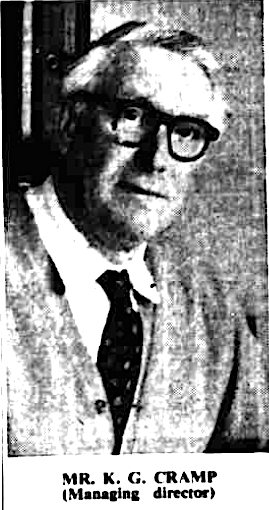
335 London Road
Builders, Joinery. Listed in the 1963 Borough of Mitcham List of Factories.
Established in 1889.
1963 ad
Text of ad:
BUILDING CONTRACTORS
CHARLES SAYERS
& SON LTD.ESTABLISHED 1889
HOUSEHOLD MAINTENANCE
AND REPAIRS335 LONDON ROAD, MITCHAM, SURREY
Telephone : MITCHAM 4015/6
This photo from 1910 is of The Broadway, looking north, and part of the name C. SAYERS can be seen on the gate on the right. Next door is the post office (the third of Mitcham’s post offices).
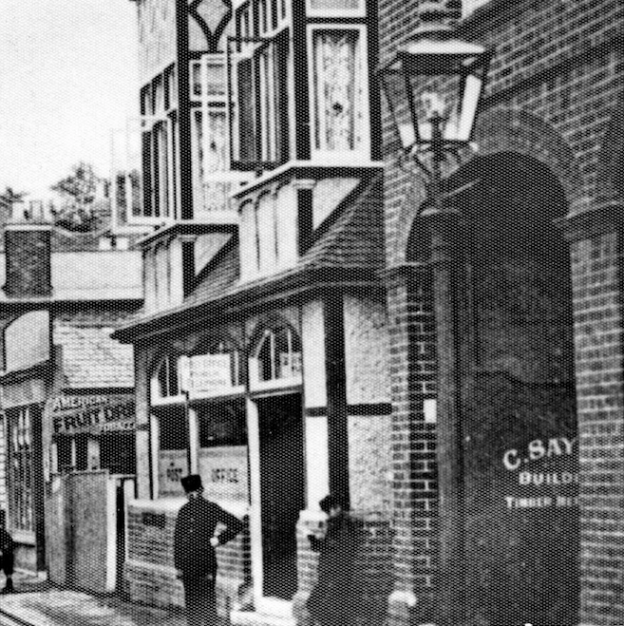
1910 clip from Merton Memories photo reference Mit_Streets_Lon_38-24
1929 ad
Text of ad:
TELEPHONE: MITCHAM 1537
CHAS. SAYERS & SON
Builders and Decorators
335, London Road, LOWER MITCHAM
SURREY
Experienced Workmen in all Branches of the Building
Trades
ESTIMATES FREE
The firm built the Child Welfare Centre (La Sporta) on the corner of Church Road and Church Path.
Newspaper Articles
Mitcham Advertiser – Thursday 04 April 1940
MR. CHARLES SAYERS
DEATH OF HEAD OF MITCHAM BUILDING FIRMThe death of Mr. Charles Sayers, head of Chas. Sayers and Son, Ltd., London-road, Mitcham, a leading firm of builders who was also a stalwart of the Methodist Church, Lower Green, a member of a family resident in the district for a hundred and fifty years, and a man widely esteemed for his sterling character and charm of personality, is a great loss to the borough and to the church, both of which he served long and faithfully in many ways. He passed away on Thursday at the age of seventy-eight.
In the beginning of April, 1936, Mr. and Mrs. Sayers celebrated their golden wedding at their home in Wandle-road, Morden, where they went to live in 1914. Mrs. Sayers died there a year or two later. Her death was a severe blow to Mr. Sayers, for they had been almost inseparable companions, and she shared his interest in the church and inspired many of his undertakings. He continued to reside there until, with failing health, he went to live, a few weeks ago, with his only son, Mr. C. O. Sayers, in London-road, his old home, where he died.
A VARIED CAREER
Mr. Sayers spent all his life in Mitcham, as did his father and grandfather. He founded the business of C. Sayers and Son, Ltd., in 1890. From small beginnings it has grown to considerable dimensions and became known far and wide as a building firm of outstanding excellence. The handsome Baptist Sunday School at Tooting Junction, Colliers Wood Methodist Church (famous for its sunlight treatment and mural painting), the recently completed Borough Council Clinic in Church-road, the extension to Wimbledon Fire Station, and the Mid-Southern Utilities building at Windsor (£30,000), are some of the firm’s more recent works. In all these contracts Mr. Sayers took a personal part despite his advanced age. He was actively engaged in a variety of labours until within a few weeks of his death.
His beloved chapel on the Cricket Green was his greatest interest outside his business. He was a leader there from its foundation in 1877. He took a leading part in the celebration of its jubilee. For over sixty years he was a member and an officer in the church, sharing the responsibility chiefly with the late Mr. G. T. Hodges and the late Mr. J. Stickings. He was treasurer and a steward of the church to the end of his life.
For many years, Mrs. Sayers, their only son and a daughter assisted him in the social work of the church. Mr. C. O. Sayers, the new head of the firm, was the organist, and Miss Dora Sayers, now Mrs. R. W. E. Stickings assisted in all the musical and social activities of the church and the “village,” as Mitcham was then called. Mr. Stickings became Sunday School superintendent. He also took an active part in Mitcham and Morden affairs generally, and became chairman of Merton and Morden Urban Council. Mrs. Stickings was best known, perhaps, as honorary secretary of the Mitcham branch of the League of Nations Union. They now live in Essex.
In 1937 Mr. Sayers was presented with an arm chair on completion of fifty years’ membership of the church. Mrs. Sayers was the leader of the sewing meeting and generally responsible for the refreshment stalls at the bazaars. She and her husband were presented with many gifts on their golden wedding day.
LINKS WITH THE PAST
In his young days as a journeyman carpenter, Mr. Sayers worked on the building of the Vestry Hall. His father was a licensed victualler in Mitcham for a time. He often spoke of the wood framed village homes, of which a few still survive in the borough, and recalled living in one at Phipps Bridge, the front of which was in Mitcham and the back in Merton. He himself was ticket collector at Old Mitcham Station for a short time as a youth. At a later period Mr. and Mrs. Sayers managed the Mitcham library, established by the Bidder family, in the house now occupied by Dr. Evans at the London-road corner of the Cricket Green. It was with the support of the Bidder and Devenish families, then leaders of the life of Mitcham, that he started the building business which has attained so much success.
One of Mr. Sayers’s most cherished possessions was an ancient book of accounts of the original Methodist Chapel in Mitcham. The building (or part of it) still stands on the edge of the Cricket Green, opposite the present chapel. In that book, dated 1791-1801, under the date June 10th, 1797, is the name of one of his ancestors with two shillings marked against it. Near by is an item, “tenpence for workmen’s beer.”
Not the least of Mr. Sayers’s many gifts and qualities was the gift of humour. It was dry and kindly, and appeared in more than one letter to “The Advertiser,” of which he was a regular reader, “from its foundation,” he used to say. He was an expert bowls player and a lover of music. He played the fiddle (“for my own amusement”).
THE FUNERAL
The worth of Mr. Sayers to his church, his friends and to Mitcham generally, was extolled by the Rev. Mr. Viney, a former minister, who conducted the funeral service in the church on Saturday morning. The Rev. D. W. Capewell, the present minister, assisted in the service. There was a large congregation, which included Mr. Tom Francis (chairman of the Mitcham and District Chamber of Commerce), Mr. and Mrs. Charles Sanders (members of the church for many years), Mr. C. Spence, Mrs. R. G. Hodges and Miss Ivy Hodges, Messrs. Burroughs and Mulford, Capt. Tull and the Boys’ Brigade, and many members of the staff of the firm.
Mr. C. O. Sayers played the organ accompaniment to “Jesu, Lover of My Soul” (his father’s favourite hymn), and “O Rest in the Lord” at the end of the service. Mrs. Thompson, a relative, played the opening voluntary.
The family mourners were Mr. and Mrs. C. O. Sayers (only son and daughter-in-law), Mr. Ralph W. E. Stickings and Mrs. Stickings (son-in-law and only daughter) and family, Lieut. K. O. Sayers, 9th Middlesex Regt., son of Mr. and Mrs. C. O. Sayers, who was given special leave to attend his grandfather’s funeral, Miss Eileen Sayers (granddaughter), Mr. W. Berwick Sayers (Croydon Borough Librarian, who is a nephew), Mr. Herbert Sayers (brother and director of the firm), Mr. and Mrs. T. Price, Mrs. Middleton, Mr. and Mrs. E. Thompson, Mrs. J. Stickings and family (Morden).
The remains were laid with those of Mrs. Sayers in the family grave in London-road Cemetery.
The large tribute of flowers included wreaths from the church organisations, the Boys’ Brigade and various departments of the firm of C. Sayers and Son, Ltd.
The arrangements were carried out by Mr Donald S. Drewitt, Upper Green, Mitcham.
Norwood News – Friday 12 March 1937
MRS. C. SAYERS
The funeral took place on Monday at Mitcham New Cemetery, London-road, of Mrs. Harriett Maria Sayers, (aged 76), who passed away on the previous Thursday at 153 Wandle-road, Morden. She was the wife of Mr. Charles Sayers, the well-known building contractor, London-road, Mitcham, and had been in failing health for some time.
The funeral was preceded by a short service at the Methodist Church, Lower Green, with which the family have been associated for many years.
Mrs. Sayers leaves a husband, one son and one daughter to mourn the loss of a devoted wife and mother.
Mr. Donald S. Drewett, Upper Green, Mitcham, was the funeral director.
Mitcham Advertiser – Thursday 11 March 1937
WIDE ROADS A DANGER.
To the Editor of the “ Advertiser.” Sir,—As a resident of Mitcham for seventyfour years I strongly protest against the curtailment of the Cricket Green. I have never known that part of the road to be congested, not even when King Edward, when Prince of Wales, used to travel that road to Epsom races. ~ There are no houses or shops on either side and therefore no special cause for obstruction. Very wide roads are a danger to pedestrians, as witness St, Helier-avenue, which has cost an enormous sum and caused more dissatisfaction than any road I have read about, There are two bottle necks in Mitcham that should receive attention, viz.,, by the Buck’s Head, Upper Green and from the White Hart to the recent widening towards the railway station. The Council that could do away with these two bottle necks would earn the gratitude of the inhabitants. C. SAYERS. 335, London-road, Mitcham.
Mitcham Advertiser – Thursday 09 April 1936
GOLDEN WEDDING. MR. AND MRS. C. SAYERS, WELL KNOWN MITCHAM CHURCH WORKERS. Mr. and Mrs. C. Sayers, of Wandle-road. Morden celebrated their golden wedding on Friday. Although they have lived in Morden since 1914, Mr. and Mrs. Sayers are associated chiefly with Mitcham, where they are very well known by reason of their business and Church activities Mr. Sayers has spent all his life in Mitcham, as did his father and grandfather.
Mr. Sayers founded the business of C. Sayers and Son, builders, in 1890. Both he and Mrs. Sayers are keen workers in the Methodist Church, Cricket Green. Mr. Sayers has been church steward for many years, and was presented in 1927, with an armchair on completion of fifty years’ membership. Mrs. Sayers was the leader of the sewing meeting and responsible for the refreshment stalls at the bazaars in aid of the church for many years. She is still an enthusiastic worker at the Women’s Meeting.
The golden wedding was happily celebrated with their children and grandchildren Mr. and Mrs. C. O. Sayers and family and Mr. and Mrs, R. W. E. Stickings and family. Many congratulations and presents were received from relatives and friends. These included a cut-glass salad bowl and a vase from the Women’s Meeting, and an eider-down quilt from friends in the Methodist Church.
Mitcham Advertiser – Thursday 30 January 1936
MRS. C. SAYERS INJURED BY FALL.
Mrs. Sayers, wife of Mr. Charles Sayers senior, the well-known Mitcham builder, met with an accident last Thursday within a few yards of her home, 153, Wandle-road. She slipped on an icy path and broke her wrist bones. She was also injured on the forehead by falling against a fence.
Dr. Shelswell attended to the injury and later Mrs. Sayers’s arm was X-rayed at Wilson Hospital. She is now staying with her daughter, Mrs. Stickings, at Brentwood. The day before the accident Mrs. Sayers was one of the most active workers at the bazaar held in the Methodist Sunday School room on the Cricket Green. Mr. Sayers is a trustee of the church.
Mitcham Advertiser – Thursday 28 March 1929
FAIR GREEN SHELTER. Messrs. C. Sayers and Son’s tender of £237 has been accepted for the provision of a shelter‘ in the Fair Green Gardens.
The restoration of Eagle House, including replacing the heads of the eagles at the front, was carried out by C. Sayers in 1928.