Demolished in 1963, after a fire in 1961, it was on the east side of the London Road, north of Baron Grove.
The office block Justin Plaza was built on the site.
Eric Montague in Mitcham Histories: 4 Lower Mitcham wrote: “Its exterior was predominantly ‘Georgian’ in style … commonly believed to be nearly 300 years old when demolished …”.
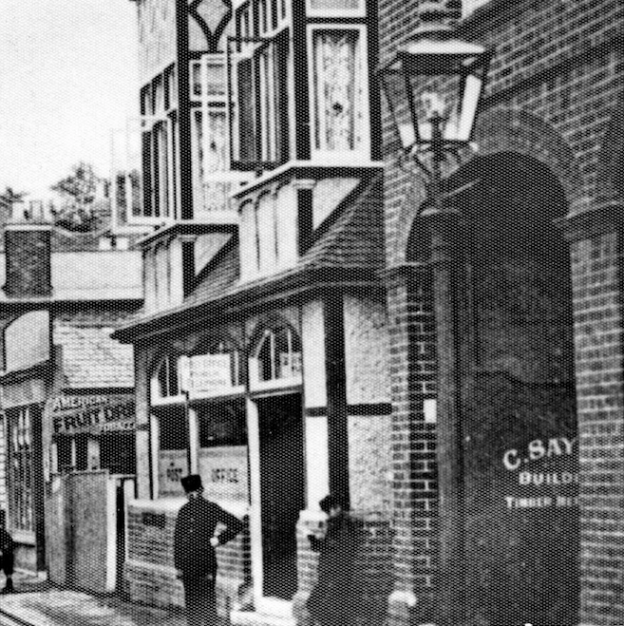
It had been sold to builder Charles Sayers in 1960, according to the Croydon Camera Club bio of H.G. Dorrett. Mr Dorrett had died in 1958, aged 87. He left the house to Miss Nettie Moon.
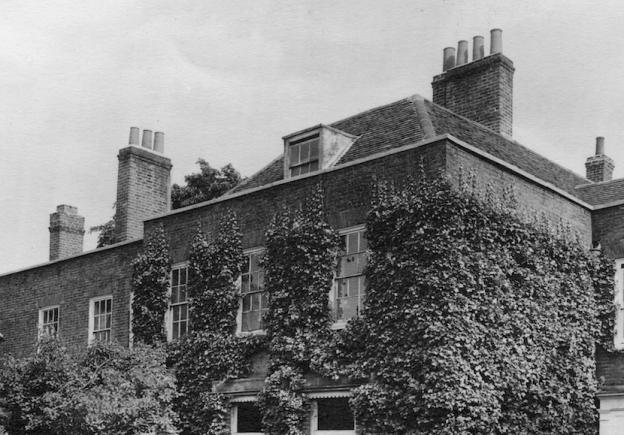
clip from Merton Memories, copyright Dorrett & Co., image reference Mit_Buildings_24-3
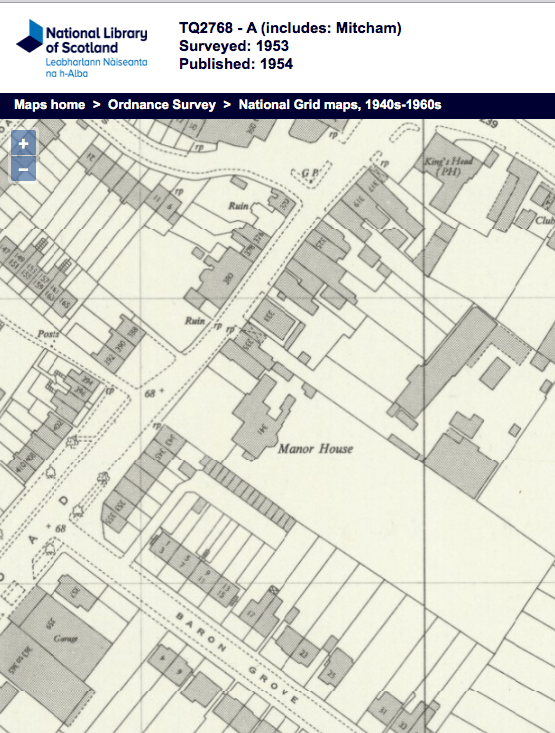
1953 OS map
Newspaper Articles
Mitcham Advertiser – Thursday 29 June 1961
Big blaze at famous old mansion ONE of Mitcham’s oldest houses, the 18th century Manor House in London Road, was severely damaged by a fire which broke out shortly after six o’clock on Monday evening. It was at the height of the rush hour, and traffic pouring in both directions was diverted round the Cricket Green while fire engines from Mitcham, Epsom, Wimbledon, Tooting and Battersea fought the blaze. Although the fire was brought under control within an hour, by firemen wearing breathing apparatus, they did not leave until the carly hours of Tuesday. The house, which was listed as an ancient monument and as being worthy of preservation because of its architectural and historical value, belongs to the Mitcham building firm of Charles Sayers. It was let to Indes Refrigerators, Ltd., of Streatham, and refrigerators valued at £8,000 to £10,000 were destroyed or damaged, At the height of the blaze, it was feared that someone might be trapped in the house, but later investigations by C.I.D. officers proved these fears unfounded. The fire, which caused extensive damage on both floors, was confined mainly to the back of the rambling building. The main drawing room, with its magnificent marble fireplace, was ruined, and the Georgian shutters in all the rooms were badly burned. Firemen managed to keep the flames from the wide carved wood staircase.
Mitcham Advertiser – Thursday 05 July 1956
MITCHAM NOTES
by The CommonerFOR the first time probably in its long and piquant history the building known as the Manor House, and as the old maintainer of the chief stumbling block to the progress of South Mitcham main road wanderers, was recently open to the view of any passer-by. The centuries old high brick wall which had hidden the Manor House’s architectural glories and preserved its privacy for centuries had disappeared, almost in a day.
For the first time, too, the place where the Manor House folk and visitors stabled their horses and carriages was open to the public view—very open, for the London Road frontage was sliced off as with a knife, revealing nooks and crannies unsuspected by the outside world.
A new wall, less obtrusive on the public weal, less obstructive in every way, and less interesting, now carries on the business of the old one, keeps the ghosts in their place and the secrets of the Manor House intact. People hurrying to the Town Hall to pay their rates, women bulging with shopping baskets and bargains, mothers with pram-loads of their latest contributions to the happiness and problems of the world, can now progress on both sides of the London Road with equal speed, safety and uprightness. South Mitcham Residents’ Association and the Borough Council can rejoice reasonably or greatly over a good deed well done.
Solid history
Made apparently of sloppier stuff, I leaned on what remained of the old wall for a moment and dropped a tear. Dash it all, the Manor House wall, built when Lords of the Manor were real and grasping, and bricklayers had no morning prayers or afternoon teas to prevent their progress to higher things, was solid history. Many a poor fellow going to or coming back from the Derby has leaned against the old Manor House wall to rest from his labours, recover his wits or count his blessings. I have seen the top of it (never despoiled with fragments of glass) decorated with scores of men and maids, not to speak of urchins and brats, determined not to miss the passing show.
Men of character, men of money, and men who helped to make Mitcham what it was and is, have lived, loved and laboured in the Manor House, Lower Mitcham, which is probably older than Eagle House, Upper Mitcham, and more modest in its claims to beauty and publicity. Not the least of its owners and occupiers is Mr. H. G. Dorrett, who has filled the heavily-timbered interior with things of beauty and in keeping with its ancient atmosphere. He is a lover, however, who does not lose his head in the presence of the beloved. His wit and humour are vintage type and he fits into the scene of the Manor House in figure, thought and temperament, and in harmony with his 86 years.
Manor House ghost
When the Manor House was vacant during the war the ghost had the time of its life and even got into the Fleet Street newspapers. The only thing it was afraid of was the caretaker, a real old Mitcham character, whom its hauntings did not scare a bit. “I do more rattlin than he does,” he told me, “especially after I have had a pint or two. He probably overhears me and so keeps out of my way.”
People fortunate enough to see the quaintly gabled and ivy-clad front of the Manor House during the fall and rise of the walls, remarked on its peculiar charm and trim appearance generally, and hoped that it would remain uncovered for aye. It is the last of the “feature” houses in that once rather patrician part of Mitcham, and would at least soften the blows given by the nearby mountains of flats in the modern style of beauty.
Mitcham Advertiser – Thursday 30 July 1942
CIVIC SOCIETY VISITS MITCHAM’S ANCIENT MONUMENTS
The view from the flat roof and glazed cupola of Eagle House, one of the scheduled ancient monuments of Mitcham, is not as striking as the view from the top of the Parish Church tower: nevertheless, about thirty members of the Mitcham Civic Society on their first official walk abroad among the few historic places left in the borough, found it interesting.
The view was breezy, too, though that was due to the wind not to the features of the landscape, near or far. The gasworks was in it, of course. It is no use turning one’s back on the gasworks anywhere in Mitcham, for it always makes its presence seen or felt. The members had a most intimate view of the new Bond Road School just below, Fred Gray’s show caravans, and some washing on the line, also of the baths on the opposite side of London Road, Mizen Bros.’ glassless greenhouses, and some places where the people queue up with coupons. After that they came down to earth again.
The guide, philosopher and friend of the society’s first pilgrimage was Mr. Tom Francis, who has an abounding knowledge of Mitcham of all times, including his own, which has provided him with the best stories. Where the historical point or historical person came under review a story invariably followed the facts and illuminated them. The monogram on the lovely old hand-wrought iron entrance gates, mercifully preserved, has puzzled the learned as much as the unlearned for an age. Three authorities differ, said Mr. Francis, not only about the identity of the person so initialled but about the initials themselves. He himself suggested that they commemorated Sir James Dolliffe, a director of the South Sea Company, who rebuilt the house in 1705. The date is recorded on a fine lead gutter-head. The earlier building was supposed to have been the property of Sir Walter Raleigh, who certainly had property somewhere in Mitcham. The stone eagles surmounting the fencing pillars, headless for years, gave rise to many conjectures—as to how they lost their heads.
Eagle House, once the residence of John Bond, London Banker, whose name is fixed in Bond Road near by, commands attention from even passers-by. Bus-top passengers new to the district invariably are interested in it. It is a finely proportioned building on rising ground, early eighteenth century in style of architecture as well as in date, whose foundations suggest that a more ancient building once stood there. A few of the more intrepid explorers of the society sought in the basement for traces of the dungeon chains tradition associates with the place, but all they found were the domestic appurtenances of the Borough Council Day Nursery, whose cook, Mrs. Farnsworth, led the members to the roof and to the cellars.
In the panelled hall Mr. Francis told the story of the house before exploring it. Among his audience were Ald. S. L. Gaston (chairman of the society), Coun. A. T. Godden (chairman of the Library Committee), Mrs. Brockin (founder of the society), Miss M. M. Green (chief librarian and secretary), Miss M. Farewell Jones (a member of the Surrey Archaeological Society), Mr. S. C. Norman (Balham Chief Librarian) and Mrs. Norman, Mrs. East and Miss East, the matron of Cumberland House, Miss Bolsover, Miss Low (Youth Council), Mr. C. P. Walker (Baths Superintendent) and Mrs. Walker, Miss E. Thrupp (Borough Council Housing Manager) and others.
ANCIENT AND MODERN
From Eagle House the party walked to the Manor House in South Mitcham, passing on the way London House, the home of the Francis family for nearly a hundred years and of more than passing historic interest itself. There Mr. Francis showed a wheel and sleeper block of the Surrey Iron Railway, the first railway in England, or anywhere, which passed through Mitcham from Wandsworth to Croydon and Merstham. There also the members decorated themselves with a sprig of the authentic Mitcham lavender.
“Where is the Manor House?” asked several members on the way there. It is safe to say that the majority of the people of modern Mitcham could not give its whereabouts. It is the most delightfully secluded building in the borough. Yet it is in the main London Road. A massive brick wall, a feature in itself, and trees behind it, hide it from the vulgar gaze. The present owner is Mr. H. G. Derrett, a name to conjure with in the realm of artistic photography and known far and wide, especially in the film world. Mr. Derrett welcomed the society to his beautiful and ancient retreat himself and conducted the members over it with an old-world courtesy and intimate personal touch which added greatly to the pleasure. The house is crammed with modern as well as ancient features, and the society was torn between two interests. Against a sombre background of old oak panelling, beamed ceilings and a grand staircase suggesting crinolines, knee breeches and powdered hair, shone out the lovely faces of American and British film actresses, life-size, some of them, and full figured. In the concentrated rays of electric lights they had a stereoscopic and so life-like an appearance that many “Oh, look!” exclamations were heard in every room the visitors entered. The “Lovelies” won the first attention. But a bust of Mr. Derrett, the work of his niece, was a finer example of art than any of the film photographs to “The Advertiser” visitor. Fine old furniture and a rare piece of glassware were noted, also a ruinous leak in the roof which brought the Manor House (circa 1730) into the same class of buildings as “Mon Repos,” (circa 1930). Mr. Derrett showed everything, including the leak, with informative data and a quiet humour. A difference of view about a ceiling that looked at one time like developing into a very learned dispute between two visitors was neatly bunkered by Mr. Derrett’s inside knowledge.
After the party had looked into every room, nook and corner, downstairs and upstairs, had admired the garden and the back view of the Manor House, had glimpsed the range and wonder of the work done there by the owner and his gifted staff, Mr. Francis entertained the visitors with photographs and stories of Old Mitcham for another half hour in the splendid old oak panelled room upstairs, which was voted the gem of them all. He and Mr. Derrett were thanked by Ald. Gaston, who, he confessed, only touched a minor chord of the appreciation the Civic Society felt of all they had seen and heard on that first tour in the company of two such knowledgeable and pleasant guides.
Maps are reproduced with the permission of the National Library of Scotland.