Tag Archives: Red Lion

Red Lion, Colliers Wood

Pub that was at 60-62 High Street, Colliers Wood, SW19 2BY. The site is now occupied by a CO-OP.

1968 photo by Eric Montague, reproduced by kind permission of the Merton Historical Society.
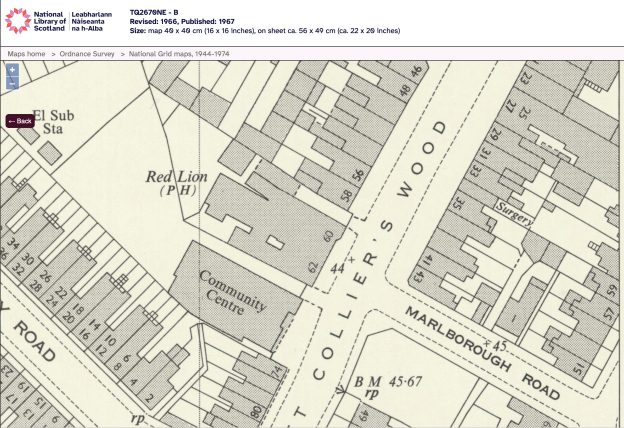
1967 OS map. Ordnance survey maps are reproduced by permission of the National Library of Scotland (reuse CC-BY).

Licensees

1972 – Dennis Callaghan (source: Mitcham and Colliers Wood Gazette 22nd June 1972)

1925 – Mrs. J. O’Neill
1902 – Ellen Kettle
1896 – Samuel Ezekiel Kettle & Mrs. Ellen Kettle
1875 – John Marchant Penfold
1870 – James Marchant Penfold
1867 – Mrs. Maria Chandler
1851 – James Townsend
1837 – Henry James Hoare
1824 – William Pithouse
1822 – Ann Ritchie

Disco Pub

In 1972 owner Charram Ltd, part of brewery Bass Charrington, converted it into a disco pub.

1972 ad from the Mitcham and Colliers Wood Gazette, colourised by Google Gemini


The Battle for Collier’s Wood: How a “Mind Blowing” Disco Pub Sparked a Residents’ Revolt in 1972 London

The conflict is timeless: a new business opens, and the quiet rhythm of a neighborhood is suddenly disrupted. Disputes over noise, parking, and a new crowd of people can quickly escalate into a battle for the very soul of a community. While these stories play out in towns and cities every day, few are as perfectly preserved in amber as the one found in a collection of 1972 newspaper clippings from South London. This is the wild, hyperlocal history of the Red Lion Disco Pub—a culture clash that pitted Go-Go Girls and groovy tunes against a residents’ association threatening “militant action.”

A New Kind of Nightlife Sparks a Fire

In 1972, an advertisement for the Red Lion at 62 High Street, Collier’s Wood, promised a revolution in local entertainment. It wasn’t just a pub; it was a “Fabulous Disco-Pub!” and “It’s South London’s latest disco!” The ad trumpeted “dancing seven nights a week,” the “Latest discs!” spun by a “Top D.J.!”, and the presence of “Go-Go Girls.” It urged patrons to “Come and do your thing!” in an atmosphere it declared both “Groovy!” and “Mind Blowing.”

This hybrid venue represented a seismic cultural shift. For a London suburb accustomed to the traditional quiet pint, the fusion of a local pub with the loud, vibrant, youth-driven energy of a modern disco was an entirely new and disruptive concept. The Red Lion wasn’t just offering a drink; it was importing a high-energy, city-center nightlife experience directly into a residential neighborhood.

“Militant Action” and a Neighborhood “Polluted with Riff-Raff”

The arrival of the disco pub was not met with universal enthusiasm. As one April headline in the Mitcham and Colliers Wood Gazette bluntly stated, the “Red Lion Pub Row Hots Up.” Residents felt “plagued” by the pub’s patrons, and their response—a blend of formal civic organizing and populist rage—is a classic example of a community reacting to perceived cultural intrusion.

Initially, the opposition was procedural. The Collier’s Wood Residents’ Association, led by its secretary Mr. Percy Whiffin, began organizing public meetings to plan their strategy. They launched a petition to have the pub’s music and dancing licence revoked, a campaign that gained significant traction, gathering nearly 500 signatures.

But as the weeks wore on, the frustration escalated dramatically. By May, the newspaper was reporting on a “stormy meeting” where residents threatened to take “militant action.” The core complaints centered on “parking, tight hooliganism and misuse of property”—the term “tight hooliganism” likely referring to drunken or loutish behavior. The strength of local feeling was captured in one resident’s fiery statement:

“We have become polluted with riff-raff who don’t even live around here. It would be a good idea if we withheld our rates or even circle the pub to stop people from going in.”

This wasn’t simply a two-sided war. The pub’s owners, Charrington, became a third party in the conflict. Mr. Wray, a general manager for the company, met with residents and assured them Charrington “had taken up the problem very seriously,” and the company put up notices inside the pub asking patrons to be quiet when leaving.

The New Manager Who Found the Chaos “Quite Enjoyable”

Thrown into the middle of this escalating war was Dennis Callaghan, the 28-year-old Irishman who had taken over as manager of the controversial pub just three weeks prior. Surrounded by angry residents and intense media scrutiny, Callaghan offered a surprisingly calm perspective on the chaos. His cheerful detachment provides a fascinating counterpoint to the high emotional stakes of the residents, highlighting the gap in perspective between the provider of the new entertainment and the recipients of its consequences.

Instead of expressing frustration, he told the Gazette he was taking the entire “row” in stride. He also defended his establishment, arguing that the troublemakers were a minority. “There was rarely any trouble inside the pub,” he stated, adding that “residents rarely appreciate that.” In an earlier interview, he had offered this moment of unexpected levity:

“This is the first disco pub I have run but it is quite enjoyable. Once all this trouble is sorted out I am sure I will enjoy working here all the more.”

The Strange Victory Where the Disco Pub Stayed Open

After months of dispute, the case went before the Greater London Council’s public services entertainments licensing sub-committee. The final newspaper headline announced a bizarre and unsatisfying conclusion for all involved: “VICTORY FOR RESIDENTS – BUT DISCO PUB STAYS”.

The residents had technically won. The council agreed with their complaints and revoked the Red Lion’s music and dancing licence. However, the pub’s owners, Charrington, immediately filed an appeal. This legal maneuver allowed the pub to continue operating as a full-fledged disco for at least another four weeks while the appeal was processed.

This ambiguous result left both sides feeling “disappointed.” For manager Dennis Callaghan, the threat still loomed. For Mr. Percy Whiffin, the win was hollow. Despite the militant talk from some residents, his stated goal had been “to keep the peace” and work towards a “mutual satisfaction for both sides.” The ruling achieved a legal victory but guaranteed that the neighborhood’s fundamental conflict would continue.

Source: blog report generated by Google NotebookLM using scans of editions of the Mitcham and Colliers Wood Gazette.

The oldest pubs in Mitcham – according to parish records

From the Mitcham Advertiser – Thursday 07 July 1927

MITCHAM NOTES.

Why are all the public houses in High-street, Colliers Wood, on one side—the west side of the road? I asked the Chairman of the Council and he said he must have notice of the question. I asked Mr. Groom-bridge and he thanked heaven he lived in the wilderness on the other side. I asked Coun. Cusden and he said “What does it matter? The beer is just as good at Cusden’s Stores.” I asked Jack Fitch and he said it was a shame. I asked George Bennett and he said that was one of the inequalities the Labour Party was out to remove. I asked Thirsty Bill, who has often been fined 10s. and costs for being all on one side himself, and he said, “Hie-wash-wash I get for tellin’ ya!”

So I led the way to the Blue Nose and Slop Basin and called for two acid drops. Thirsty Bill’s eyesight is getting bad and in mistake he drank both. “Shay, guv’nor,” he hiccoughed, “don’t-tcha berlieve it.” “Believe what?” I asked. “Thash all pubs in thish—thish street—hic—thash all pubs in any streetsh on one sidesh. Nope. Sh’all wrong. Man who shesh pubs in thish tsreetsh all on one shide—sidesh ish—hic—ish drunk.”

In desperation I asked Mr. R. M. Chart. Mr. Chart knows more about the pubs of Mitcham than any man. This statement, I hope, will be taken in the right spirit. With his usual courtesy he let me waste his time while I propounded the more or less important question then said “It’s an interesting point certainly, and, I think, easily explained.”

Mr. Chart reminded me that unknown to many of the residents of Colliers Wood a brook flows down the east side of High-street into the Wandle at Merton. It is under the roadway and was covered in within living memory. It is the same stream that protects Mitcham from Tooting. “It is reasonable to suppose,” he added, “that when High-street was a rural way with an open brook along the whole of its east side the roadside inns were built on the west side to avoid that brook.”

A simple solution, you must agree, of a great mystery to you and me. Evidently mine host of the days of yore took more pains than does Boniface of to-day to pre-vent his customers from mixing their drinks—involuntarily.

It would have been utterly foolish to let Mr. Chart go without asking him for facts about the King’s Head and the grand old elm slain last week to make a motorist’s holiday.

“Time hollowed in its trunk a tomb for centuries,
And buried there the epochs of the rise and fall of states,
The fading generations of the world,
The memory of men.”

Mr. Chart not only enlightened me about the King’s Head and the elm, but gave me historical notes of a dozen other Mitcham hostelries. The earliest mention of the King’s Head in the Parish Records of Mitcham is under date 1732. There is evidence, however, that the house was erected in the Elizabethan period, for it is a very old timber framed building re-faced with brickwork. The elm, lamented as much by tea sloppers as by froth blowers, was probably more than 250 years old.

On the occasions when the Prince of Wales (afterwards King Edward) attended Epsom Races and changed horses at the King’s Head, as told in the “Advertiser” last week, the Village Beadle, William Hills, a builder and a fine portly man, who lived at Vine Cottage, Lower Green, the oldest house in Mitcham, was always present in gold laced uniform ostensibly to keep the crowd in order. After one cere-mony of the kind he received a letter written on notepaper crowned with the Royal Arms thanking him for his atten-tion and services.

Mr. Chart thinks the Beadle never knew that he was the victim of a parish wag, for he was always fond of exhibiting the letter. Mr. Hills was also the Town Crier. He paraded the village with a hand bell and always wound up his orations on the subject of the lost sheep or other matters with the pious and loyal sentiment “God Save the Queen.” To which the children, who usually followed in his train, added “And hang the Crier!”

The Bull, Church-road, is first mentioned in parish records in 1753, so it appears to be the second oldest inn in Mitcham. Un-doubtedly all the inns were in existence long before the dates given. The Buck’s Head is mentioned in 1776. It was re-built about twenty years ago and set back 10-ft. from its original frontage on London-road.

The White Hart, beloved of Councillors, and, if I remember aright, of church-wardens of other days, came to the official notice of Mitcham in 1784. The King’s Arms, formerly a timber framed building on a site north of the present building, was first recorded in 1787. The Red Lion (Colliers Wood) comes into prominence in 1792 and two years later the Nag’s Head, a timber building except the front, is men-tioned, as is also the Swan.

The Goat comes next into the records in the year 1805. In 1819 the Half Moon shone at the corner of Lock’s-lane, but it has long since set to rise no more. The Six Bells, Merton Bridge, can also be traced back to 1819. A year later the Cricketers Inn is officially taken notice of, but I have a feeling that it was unofficially observed long before that time, particularly by sportsmen with a dry humour.

The last pub turned up by Mr. Chart was the Phoenix, first mentioned in 1838. It justified its name some years ago by rising out of its dead ashes as the Horse and Groom. Of the Sportsman, which formerly gave Dutch courage to those about to enter Love-lane, there is no official record at all. Which only shows you that the Vestry Clerk of that day, like the last of his line, was a gentleman of discretion.

If Mr. Gaston had been a member of the Fire Brigade Committee, or a follower of the statesman who urged all public per-sons to verify their references, he would not have “made the bloomer” of assuming that the Chief Officer was advocating the purchase of a foam generator like “the only one in London.” That is a machine the size of a motor pump and costing as much. Mr. Wells clearly stated in his report (in front of Mr. Gaston as he spoke) that the machine he had in mind would cost £75. He also clearly stated that his remarks and suggestions were “applicable to the storage of inflammable liquids that do not come within the provisions of the Petroleum Act.”

Now I say that as certain councillors do not come within the provisions of the Petroleum Act it is the duty of the rest to safeguard themselves and Mitcham by the purchase of a continuous foam extinguisher not generator. If one can be got for £75 and will prevent Coun. Groombridge, for instance, from bursting into flames more than fifty times at one meeting it will be a real economy to buy it.

THE COMMONER.

This text was extracted using Google’s AI Studio, model “Gemini 2.5 Pro Preview 03-25 gemini-2.5-pro-preview-03-25”, with the prompt “extract the text from this 1927 newspaper article” against the downloaded article image from the British Newspaper Archive.

Image © Successor rightsholder unknown. Please contact support@britishnewspaperarchive.co.uk if you wish to claim rights to this title.. Image created courtesy of THE BRITISH LIBRARY BOARD.