Category Archives: Urban District

Manor Road

In this 1913 OS Map, Manor Road was the name of the road at the northern edge of the Urban District boundary, and continued along past the Streatham Park Cemetery, then south towards Mitcham Common.
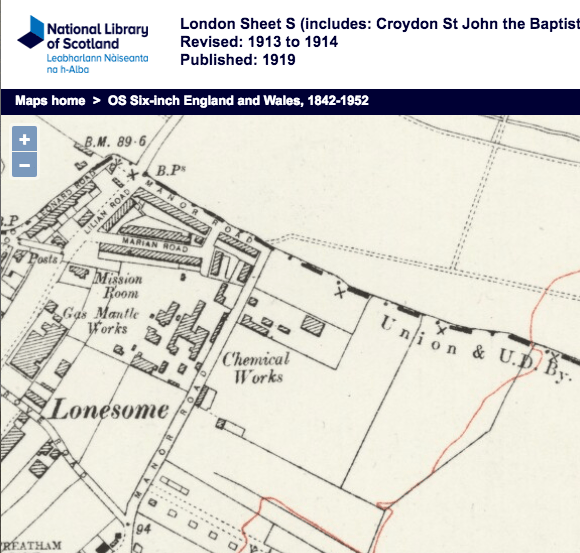
1913 OS Map
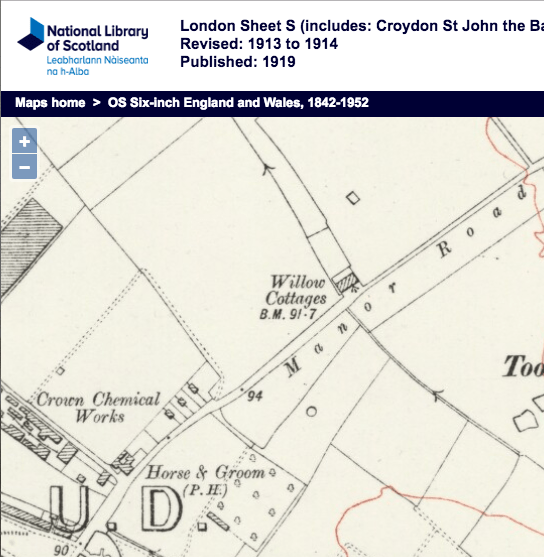
1913 OS Map

1913 OS Map

1913 OS Map

Parts of the road were renamed, after this suggestion in 1926:

From the minutes of the Mitcham Urban District Council
Highways, New Streets and Buildings, and Lighting Committee
Tuesday, 14th September, 1926

6. MANOR ROAD.

— Read letters from the Battersea District Post Office and the Streatham Park Cemetery Company suggesting the renaming of Manor Walk and a portion of Manor Road in order to prevent confusion.

Resolved to recommend, That the following names be adopted :

Manor Road, from Commonside East to a point 300 yards north-east of Willow Cottages ;

Northborough Road, from Manor Road to Croydon Boundary, and to be numbered from the Croydon end of the road ;

Rowan Road, from Manor and Northborough Road to Wandsworth boundary opposite No. 31, Greyhound Terrace ;

Greyhound Terrace, from Rowan Road to Lilian Road.

Newspaper Articles

191 Manor Road – from the Mitcham Advertiser – Thursday 20 October 1927

“A BIT O’ LUCK.” The True Tale of a Mitcham Cupboard, Not Exaggerated.—(Official). Mrs. Arkle, the wife of Quarter-master Gunner Arkle, came over from Chatham to Mitcham to see the new house her officer husband had bought from the Tamworth Park Construction Company. It is 191, Manor-road, ~ In the course of her inspection Mrs, Arkle placed her purse containing 30s, in Treasury notes and a few coppers on the top shelf of a cupboard. Workmen were in the house all the time, Two days later, when about to return to Chatham from London, where she was staying, she missed the purse and only remembered after an effort where she had laid it “I hurried back to the house,” she told the “Advertiser,” and found workmen still at work there. I asked one if he had seen a purse, and from the bhewildered exsression on his face I knew he had not. then looked in the cupboard and to my great delight, for money is money when you are paving for a house, and we are only poor people, the purse and its contents were exactly where I had left them. It was a marvellons bit of luck, I think.” “You are sure it was not £100,” said the “Advertiser” representative. Mrs, Arkle had just been told that an imaginative contemporary had accused her of leaving £100 in the house. Her reply was too poetical for these pages.“Another great myth exploded” chuckled her sailor husband.

World War 2 Connections

No. 78, 2nd. L/T. W. ROWNTREE joined the Home Guard
No. 127, Cpl. H. PLEDGE joined the Home Guard 15th October 1940

Civilian Casualties

17th October 1940
Mary Ellen KING, aged 56

22nd June 1944
Frederick William BAKER, aged 64


Minutes of meetings held by the Mitcham Urban District Council are available on request from the Merton Heritage and Local Studies Centre at Morden Library.

Maps are reproduced with the permission of the National Library of Scotland.

1932 Lighting of Colliers Wood High Street

In 1932, Colliers wood was part of the Mitcham Urban District.

1934 OS Map - the boundary with Wandsworth Borough was just north of the bridge over the railway line, south of the junction with Blackshaw Road and Longley Road

1934 OS Map – the boundary with Wandsworth Borough was just north of the bridge over the railway line, south of the junction with Blackshaw Road and Longley Road

The council’s surveyor reported that the Gas Company’s chief engineer proposed using reflectors to increase the light from the ‘Windsor’ gas lamps in use, and that Windmill Road was to be used for a test. This road, across Mitcham Common, had no housing and without any lighting nearby would be a good way of assessing the effectiveness of this proposal.

For more on the Windsor type of gas lamps, see the William Sugg & Co. History website.

From the minutes of the Mitcham Urban District council
Volume XVII 1931 to 1932
Highways Committee
4th February, 1932
Pages 647 to 648

STREET LIGHTING, WINDMILL ROAD

The Chief Engineer to the Gas Company has now evolved a system of reflectors suitable to Windsor type lanterns, and is willing to demonstrate them free of charge in Windmill Road, and I have given him authority to carry out this improvement on the understanding that should they not prove satisfactory there will be no charge. The reflectors have now been fixed in position, but I have not yet had an opportunity of inspecting them at night, and will make a further report to the Committee next month.

The cost of fitting these reflectors on the six lamps is 24s., and the cost of conversion to double burners 12s., with an extra maintenance cost of £10 2s.

HIGH STREET, COLLIER’S WOOD.

The length of High Street, Collier’s Wood, is 970 yards, and is lighted by means of three-burner Windsor type lamps, eight of which are on the west side and twelve on the east side. The maximum distance apart is between the lamp at the corner of Cavendish Road to that opposite North Gardens, a distance of 80 yards; whilst the
minimum distance is 30 yards, this being the distance between the same lamp at the corner of Cavendish Road and that at the corner of Byegrove Road.

The length of the road in the Metropolitan Borough of Wandsworth, immediately adjoining the district boundary, is lighted by means of six-burner lamps fitted with reflectors, and is very well illuminated at this point, due, firstly, to the extra lamps being installed on the tramway refuge by Longley Road, and, secondly, to the close spacing and high power of the lamps, the maximum distance apart being 38 yards. In a length of 125 yards from the district boundary, there are 7 six-burner lamps. I suggest that alterations take place on the Mitcham side in order to tone the lighting down gradually. I propose that the second lamp be resited and converted to six-burner at a distance of 50 yards from the first lamp in Wandsworth, and the remaining lighting on the bridge approach would then be adequate.

In my previous report I proposed that a three-burner lamp be fixed to replace an obsolete type lamp opposite No. 216, and on further inspection, late one Sunday night, I suggest two additional lamps be erected, one midway between North Gardens and Cavendish Road, and one between College and University Roads on the east side. When these lamps are fixed I think the road will be reasonably well lighted.

I have prepared a plan and estimate of the cost of lighting the road in the same manner as the recently relighted Tooting High Street, where each lamp is fitted with six burners at a maximum distance apart of 50 yards. The capital cost of this scheme would amount to £230 and the extra annual maintenance cost would be £150. I cannot see that this expenditure is justifiable in any way.

If the reflectors on the lamps in Windmill Road prove satisfactory they could be fixed with advantage to the lamps in High Street, Collier’s Wood.

Yours obediently,
RILEY SCHOFIELD, Assoc. M.Inst.C.E.,
engineer and Surveyor.

Resolved

(d) Lighting of Windmill Road. – That the Committee consider this question at the next meeting, when an opportunity has been given to the members to observe the effect of the new system of reflectors.

(e) Lighting, Collier’s Wood. – That the Surveyor be authorised to replace the obsolete type of lamp opposite No. 216 with a new three-burner lamp, and that two additional lamps suggested by the Surveyor be also provided, and that if the reflectors prove satisfactory in Windmill Road this system is adopted in High Street, Collier’s wood.


Inflation adjusted costs:

1932 2016
12s. £37
24s. £74
£10 2s. £620
£150 £9,200
£230 £14,000

Minutes of meetings held by the Mitcham Urban District Council are available on request from the Merton Heritage and Local Studies Centre at Morden Library.