Tag Archives: Rutter

Hannah Lack, draper

Draper who, in 1910, was at no. 2 and 4 High street, Mitcham.
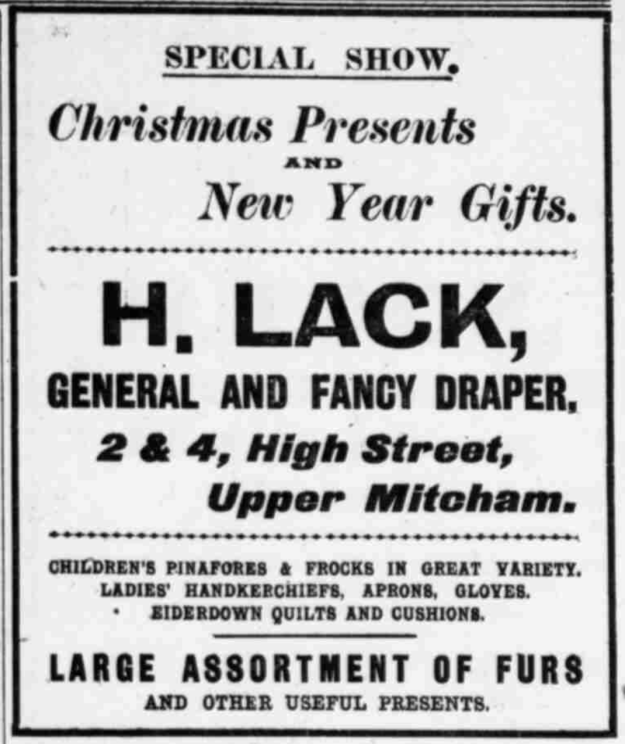
Mitcham Advertiser – Friday 16 December 1910
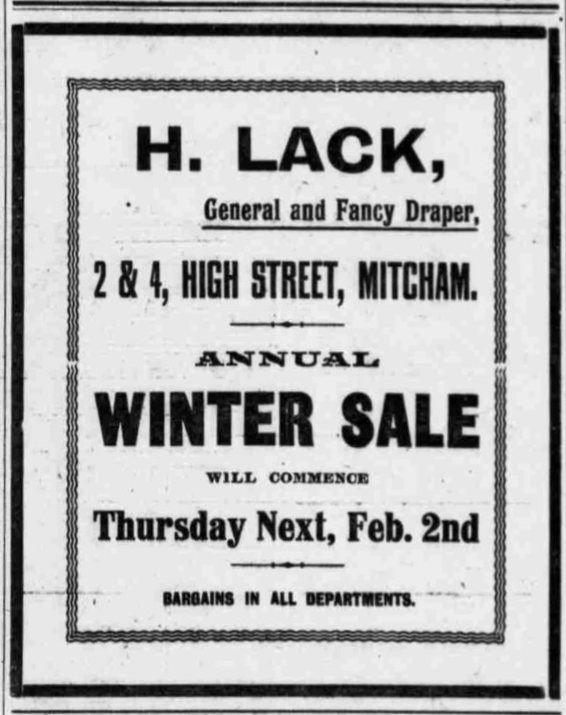
27th January 1911, Mitcham Advertiser
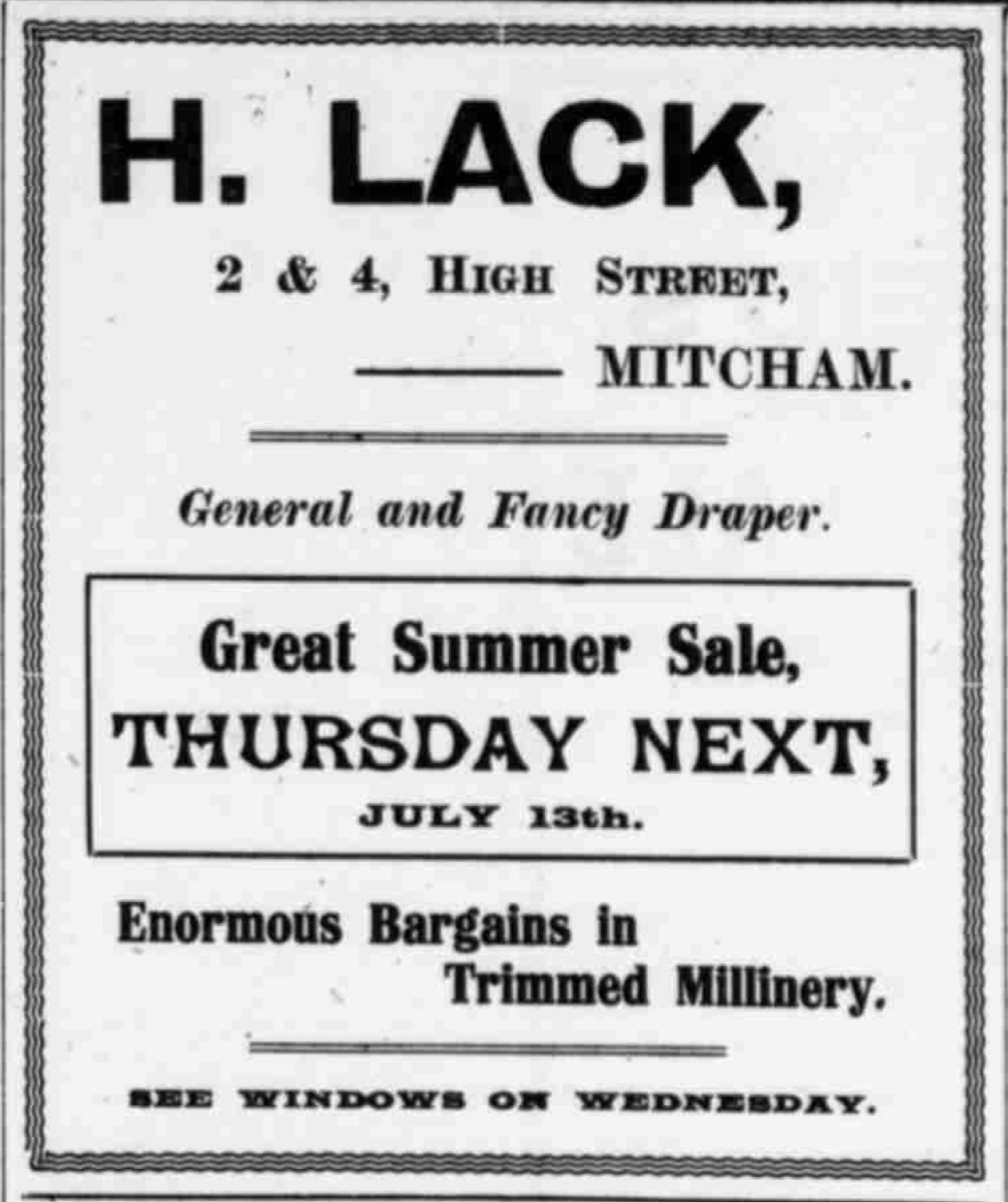
Mitcham Advertiser – Friday 07 July 1911

This shop was next to the King’s Arms pub, as shown in the 1912 street directory, which lists entries going south.

… here is Sibthorp Road
George Joseph DALE, newsagent
William BARTER, grocer
STANSFELD & Co. Ltd., brewers and wine merchants
Walter MARTIN, butcher
John CUMMINGS, greengrocer
Mrs H. LACK, draper
The King’s Arms P.H., H. & E.F. MOORE

See also the comments below by a descendant of the family and the entry on Wikipedia Lack Brothers

This postcard from the early 1900s shows shops with awnings, the nearest to the Kings Arms is likely to be the draper shop of Mrs Lack.
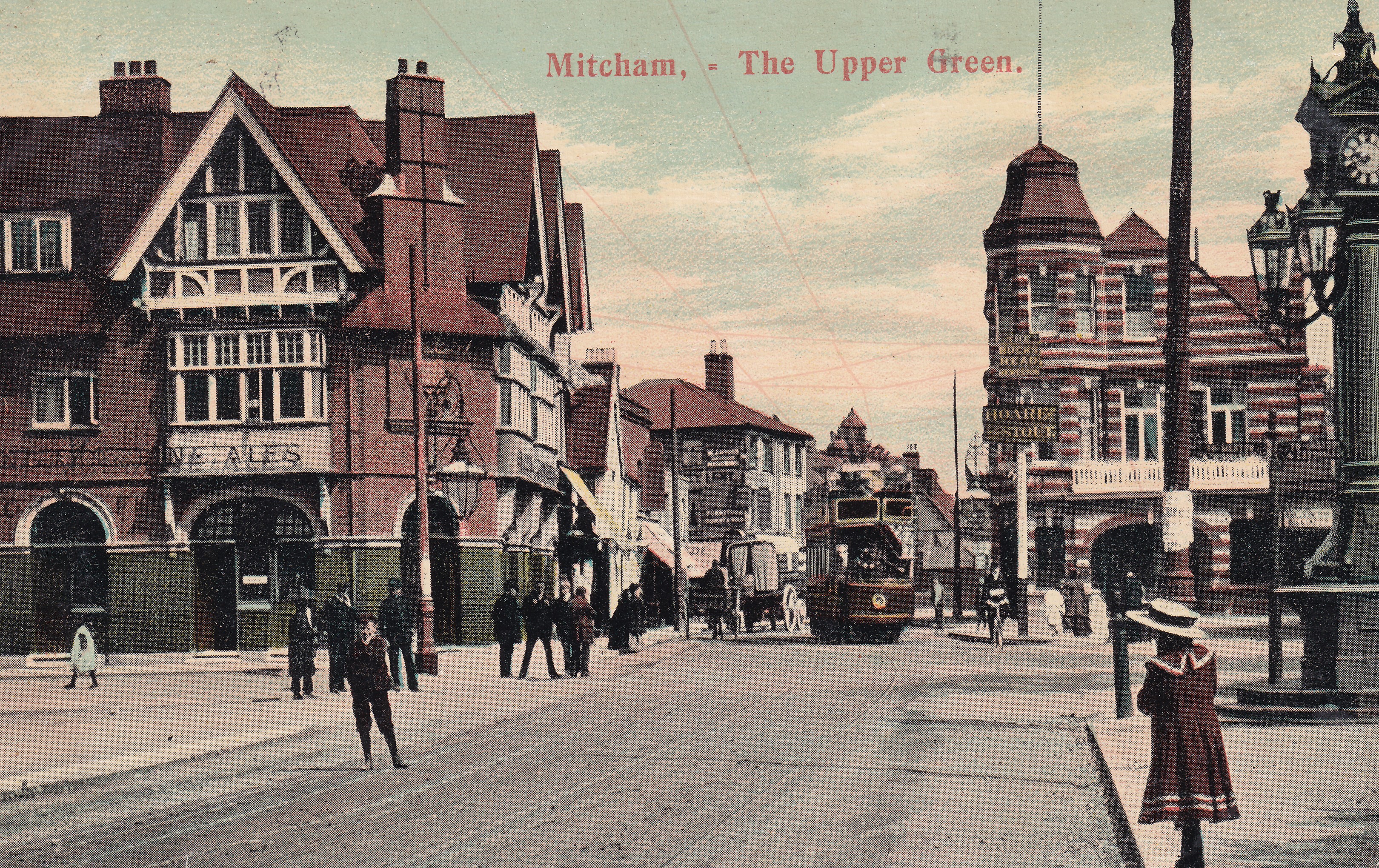
Postmarked 28th Feb 1907

Mitcham Advertiser – Friday 27 April 1917

A “SPECIAL’S” WEDDING. SERGT. C. LACK AND MISS E. M. RICHENS MARRIED.

Great interest was taken in the wedding at St. Mark’s Church, Mitcham, on Wednesday, of Mr. Charles Lack, younger son of – Mrs. H. Lack, High-street, and of the late Mr. G. A. Lack, and Miss Emily May Richens, elder daughter of Mrs. F. Richens, Newton House, and of the late Mr. John Richens of Tooley-street. The church was filled with spectators.

Mr. Lack was born in Mitcham, is one of the most successful business men in the town, and his social qualities have won him the esteem of all classes. For ten years he has been hon. treasurer of the Tooting, Balham, Merton, and Mitcham Horticultural Society; for 15 years he was a member of the choir of St. Mark’s, and he is now a sidesman; he is hon. secretary of the East Ward Naval and Military Pensions Committee; and since the war began he has been a zealous member of the Mitcham Special Constabulary, of which he is now a sergeant. On several occasions Mr. Lack has been pressed to try tor Municipal honours, but declined, The bride’s family have been domiciled in Mitcham for 30 years, and has always held a high position in the esteem of the inhabitants, and the bride herself has won the particular regard of the people of St. Mark’s, in which parish she has been a constant worker. She has also taken a great and active interest in the military hospital.

Among the congregation were Coun. E. J Mizen (People’s Warden), Coun, Ernest Mizen, Mr Taylor, a former Warden, Mrs. Edward and Mrs. Ernest Mizen, Miss E. Mizen, and Mrs. C. Rutter. Thirty members of the Special Constabulary in uniform formed a guard of honour, and in the church lined the central aisle on both sides. The sergeants present were Sergts, Dale, Cooper, Freeman, Rutter, Billington and McCaul. At the door was the veteran Special Constable Merrick, glowing with Army medals. The service was fully choral, and was conducted by the Rev. James Bevan, of All Saints’, Beddington Corner, a former curate of St. Mark’s, assisted by the Rev. W. K. Roberts, Vicar of St. Mark’s and the Rev. E. J. Baker, Vicar of St. Barnabas. The organist was Mr, J. Hopton. A brief address was delivered at the close of the service by the Rev. James Bevan, and the Rev, W. K. Roberts gave the benediction. Afterwards all joined in singing a verse of the National Anthem. The bride was escorted to the altar by Mr. Tom Richens, her eldest brother, and she was given away by her mother. She was beautifully attired in grey crepe de Chine, trimmed with amethyst bead em- broidery. She wore a grey silk hat, and carried a shower bouquet of liIies and orchids. Her going away dress was a Russian blue coat and skirt, with black and gold hat. There were no bridesmaids.

The Best man was Capt. S. James, King’s Royal Rifles, From the porch to St. Mark’s-road the “Specials” were drawn up in a double line, and when the bride and bridegroom appeared at the church steps they formed an arcade of their truncheons. The Culvers, Carshalton, was lent by Mr and Mrs George Mizen for the reception. Mrs. Richens acted as hostess to about fifty guests, Later in the afternoon Mr. and Mrs. Lack left for Cornwall. On returning to Mitcham they will reside at Home Close, St. Mark’s-road. One of the handsomest of the many beautiful wedding gifts was a canteen of cutlery from the Special Constabulary. From the Horticultural Society was received a beautiful silver rose bowl. Another gift of special interest was a handsome brass and copper paper stand presented by the lady assistants at the High-street establishment.

Note that Home Close, is number 26 St Marks Road, the current home of the Royal British Legion, on the corner with Chalkley Close.

Mitcham Advertiser – Thursday 29 July 1926

DEATH OF MRS. HANNAH LACK.
In Business in Mitcham Fifty Years.

A link with the old village of Mitcham was severed this week by the death of Mrs. Hannah Lack, who was in business as a draper in London-road for fifty years.

She passed away in her 82nd year on Thursday, July 22nd, at The Culvers, Carshalton, the residence of her son-in-law and daughter, Mr. and Mrs. George Mizen.

No Mitcham resident was held in greater esteem than Mrs. Lack. She came to the village, as it then was, 67 years ago and lived in the same house and conducted the same business in the High-street section of London-road, near the Fair Green, until she retired during the war. She was the widow of Mr. George Albert Lack, who died in 1878.

Mrs. Lack was a fine business woman and during her regime the shop flourished exceedingly. In later years she was assisted by her son, Mr. Charles Lack, who took over the business entirely when his mother retired. To the great regret of all the older residents the business ceased to be a few months ago.

THE FUNERAL.

The funeral took place on Tuesday afternoon at Mitcham churchyard. The Rev. W. K. Roberts, Vicar of St. Mark’s, conducted the service. There was a large attendance of the older residents and tradespeople.

The chief mourners were Mr. and Mrs. Joseph Lack (son and daughter-in-law), Mr. and Mrs. Charles Lack, Home Close, Mitcham (son and daughter-in-law), Mr. and Mrs. George Mizen, The Culvers, Carshalton (son-in-law and daughter), Douglas Lack and Lewis Mizen (grandsons), Mr. W. T. Lack and Mr. Percy Martin (nephews), Mr. Stanley Lack and Mr. Charles Lack (great nephews).

Others present at the church and at the graveside were Mr. and Mrs. Stanley Schneider, Mrs. Avery, Mrs. Heasman, Miss Howell, Mr. Ernest Ghinn, Mr. Ernest Ghinn, jun., Mr. Percy Ghinn, Mr. and Mrs. Arthur Tibbitts, Mr. and Mrs. Frederick Mizen, Mr. W. Barton, Mr. H. H. Dance and Mr. J. Cummings.

The exceptional number of floral tributes included wreaths from Mr. and Mrs. George Mizen, Mr. and Mrs. Charles Lack, Mr. and Mrs. Joseph Lack and family, Lewis, Hubert and Howard (grandchildren), Will, Edie and family, Agnes and family, Mona and Charles Lack, Stanley and Cousie, Miss F. Bowhill and Miss G. Chippendale, Mr. and Mrs. Warr, Beatrice and Bertha, Mrs. Sweet and family, Lil and Harry, Gladys and Fred, Mr. and Mrs. Woonton, Mr. and Mrs. Arthur Tibbitts, Mr. and Mrs. H. C. Millen, Auntie Byford, Mrs. and Miss Dale, Mr. and Mrs. Sidney Miller, Mrs. George Miller, sen., Mrs. Hicks and family, Rosie, Fanny, Stanley and Cissie, Edie and Fred, Mary Howell, Mr. and Mrs. George Lack.

1879 : Beating the Bounds

From the Croydon Advertiser and East Surrey Reporter – Saturday 31 May 1879, via the British Newspaper Archive

PERAMBULATION OF THE PARISH OF MITCHAM.

On Ascension Day, May 22nd, and the day following, was witnessed in the parish of Mitcham the now almost obsolete practice of “Beating the bounds of the parish,” which had not taken place since 1835, although a dispute as to boundary occurred in 1847 which was settled by the now fashionable means of arbitration. The arrangements having been kept somewhat secretly, prevented the assembling of so large a concourse of people as might have been expected, the weather being on the first day all that could be desired. We understand that there bad not been a general invitation to the parishioners to attend, but it extended only to the clergy and parish officers. But before giving any further details of the day’s proceedings it may interest many of our readers to give a short account of perambulations in general, and that of Mitcham in particular.

It is stated in Shaw’s Guide to parish law, published upwards of century ago, that “The boundaries of parishes being now settled by custom care is and ought to be taken to preserve them by annual perambulations, which should be kept up at the usual time, and the boundaries of the parishes so carefully viewed and settled in them as to leave no room for any doubt or contest about them. In the times of Popery these perambulations were performed in the nature of processions, with banners, handbells, lights, staying at crosses, &c., and therefore, though such processions were forbidden by the injunctions of Queen Elizabeth, yet by the same injunctions, the useful and innocent parts of perambulations were and are still retained.”

The earliest account that we can find of a perambulation of the parish of Mitcham is obtained from the oldest volume of Churchwardens’ accounts, which covers a period from 1653 to 1680, for in the accounts for the year 1662, the following item occurs: —“ Pd for our dinner and the boyes att our perambulatinge 7s. 2d.” Whether the boys underwent the bumping and whipping generally understood to take place upon those occasions, to indelibly impress the doubtful and difficult parts of the boundary in the juvenile mind, is not here stated, but in the year 1663 is this entry, “Expended on those who went perambulatinge in the Rogation weeke for victualls and drinke the sum of £1 0s. 4d.” and again under date 1670, “ Expended at the perambulacon on those that went ye bounds of ye Pish, £3 2s. 2d.” In the year 1673 the the description of the fare provided upon these occasions is more fully expressed thus for meat, drinke, and cheese, for those that went the perambulation.” No further mention is found of the matter until 1678, when “Expended at the perambulacon on Holy Thursday £3 0s. 0d. for horse hyre that day, 1s.” These items distinctly prove that perambulations of the parish were much more frequent in the 17th than 19th century. Passing over a few years we find that these gatherings did not always pass off quietly as could be wished, as is shown by the following extract from the minutes of a vestry held 20th June, 1731 :- “It is the opinion or the parishioners now in vestry assembled that the churchwardens, against whom actions are brought by William Farrer, Esq., Henry Downs, clerk, Thomas Green and Osmond King, For going in their perambulations on Ascension Day last thro’ a place called the new grounds formerly taken out of Mitcham Heath, ought to bee indemnified by the parish from all costs and charges that shall arise concerning the same.” The foregoing is followed by resolution passed at a vestry held on Sunday, 27th of same month, that “It is the oppinion of the parishioners that Mr. Peter’s be employed to make a case concerning the perambulatious, &c.” The bounds were also ordered to be walked in 1771 and 1772. With the following two entries from the churchwardens’ accounts we shall close our notice of the ancient perambulations of the parish:- “3 May, 1733, Paid for the dinner, wine, bread, beer, cheese, &c., when Mr. Hatsell and the churchwardens, with a great number of the other inhabitants of Mitcham, went the whole perambulation of the parish of Mitcham, £6 19s. 5d.” The Mr. Hatsell here mentioned was the Rev. William Hatsell, eldest son of Sir Henry Hatsell, Baron of the Exchequer. He was instituted vicar of Mitcham 13th July, 1724, and resigned 13th January, 1733-4. “23 May, 1724, To the Wid Boddison was due to her late husband for drink at the perambulation 3 May, 1733, and left unpaid, 10s. 6d. Paid for the dinner, wine, bread, beer, cheese, &c., when the churchwardens, and great number of the parishioners of Mitcham went again the perambulation on the south side of the parish, taking in all Mitcham Common as usual, together with the 80 acres called new grounds, antiently taken out of Mitcham Heath, £6 10s. 0d.”

The place of rendezvous selected on Thursday was the Goat Inn, situated about half-a-mile from Mitcham Junction, and punctually at eight a.m. the perambulation was commenced. Amongst the company present were the following:- Rev. D. F. Wilson, M. A., vicar, Rev. H. G. Dod, curate, Mr. Churchwarden Nobes, who bore his wand of office, the three overseers, viz., Messrs. W. R. Harwood (who carried a staff inscribed Mitcham Parish,” apparently a relict of long defunct bumbledom), S. Love, and J. Lewis. A few other parishioners and friends joined later on.

The arrangements for the day were principally under the direction of Messrs. E. and R. M. Chart, the latter of whom carried a ribbon map of the boundaries, upwards of 25 feet in length. The proverbial “boys,” six in number, especially told off for the duty, beat the various boundary posts and streams of water, &c., with willow wands. The “State” was represented by two policemen, who apparently enjoyed this somewhat novel form of duty.

Starting from the Goat Inn the party followed the river, leaving McRae’s tannery on the left, a man provided with waterman’s boots defining the boundary down the stream, but it was found advisable to take a punt where the water was particularly deep and muddy. Searl’s and Ashby’s mills were passed in due course, and the various boundary posts having been beaten by the boys after the Vicar had pronounced, whilst the perambulators stood bare-headed, “ Cursed be that removeth his neighbour’s land mark.” Entering the grounds of the late Mr. G. P. Bidder, the stream was followed to Rutter’s snuff mills, then through the grounds of Morden-hall, and past Phipp’s-bridge to Merton Abbey Station. Merton bridge was reached at 12.15 p.m., where a stick was floated under, the waterman being in mid stream ready to receive it as it came out on the other side.

The company then adjourned to the Six Bells for lunch, which was admirably served by Host Giles. The chair was taken by Rev. H. G. Dodd, the Rev. D. F. Wilson having left the party, but rejoined it later on in company with Rev. F. S. Legg, vicar of Christ Church, Singlegate, Mr. Churchwarden Nobes taking the vice chair. After all had done justice to the collation.

The Chairman rose and in a short but pointed speech proposed, “The Queen,” which the company heartily responded to by singing the National Anthem. The Vice-Chairman, in rising, said he had much pleasure in being present on that occasion. It was the first time he had walked the bounds of Mitcham, although he had done so in another parish. He spoke of perambulations being an ancient custom and alluded to Lord Nelson having resided at Merton, upon the verge of which parish the company were then assembled. After complimenting the overseers and Mr. Chart upon their excellent arrangements, he concluded by calling for three cheers for those gentlemen.

Mr. W. R. Harwood, in an appropriate speech, returned thanks for the overseers, and Mr. Chart, whom said they were all indebted.

The perambulations were again commenced, through the garden of the Six Bells, over part of what was once the Wandsworth and Croydon tramway, the boundary here being somewhat intricate, to the back of Child’s flour mill, and Byegrove-mead, where the new sewage works are in course of and up to the wall of Garrett Cemetery. The railway crossed in several places, the axe being used on the various boundary posts to show that none had been passed over. Some little time was spent in defining a small detached part of the parish, which being at last satisfactorily settled, the party made towards Tooting Junction, some of them going through a house that had been built over the parish boundary. Tooting Junction was reached at 4.30 p.m. and after crossing the garden of the house supposed to have been the residence of Daniel de Foe, the company separated, having had a somewhat tiring but agreeable day.

The weather on Friday morning looked very threatening, and heavy showers were experienced during the day, but nevertheless at a few minutes after 8 a.m. the Rev. H. G. Dodd, the overseers, and others arrived Tooting Junction, and immediately the perambulation was recommenced under the guidance, as before, of Messrs. E. and R. M. Chart. Following the course of the Graveney, a tributary of the Wandle, to Streatham-lane, where noted the bridge over the stream, called Roe Bridge,” which connects the parishes of Mitcham and Streatham, has a stone let the north side, bearing the Merchant Taylor’s arms, and inscribed, “This bridge was built at the cost of the Worshipful Company of Merchant Taylors, 1652.” Still following the river to the railway, which was crossed near Streatham Rifle Butts, the party proceeded to Lonesome, passing over the race course and leaving the stand the left. Here several posts put up by Croydon parish were duly marked with a cross. Passing through the wood to the extreme north east corner of Mitcham Common, which was reached at ll a.m., and at that point, the rain having cleared up for a short time, an enjoyable al fresco lunch supplied by Mr. Marchant, of the Horse and Groom, was partaken of. The common was then skirted to Beddington station, and after going down Beddington-lane for a short distance the fields were entered on the right, and a walk straight across country passing over the railway en route brought the company out of the plantation near Beddington Corner. Mr. Chart informed us that the enclosure of this piece of ground, about 80 acres in extent, was the cause of considerable litigation which was finally settled about 1816 by the Court of King’s Bench. The vicar here joined the party, and skirting the plantation, reached the post opposite the Goat Inn at 1 p.m., and against it “the boys” received the orthodox bumping, although of a mild description, which brought the perambulation to close.

We cannot conclude without commenting upon the orderly manner in which the proceedings were conducted throughout, and which reflected great credit upon all concerned.

The overseers expressed their determination place iron boundary posts at various points decided upon during the perambulation.