Road on western edge of the Mitcham Gas Works, and north of Fox’s Path.
It was built in 1902, by builder T. Jordan.
Contents
Photos
Occupants
Maps
Stories
War Connections
Council minutes
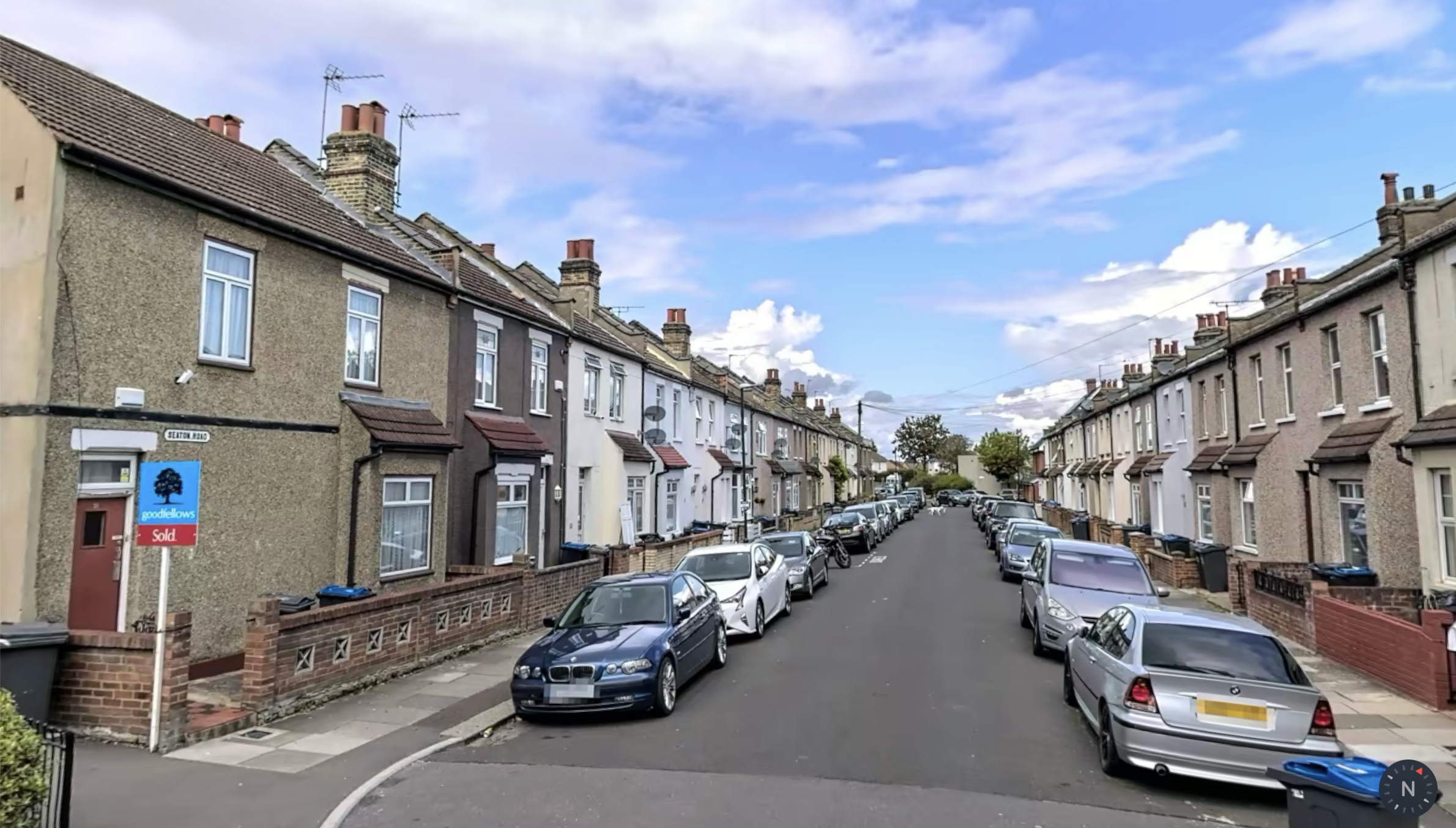
2019 street view from Apple Maps.
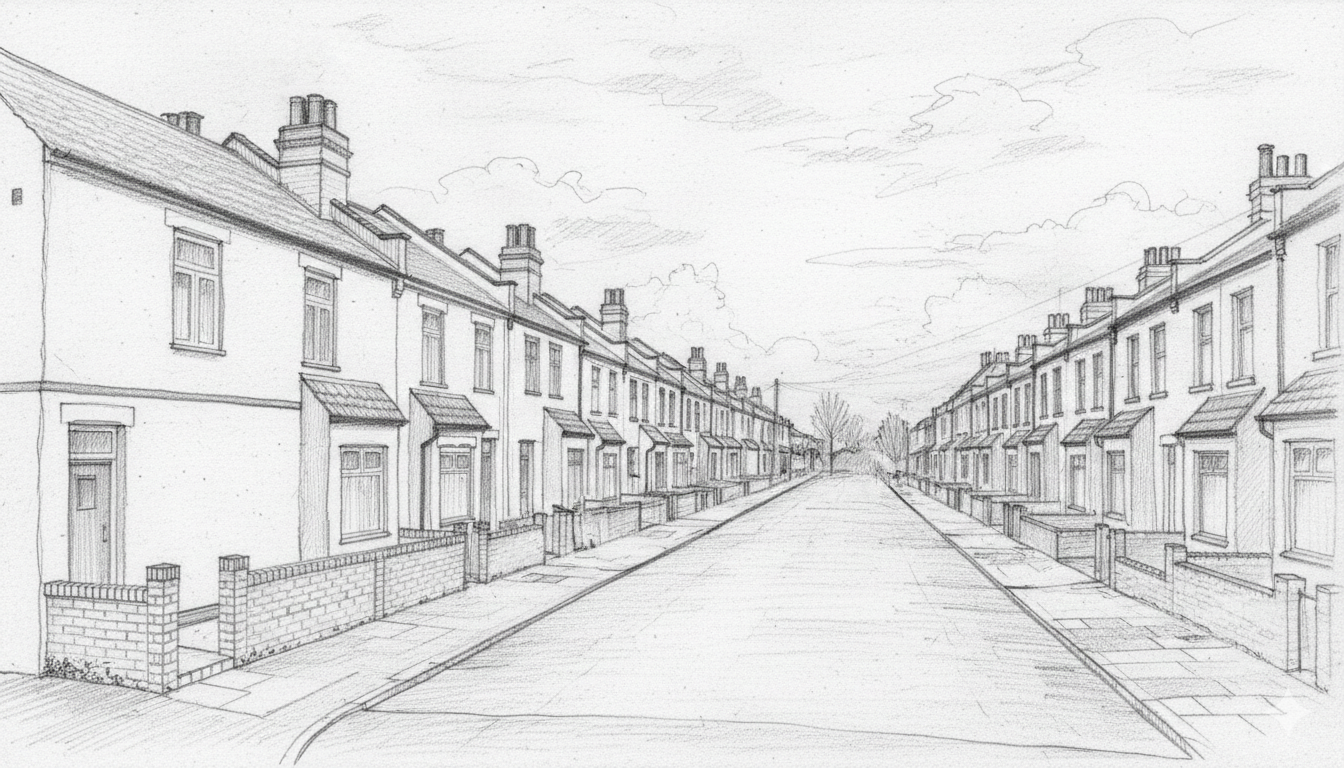
A sketch of the road, showing no cars, TV aerials, bins, and is based on the 2019 street view above.
Maps
On the 1952 OS map there are two rows of houses, numbered, from south to north, 1A to 18A on the west side and 1 to 16 on the east side.
On the 1910 OS map, there were two more houses on the east side, at the corner with Portland Road, numbers 17 and 18. These may have sustained bomb damage during World War 2, and were demolished. In 1986, planning permission by British Gas was approved to build two new houses, numbered 17 and 18.
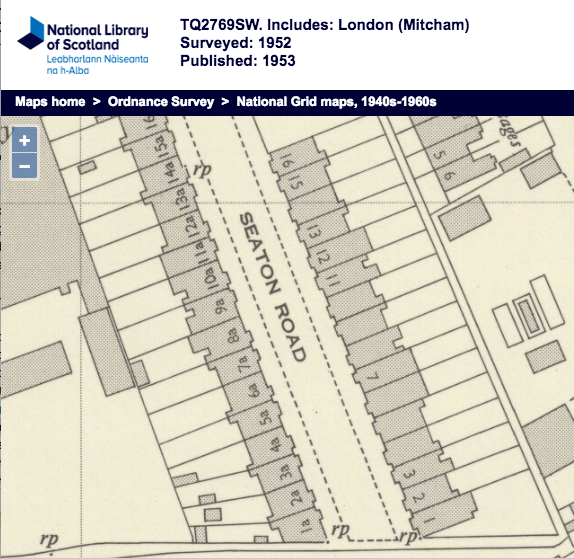
1952 OS map
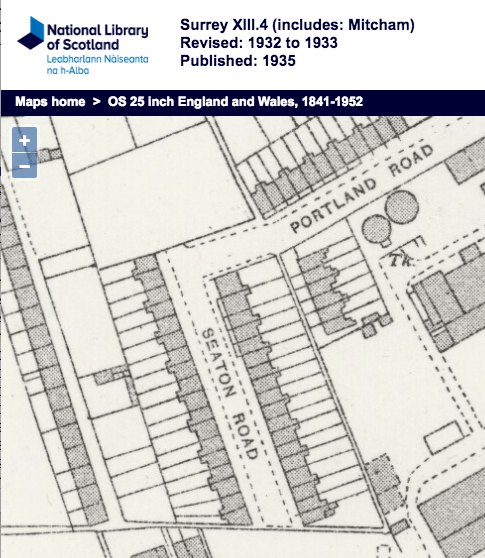
1932 OS map
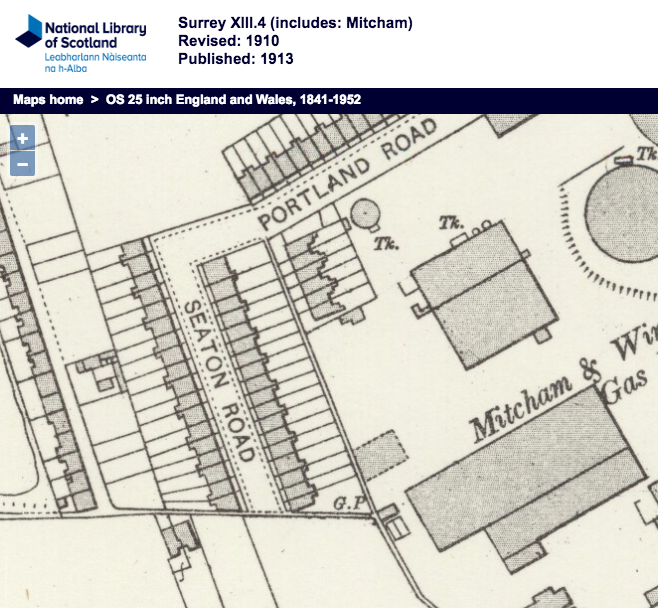
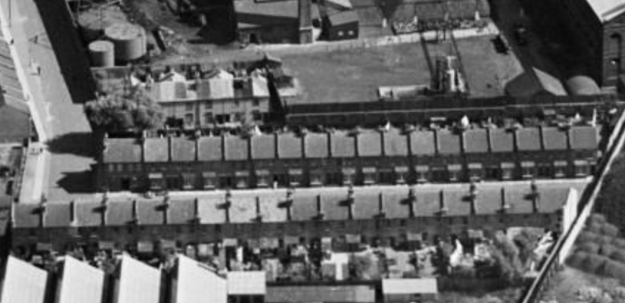
1937 aerial view looking to east. At top of photo is the Mitcham Gas Works. On the right, the footpath is Fox’s Path. On the bottom of the photo can be seen part of the factory roof of Standard Upholstery.
Occupants
1911 Census – list of heads of household
Note that 20 houses had more than one family living there.
| Door no. | Head of household | Age |
|---|---|---|
| 1 | Edward COOK | 45 |
| 1 | Griffin CRESSWELL | 31 |
| 2 | Liddy DIGHTON | 57 |
| 3 | John BACKHURST | 41 |
| 3 | John Thomas ADAWAY | 23 |
| 3 | John LEONARD | 34 |
| 5 | Weaster LEE | 42 |
| 5 | Jessie SMITH | 34 |
| 6 | Arthur HOLKEM | 36 |
| 6 | Thomas LEE | 40 |
| 7 | William BRAZILL | 49 |
| 7 | William BRAZILL | 26 |
| 8 | John JAMES | 53 |
| 8 | John DEDMAN | 32 |
| 9 | John POWELL | 30 |
| 10 | Alice POWELL | 56 |
| 10 | Henry SCOTT | 23 |
| 11 | Robert JAMES | 41 |
| 11 | George BATTERS | 56 |
| 12 | H M MORLEY | 37 |
| 13 | George ASLETT | 40 |
| 13 | Alfred RIGGS | 43 |
| 14 | William FRANKLIN | 25 |
| 14 | Jane LYON | 63 |
| 15 | Henry CRISP | 23 |
| 15 | William John SALES | 33 |
| 16 | Josiah SMITH | 47 |
| 17 | Augustus STANLEY | 42 |
| 18 | Samuel OAKES | 42 |
| 2A | Jane HOLDFORD | 60 |
| 2A | John HOLDFORD | 30 |
| 3A | Leonard DIXEY | 26 |
| 3A | Nelson SMITH | 25 |
| 4A | John SURKITT | 32 |
| 4A | Henry HERRINGTON | 44 |
| 5A | Ben COATES | 26 |
| 5A | William JELLEY | 28 |
| 6A | Fred MATTHEWS | 48 |
| 6A | Henry MATTHEWS | 22 |
| 7A | Ralph Walter HITCH | 31 |
| 8A | John Henry WARD | 35 |
| 8A | Frank CURLEY | 40 |
| 9A | Henry CURRELL | 30 |
| 10A | Charles NIGHTINGALE | 53 |
| 10A | James GRANGE | 25 |
| 11A | Rose POWELL | 43 |
| 12A | William JONES | 31 |
| 12A | James Jones JONES | 27 |
| 13A | Henry G COLE | 43 |
| 14A | Willie George WARD | 38 |
| 15A | Ernest COOK | 31 |
| 15A | Jose PINDER | 59 |
| 17A | Thomas POWELL | 50 |
Street Directories
1904
North Side
1, John O’ROURKE
2, Stewart Daniel SLATER
3, G. Gordon ROBERTSON
5, William HOWE
6, Edward NORTH
9, John BURCHITT
11, James BATES
12, Joseph WOOLMER
18, Samuel A. OAKES, (grocer)
1925
South Side
1, William John SMITH, junior
2, Amos SMITH
3, James ROBINSON
4, Alfred ALLEN
5, Thomas DREWETT
6, Mrs POWELL
7, William W BIRD
8, John CHALLIS
9, George CRESSWELL
10, Bertram YEATES
11, Charles John DOLBY
12, Arthur KING
13, Alfred DEACON
14, Frederick MATTHEWS
15, James WILLCOCK
16, Harry NEW
17, Augustus STANDING
18, A.M. TOLHURST & Sons (grocers)
North Side
1A, John TIBBLES
2A, Henry JAMES
3A, Alfred HUDSON
4A, Leonard DIXIE
5A, Bernard JEWELL
7A, George HATFIELD
8A, Samuel CHAMBERS
9A, Mrs Louisa CRESSWELL
10A, Reginald F. WILLIAMS
11A, Arthur RUSSELL
12A, George CAIN
13A, George Albert BENNETT
14A, Abraham BATES
15A, John COYLE
16A, David LUXSON
17A, Thomas POWELL
18A, Arthur DREW
War Connections
A total of 30 men from this road joined up in World War 1, with 6 not returning.
Of the six that died, it’s possible that Frederick Matthews lied about his age. On the Surrey Recruitment Register his age is shown as 19 when volunteering on 30th October, 1915, but the Commonwealth War Graves Commission has his age as 20 when he died in March 1918. His elder brother had volunteered on the 3rd June 1915.
The names of the six fallen are on the Mitcham War Memorial.
From the Commonwealth War Graves Commission:
From the Surrey Recruitment Registers:
F A BEARD of 7a Seaton Road, aged 24 Years 2 Months, Labourer. Conscripted on 13 June 1917 to the 84th Training Reserve Batn.
G T BUCKFIELD of 5 Seaton Road, aged 21 Years 6 Months, Greengrocer. Joined on 8 March 1917 to the Royal Field Artillery.
S CHAMBERS of 8a Seaton Road, aged 25 Years 7 Months, Labourer. Conscripted on 7 August 1917 to the Labour Centre.
C F CHAPMAN of 6a Seaton Road, aged 30 Years, Carman. Volunteered on 21 April 1915 to the Army Service Corps.
T DEACON of 6a Seaton Road, aged 19 Years, Hawker. Volunteered on 1 November 1915 to the Royal Fusiliers.
J ENEVER of 11a Seaton Road, aged 33 Years 9 Months, Labourer. Volunteered on 6 July 1915 to the Royal West Surrey Regiment.
C H FLINT of 11a Seaton Road, aged 30 Years, Labourer. Conscripted on 25 June 1917 to the 301st Labour Coy (5th Batn).
J W GREEN of 4 Seaton Road, aged 19 Years, Carman. Conscripted on 28 February 1917 to the Royal West Surrey Regiment (labour Coy).
J H HICKS of 1 Seaton Road, aged 45 Years, Painter. Volunteered on 2 June 1915 to the Middlesex Regiment.
D. HOLDFORD of 5 Seaton Road, aged 25 Years 1 Months, Carman.
W. G. HOLDFORD of 5 Seaton Road, aged 23 Years 5 Months, Labourer. Both volunteered on 16 January 1915 to the Royal Field Artillery.
D E LUXON of 16a Seaton Road, aged 25 Years 4 Months, Fitter. Volunteered with the Derby Scheme on 10 December 1915 to the Royal West Kent Regiment (5th Batn).
H MATTHEWS of 14 Seaton Road, aged 26 Years 5 Months, Hawker. Volunteered on 3 June 1915 to the Royal Fusiliers.
F MATTHEWS of 14 Seaton Road, aged 19 Years, Hawker. Volunteered on 30 October 1915 to the Royal Fusiliers.
J PAGE of 15 Seaton Road, aged 27 Years 3 Months, Labourer. Volunteered with the Derby Scheme on 09 December 1915 to the East Kent Regiment (9th Batn).
P J REEVES of 3 Seaton Road, aged 29 Years 7 Months, Carman. Volunteered on 13 March 1915 to the Army Service Corps (ht).
D RILEY of 1a Seaton Road, aged 24 Years 11 Months, Labourer. Conscripted on 26 June 1917 to the 105th Training Reserve Batn.
W RILEY of 1a Seaton Road, aged 31 Years 2 Months, Labourer. Volunteered on 21 December 1915 to the East Surrey Regiment (4th Batn).
W S SELBY of 11 Seaton Road, aged 31 Years, Porter. Conscripted on 7 June 1916 to the Reserve Household Batn.
C SMITH of 3a Seaton Road, aged 20 Years 2 Months, Carman. Volunteered with the Derby Scheme on 1 March 1916 to the Royal Field Artillery.
W SMITH of 3a Seaton Road, aged 23 Years, Labourer. Conscripted on 1 March 1917 to the Royal West Surrey Regiment (labour Coy).
H SMITH of 2 Seaton Road, aged 18 Years 2 Months, Hawker. Conscripted on 2 February 1917 to the 24th Training Reserve Batn.
H SUMMERS of 4 Seaton Road, aged 29 Years 11 Months, Carman. Volunteered on 4 June 1915 to the Royal Field Artillery.
J TIBBLES of 1a Seaton Road, aged 41 Years, Carman. Volunteered on 14 July 1915 to the Army Veterinary Corps.
N F WILLIAMS of 10a Seaton Road, aged 25 Years, Handy Man. Volunteered with the Derby Scheme on 27 March 1916 to the Army Service Corps (mt).
Stories
Croydon Express – Saturday 07 August 1909
OAKES OPPOSES OLLERHEAD
At the Croydon County Bench this morning, Samuel Oakes, of 18, Seaton-road, Mitcham, was summoned for using threats towards James Ollerhead, of 21, Church-road, Wimbledon, on July 28th.— Mr. J. D. Finch appeared for the complainant, and Mr. H. R. Hodson (instructed by Mr. W. Hood) defended.
— Complainant is a freeholder of premises in Seaton-road, which he said he was converting into a shop. Defendant came over to him on the day in question and abused him, saying that complainant would soon be in his coffin. He said that he would do ten years for it. The reason was because complainant was opening business in opposition.
— Cross-examined: He had not annoyed the defendant, nor did he remind him that he had committed a breach of building laws. He had read the Building Acts to the defendant some months previously.
— Walter Godsell, of 7, Portland-road, Mitcham, who works for complainant, gave corroborative evidence.
— Cross-examined: Mr. Ollerhead did not appear to be very frightened at the time.
— Defendant, who was formerly a sergeant in the Army, said that he had been in business for seven years. Complainant continually annoyed him. and said that he would take his roof off him before very long. He came into the whop when defendant was very busy and called his attention to paper outside the shop, or else to the bye-laws.
– The Bench bound the defendant over to keep the peace for six months, and ordered him to pay the costs, 21s.
Mitcham Advertiser – Friday 12 November 1909
MITCHAM MAKING UP OF SEATON ROAD.
There was a special sitting of the Croydon County Magistrates to-day (Friday) to hear objections to the provisional apportionments for the making up of Seaton-road, Mitcham. Ald. R. V. Barrow (Chairman) and Mr. T. E. Stephens were the magistrates present. Mr. E. J. Gowen appeared for the Council, and stated that there were two objectors, Mr. J. Ollerhead and Messrs. Horne & Birkett, solicitors for the mortgagees in possession of 12 houses. There were 36 houses in the road, and the total estimated cost of the work, including the five per cent. allowed for supervision, was £262 11s. The total frontage charged with 594-ft. 6-in., and the total cost divided up was 8s. 10d. per foot run of frontage. The objections were that the work was unreasonable and the cost excessive.
—Mr. Ollerhead also said that the existing gullies were amply sufficient to carry away the drainage and surface water. The road was made up in 1902, and there had been complaints as to its condition from time to time. In 1907 it was proposed to make up the road, but the Council stayed their hands on the owners undertaking to keep the road cleaner. Further complaints were received again this year, and the Council decided to proceed with the work.
— Mr. R. M. Chart, Surveyor to the Council, produced the provisional apportionment, plans, estimate, and specification. The present condition of the road was one of filth and dirt. There was no paving at all beyond the gravel path. It was necessary that these works should be carried out. He was of opinion that all the works were necessary. The paths would be tar-paved and kerbed.
— Replying to Mr. Ollerhead, witness admitted that there were about fifty roads in the parish not channelled as this was proposed to be, but he said the same conditions did not prevail.
— Mr. Ollerhead, not being able to get satisfaction from the witness, said he should appeal to the Local Government Board. The other objectors were not present.
— Mr. Ollerhead gave evidence and said the amount to be objected to was £92 7s. If broken flints and broken granite were good enough for the main roads, they were good enough for a back road like Seaton Road.
— The Bench decided to confirm the apportionment.
Mitcham Advertiser – Thursday 10 February 1927
Mitcham Advertiser – Thursday 03 March 1932
MITCHAM FIRE.
SPARK CAUSES DAMAGE IN SEATON ROAD.A spark from a newly lighted fire caused much alarm and considerable damage at No. 18a, Seaton-road, Mitcham. on Monday evening. At 6.17 the Fire Brigade were warned of an outbreak at that address and promptly responded under Chief Officer Wells. They found the bedding in a front bed-sitting room on the first floor burning. Apparently a spark from the fire, freshly lighted, ignited a wicker chair and set fire to the bedding close by, the hearth rug, the mantel board and the piano, which was badly scorched. The flames were put out with buckets of water, Mr. A, Drew, the occupier of the room, and his family discovered the fire in time to prevent a serious outbreak.
FLOWER SELLER’S FUNERAL
There was almost a demonstration of people at Mitcham Cemetery on Friday afternoon when the funeral of Mr, Thomas Deacon, of Seaton-road, one of the best known flower sellers in South London, took place. Mr. Deacon, who was fifty-five, died in Guy’s Hospital. The wreaths numbered more than fifty and some were exceptionally beautiful.
Council Minutes
From the minutes of the
Croydon Rural District Council
Roads and Buildings Committee
Volume VIII 1902 – 1903
21st June 1902
page 217
2. Deposited Plans. – The Buildings Sub-Committee reported that they had carefully examined al the plans of new streets and buildings deposited since the last meeting, and on their recommendation, it was Resolved:-
(a) That the undermentioned be approved:
No. 2165, Jordan, T, 18 houses, Seaton Road, Mitcham
and on 20th November 1902
page 572:
No. 2313, Jordan, T, 20 houses, Seaton Road, Mitcham
From the Mitcham Urban District Council minutes,
Volume 3, page 120, Finance and General Purposes Committee meeting of 11th September, 1917, Mr Rabbetts reported contraventions under the Shop Act of Mrs H. Evens of 14A, Seaton Road, for serving a customer after closing time. Also Mr Carmino Tortolano of 18, Seaton Road, who at 7.15pm served a customer with pickles.
The 1911 Shops Act dictated the half-day closing of Wednesdays, in order to give staff time off.
Maps are reproduced with the permission of the National Library of Scotland.
Minutes of meetings held by the Croydon Rural District Council, and Mitcham Urban District Council are available on request from the Merton Heritage and Local Studies Centre at Morden Library.
 Mitcham History Notes