Tag Archives: Carshalton

Peppermint in 1875

From The Canadian Pharmaceutical Journal, Volume IX, 1875-6, pages 127-130, a free Google ebook.

PEPPERMINT

The peppermint that clothes the fields and scents the lanes in the parishes of Mitcham and Carshalton, although an indigenous plant in England, is not supposed to have been generally used until the middle of the last century, and afterwards, upon the recommendation of the English herbalists, it was introduced into Germany, where it has since been employed in medicine. The experience of one hundred years has not detracted from the acknowledged excellence of the qualities of the plant, but has completely established its hold upon the tastes of all classes of the population, both high and low. There is said to be nothing new under the sun, and this adage is confirmed by all our discoveries amid the buried and mouldering antiquities of the past. It is not, therefore, any subject for surprise that amongst the classical authors we should meet with references to the peppermint. That universal naturalist Pliny has not allowed this herb to escape his attention, for he mentions in one of his books that it is not possible for a stranger to pay a visit in the country to a husbandman and there to partake—as no doubt he often did himself whilst upon his botanizing excursions — of the frugal fare offered without discovering that all meats from one end to the other of the table were seasoned with mint. He also tells us of the uses to which this plant was put in the dairies, where, being placed in the milk, it prevented the same from curding or turning sour, and this quality might be easily tested at the present day. It appears that Ovid, who was another lover of nature and depictor of rural scenes, in his story of Baucis and Philemon mentions that the rustics perfumed or scoured their tables with this herb before they sat down to supper. In these lines he says :

Then rubbed it o’er with newly gathered mint,
A wholesome herb, that breathed a grateful scent.

There are three different species—peppermint, spear mint or mintha mint, and pennyroyal, all cultivated in a similar manner. The mode of propagation is from young plants which spring from runners. Early in the spring, during the months of April and May, the plants are drawn and placed in rows, the space between varying
according to the custom of each grower from one foot to eighteen inches. One of the most experienced growers at Mitcham adopts the latter distance, which he finds more favorable to the strong and healthy growth of the plant. By placing them closer, although a larger number are contained upon an acre of land, the amount of produce is diminished by the crowding. The opportunity of showery weather should be taken to place the cuttings, each five or six inches in length, about half way into the earth. The first season they require to be constantly attended to during the weeding-time, and should receive six or more hoeings, which essential part of the
cultivation should be scrupulously attended to every succeeding year, otherwise the quality of the oil would be injured in the distilling process. In the months of October, November, and December the beds are trenched like asparagus, the earth being piled up between the trenches to the width of three or four feet and of sufficient depth to protect the roots during winter. The fields are ploughed
up and changed every five years, the first crop being generally the most abundant and the purest. The qualities of soil best suited are moist and loamy, and the effect produced by the soil is more striking in the case of peppermint than in any other plant. Two crops of peppermint standing side by side indicate when distilled considerable difference in the yield of oil; and the larger quantity is not
unfrequently obtained from that crop which presented the least promising appearance. It has been remarked by many growers both at Carshalton and Mitcham that peppermint plants raised at the latter place and laid out at the former, although an adjacent parish, yield a very different product when distilled, both in the aroma of the oil and the quantity obtained.

At Mitcham, which is the original seat of the cultivation, most growers supply large, but evidently insufficient, quantities of manure to their land; as the yield is continually diminishing others plant potatoes after peppermint, then renew the soil with manure and again plant peppermint. For some reasons, however, the productions is considerably reduced, although a walk of several miles around the neighborhood, embracing Sutton, Bumstead, Wallington, and Beddington, will show that the peppermint and the lavender are peeping out in many places that were formerly occupied by ordinary agriculture. Within our knowledge persons have been obliged to give up their residence at Wallington, where, during certain months, the air has been found to be oppressive and unbearable in consequence of the perfume of the surrounding fields. The reverse has taken place at Mitcham, for, as we were informed, a large farm, consisting of more than a thousand acres, which was a few years ago laid out with lavender, peppermint, roses, camomile, etc.,
is now wholly employed for the production of the cereal crops, and the majority of growers, rather than incur the risk of this description of farming, prefer to lay out their land with culinary vegetables. The uncertainty of the seasons in England and the introduction of foreign produce are alleged as the causes of this change, but we should rather attribute it to some fault in the cultivation or else that
the earth has been exhausted of certain of its chemical properties. There is scarcely any prettier or more charming sight to be witnessed than an August morning or afternoon, when the sun is shining brightly upon the golden fields of wheat interspersed amongst the varied purple colors of the lavender, the sombre hues of the peppermint and the sparkling brilliancy of the white camomile flower.

Any person who wishes to satisfy his curiosity can easily do so by taking the rail to Wallington, Sutton, or Mitcham. At either place he cannot fail to be amply requited for the trouble and trifling expense incurred by such a short and accessible excursion from the metropolis.

The harvesting takes place during the months of July and August, according to the propitious character or otherwise of the season. The produce varies from four to six tons per acre, the average being five tons, but the amount of oil yielded bears no definite relation to the quantity of the plant. When the summer has proved wet and cold, the plants, although bulky, have been known to produce only a small proportion of oil, and in other years, when the season has been warm and dry, the reverse has been the case, and small plants have yielded a double quantity of the oil. The spearmint produces about half as much as the peppermint, and it is therefore grown only in sufficient quantity to meet the actual demand, and in the absence of orders beforehand, the ground is otherwise appropriated. A native of this country, it may be seen growing wild in marshy places and around ponds. It has a strong aromatic odor, with a warm and slightly bitter taste, which is less pungent but more agreeable than that of peppermint.

The oil of spearmint, which is of a pale yellow or greenish color when fresh, becomes darker with age, and ultimately of a mahogany color, and is used for the same purpose as the peppermint. In the spring the young leaves and tops are used with salads, or mixed with certain dishes, such as peas, etc., or made to flavor soups. Pennyroyal is the least valuable of the three species of mint. This plant was formerly called “pudding grass,” from the old custom of using it in hog
puddings, also “run by the ground” and “lurk in the ditch,” from its creeping nature and preference for damp soils. How its name became converted is not known, but great quantities are said to have been brought to market from a common near London, called Mile’s End, in the time of Queen Elizabeth.

The peppermint plant is generally cut about the latter part of August, and placed in small cocks like those of hay, which are allowed to stand in the fields some days before being taken in for distillation. At the beginning of the present century there were no stills at Mitcham, and the herb was sold fresh. Since then many of these buildings have been erected both at Mitcham and Wallington, where the smoke from the chimneys may be seen during the harvest season. Messrs. Piesse & Lubin, the celebrated perfumers, of Bond Street, have a distillery upon the high road to Mitcham, where the process may be witnessed upon an introduction to the firm. The whole apparatus is exceedingly simple. It consists of a boiler for raising steam, a still made of wood for receiving the charges of peppermint, a cooler for cooling the oil, and a receiver into which it flows. The plants are packed into the wooden still and trampled down with the feet. When a full charge is thus ready, the lid of the still is put on and steam admitted at the bottom by a pipe from the boiler. When the peppermint is heated to about 212 degrees Fahrenheit the essential oil passes over with the steam into a worm, which is placed in a cooler, and as it condenses into oil and water, it then passes out of the worm into a converted receiver, where the oil as it floats on the surface is lifted out with dippers, is then placed in tin cans, and becomes ready for sale. The refuse mint taken from the still is placed in piles, dried, and then makes tolorable fodder for
sheep.

The consumption in this country, as may be supposed, is very considerable, for as many as 12,000 lbs. of the oil are imported from abroad. The quality of the English grown is, however, so superior that a large export likewise takes place. At the great French Exhibition of Industry, held in Paris in 1855, which might be regarded as a crucial test, in competition with such excellent perfumers as the French manufacturers are known to be, the oil prepared in this country was considered the best then exhibited.

There has lately been a new kind of crystallized peppermint oil introduced from Japan, but it is not known at present from which plant this oil is obtained ; but it is not greatly inferior in point of fragrance to the best Mitcham oil, and were a demand first to arise in this country from the confectioners and others, there is little doubt that it could be supplied at a lower price.

Hawthorn Cottages, Belgrave Walk

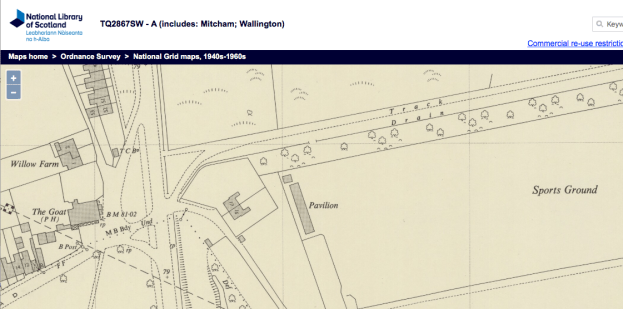
Two rows of four houses that were between Belgrave Walk and Church Road.

1973 photo by Eric Montague

Occupants in the 1925 directory

North side

1, Walter BEADLE
2, Albert Edward MULLIS
3, William Henry WILKS
4, Thomas James WILKES

South side

5, Horace Victor CLARK
6, Albert Edward TAPPING
7, Mrs E.H. HILL
8, William John POWELL

Newspaper Articles

Mitcham Advertiser – Thursday 25 December 1930

MITCHAM WEDDING. Miss B. Powell — Mr. L. J. Tapping. Gold was the principal colour in a pretty Christmas wedding at Mitcham parish Church on Saturday. The bride was Miss Blanche Powell, eldest daughter of Mr. and Mrs W. Powell, of Hawthorn Cottages Church- road, and the bridegroom was Mr. Leonard Joseph Tapping. younger son of Sub-Officer A. Tapping, Fire Brigade, and Mrs. Tapping, of Hawthorn Cottages. The service was conducted by the Rev. C. Aubrey Finch, Vicar of Mitcham. Miss Powell, who was given away by her father, wore a white crepe-de-Chine dress with veil and coronet of orange blossom. Her bouquet was a “shower” of pink roses. The four bridesmaids were the Misses Ivy, and Lilian Powell (sisters of the bride), Miss Winifred Tapping (sister of the bridegroom) and four years old Gwendoline Penegar (niece of the bridegroom), a dainty little figure. All four were dressed alike in green silk trimmed with old, gold shoes and stockings and gold head dresses, Each carried a shower bouquet of gold chrysanthemums. The best man was Mr. Archie Tapping (brother of the bridegroom). About forty guests attended the reception at the bride’s home, where the numerous wedding presents were on view. These included a Westminster chiming clock from the bridegroom’s fellow workers at Messrs, McPherson’s “Cock Chimney” Varnish Factory, a cut-glass crystal fruit bowl from Mr. Donald McPherson (a director of the firm), and a canteen of cutlery from the bride’s fellow workers at Messrs. Mullard’s Works, Hackbridge.

Mitcham Advertiser – Thursday 21 April 1938

MITCHAM FIRES BRIGADE OFFICER GIVES ALARM

A few minutes past nine on Tuesday morning, Second Officer A. Tilley, of Mitcham Fire Brigade, was cycling in Church-road when he ran into a thick fog of smoke which blotted out that part of the road near Miles-road. Stopping to investigate the circumstance, he found a chimney on fire at No. 5, Hawthorne Cottages, Belgrave-walk, occupied by Mr. and Mrs. Horace Clark and family. The Fire Brigade were called by telephone. Working on the roof. the firemen found that flames had penetrated through the brickwork to the top of the house next door, occupied by Mr. Albert Tapping, formerly a sub-officer of Mitcham Fire Brigade. He was working on the road close by as an employee of the Borough Council and went to assist in putting out the blaze. Damage was done to the furniture by smoke and soot.

Albert Edward MULLIS

A.E. Mullis was the Labour Party candidate in the South Ward elections in 1920, as reported in the Mitcham Advertiser. He was a nominee of the General Workers’ Union, employed as a blacksmith at the Gas Works. He was defeated by Dr. Henry Love, Independent, who had 376 votes to his 241.

He was also part of the Gas Company Ambulance Brigade, and was a groundsman on the Wandgas playing fields.

Mitcham Advertiser – Thursday 12 January 1939

POPULAR GROUNDSMAN Funeral of Mr. Albert Mullis The funeral took place at Church-road Cemetery on Wednesday of last week of Mr, Albert E. Mullis, whose sudden death occurred at his home on December 30th. In his position as sports groundsman to the Wandgas Athletic Club he was very popular, This was testified to by the presence at the graveside of Dr. Mosley, Mr. Shepherd Mr. A. Rayner, Mr. W. Roberts, Mr. Wright and Mr. Ross, officials of the Wandsworth, Wimbledon and Epsom District Gas Company. Members of the Gas Company Ambulance Brigade attended, Mr, Mullis was a member of the brigade. During his fifteen years at Benedict-road sports ground, Mr. Mullis made many friends, especially among school children, who frequently used this ground for their sport. Among the floral tributes was a beautiful wreath from the Lower Mitcham Junior Schools bearing the words “The children loved him.” The family mourners present were the widow, Mr, and Mrs, E. A, Mullis (brother and sister-in-law). Mrs, C. Hudson (sister), Mr. and Mrs. W. H. Wilks (sister and brother-in-law), Mrs, R. Andrews (sister). Owing to impaired health, his aged mother was unable to be present. The Rev. C, A, Finch, Vicar of Mitcham, officiated. Floral tributes were sent by the Pastor and members of Mitcham Baptist Church, Mitcham Free Church, Wandgas Athletic Club (Mitcham Station), Empioyees of Mitcham Gas Works, Members of Wandgas Athletic Club, Bodman-street ground staff, Benedict-road ground staff (Mr. Miles) Lower Mitcham Junior Schoals, St Christopher’s School, Officers and Members of No. 128 (Wandsworth Gas Company) Division St. John Ambulance Brigade, Members Mitcham Gas Company Section St, John Ambulance Brigade, Edward Ash Ltd. (workmen). Mrs. Middleton Powell (Brighton), Mr, F. Powell (Shrewsbury), and others.

Mitcham Advertiser – Thursday 21 September 1939

MITCHAM SIGNALMAN COLLAPSE AT VICTORIA STATION An Expert Chrysanthemum Grower

Mr. William Henry Wilks, aged forty-eight, of 3, Hawthorne-cottages, Church Road, Mitcham, collapsed in a signal box at Victoria Station about two o’clock on Tuesday morning. At Westminster Hospital he was found to be dead.

He had been attended by a doctor at intervals for some time. and as death was found to be due to natural causes no inquest was necessary.

Mr Wilks, a native of Mitcham and a very popular personality, been a railway man for thirty-four years. For twenty he had been employed at Victoria Station. He was in charge of the signal box that night with a boy assistant. He was one of the first men to do duty in that box, a new all-electric power cabin in which no levers are pulled. One of his greatest friends, Mr. A, of Carshalton, shared the duty with him, and they had been associated as fellow workers and fellow members of the National Union of Rallwaymen for twenty years.

In his early days Mr. Wilks was employed at London House by the late Mr. Francis. He was an enthusiastic member of the Mitcham and Tooting Horticultural Society, and was winner for the first three years of the silver cup for chrysanthemums. His garden at the rear of the home he had occupied most of his life is a grand display of colour at the present time.

Mr. Wilks was also an enthusiastic member of St. John Ambulance. He was a keen supporter of the old Mitcham Wanderers Football Club, and acted as honorary ambulance attendant to it.

Mrs, Wilks, two sons and one daughter mourn the loss of a devoted husband and father.

The funeral will take place at Mitcham Parish Church on Saturday morning. The mourners will include Mr. A. Burton and Mr, T. Pocock, of Victoria Station staff. who will represent the staff and the National Union of Railwaymen, who are also sending wreaths.