Tag Archives: Kings Arms

The oldest pubs in Mitcham – according to parish records

From the Mitcham Advertiser – Thursday 07 July 1927

MITCHAM NOTES.

Why are all the public houses in High-street, Colliers Wood, on one side—the west side of the road? I asked the Chairman of the Council and he said he must have notice of the question. I asked Mr. Groom-bridge and he thanked heaven he lived in the wilderness on the other side. I asked Coun. Cusden and he said “What does it matter? The beer is just as good at Cusden’s Stores.” I asked Jack Fitch and he said it was a shame. I asked George Bennett and he said that was one of the inequalities the Labour Party was out to remove. I asked Thirsty Bill, who has often been fined 10s. and costs for being all on one side himself, and he said, “Hie-wash-wash I get for tellin’ ya!”

So I led the way to the Blue Nose and Slop Basin and called for two acid drops. Thirsty Bill’s eyesight is getting bad and in mistake he drank both. “Shay, guv’nor,” he hiccoughed, “don’t-tcha berlieve it.” “Believe what?” I asked. “Thash all pubs in thish—thish street—hic—thash all pubs in any streetsh on one sidesh. Nope. Sh’all wrong. Man who shesh pubs in thish tsreetsh all on one shide—sidesh ish—hic—ish drunk.”

In desperation I asked Mr. R. M. Chart. Mr. Chart knows more about the pubs of Mitcham than any man. This statement, I hope, will be taken in the right spirit. With his usual courtesy he let me waste his time while I propounded the more or less important question then said “It’s an interesting point certainly, and, I think, easily explained.”

Mr. Chart reminded me that unknown to many of the residents of Colliers Wood a brook flows down the east side of High-street into the Wandle at Merton. It is under the roadway and was covered in within living memory. It is the same stream that protects Mitcham from Tooting. “It is reasonable to suppose,” he added, “that when High-street was a rural way with an open brook along the whole of its east side the roadside inns were built on the west side to avoid that brook.”

A simple solution, you must agree, of a great mystery to you and me. Evidently mine host of the days of yore took more pains than does Boniface of to-day to pre-vent his customers from mixing their drinks—involuntarily.

It would have been utterly foolish to let Mr. Chart go without asking him for facts about the King’s Head and the grand old elm slain last week to make a motorist’s holiday.

“Time hollowed in its trunk a tomb for centuries,
And buried there the epochs of the rise and fall of states,
The fading generations of the world,
The memory of men.”

Mr. Chart not only enlightened me about the King’s Head and the elm, but gave me historical notes of a dozen other Mitcham hostelries. The earliest mention of the King’s Head in the Parish Records of Mitcham is under date 1732. There is evidence, however, that the house was erected in the Elizabethan period, for it is a very old timber framed building re-faced with brickwork. The elm, lamented as much by tea sloppers as by froth blowers, was probably more than 250 years old.

On the occasions when the Prince of Wales (afterwards King Edward) attended Epsom Races and changed horses at the King’s Head, as told in the “Advertiser” last week, the Village Beadle, William Hills, a builder and a fine portly man, who lived at Vine Cottage, Lower Green, the oldest house in Mitcham, was always present in gold laced uniform ostensibly to keep the crowd in order. After one cere-mony of the kind he received a letter written on notepaper crowned with the Royal Arms thanking him for his atten-tion and services.

Mr. Chart thinks the Beadle never knew that he was the victim of a parish wag, for he was always fond of exhibiting the letter. Mr. Hills was also the Town Crier. He paraded the village with a hand bell and always wound up his orations on the subject of the lost sheep or other matters with the pious and loyal sentiment “God Save the Queen.” To which the children, who usually followed in his train, added “And hang the Crier!”

The Bull, Church-road, is first mentioned in parish records in 1753, so it appears to be the second oldest inn in Mitcham. Un-doubtedly all the inns were in existence long before the dates given. The Buck’s Head is mentioned in 1776. It was re-built about twenty years ago and set back 10-ft. from its original frontage on London-road.

The White Hart, beloved of Councillors, and, if I remember aright, of church-wardens of other days, came to the official notice of Mitcham in 1784. The King’s Arms, formerly a timber framed building on a site north of the present building, was first recorded in 1787. The Red Lion (Colliers Wood) comes into prominence in 1792 and two years later the Nag’s Head, a timber building except the front, is men-tioned, as is also the Swan.

The Goat comes next into the records in the year 1805. In 1819 the Half Moon shone at the corner of Lock’s-lane, but it has long since set to rise no more. The Six Bells, Merton Bridge, can also be traced back to 1819. A year later the Cricketers Inn is officially taken notice of, but I have a feeling that it was unofficially observed long before that time, particularly by sportsmen with a dry humour.

The last pub turned up by Mr. Chart was the Phoenix, first mentioned in 1838. It justified its name some years ago by rising out of its dead ashes as the Horse and Groom. Of the Sportsman, which formerly gave Dutch courage to those about to enter Love-lane, there is no official record at all. Which only shows you that the Vestry Clerk of that day, like the last of his line, was a gentleman of discretion.

If Mr. Gaston had been a member of the Fire Brigade Committee, or a follower of the statesman who urged all public per-sons to verify their references, he would not have “made the bloomer” of assuming that the Chief Officer was advocating the purchase of a foam generator like “the only one in London.” That is a machine the size of a motor pump and costing as much. Mr. Wells clearly stated in his report (in front of Mr. Gaston as he spoke) that the machine he had in mind would cost £75. He also clearly stated that his remarks and suggestions were “applicable to the storage of inflammable liquids that do not come within the provisions of the Petroleum Act.”

Now I say that as certain councillors do not come within the provisions of the Petroleum Act it is the duty of the rest to safeguard themselves and Mitcham by the purchase of a continuous foam extinguisher not generator. If one can be got for £75 and will prevent Coun. Groombridge, for instance, from bursting into flames more than fifty times at one meeting it will be a real economy to buy it.

THE COMMONER.

This text was extracted using Google’s AI Studio, model “Gemini 2.5 Pro Preview 03-25 gemini-2.5-pro-preview-03-25”, with the prompt “extract the text from this 1927 newspaper article” against the downloaded article image from the British Newspaper Archive.

Image © Successor rightsholder unknown. Please contact support@britishnewspaperarchive.co.uk if you wish to claim rights to this title.. Image created courtesy of THE BRITISH LIBRARY BOARD.
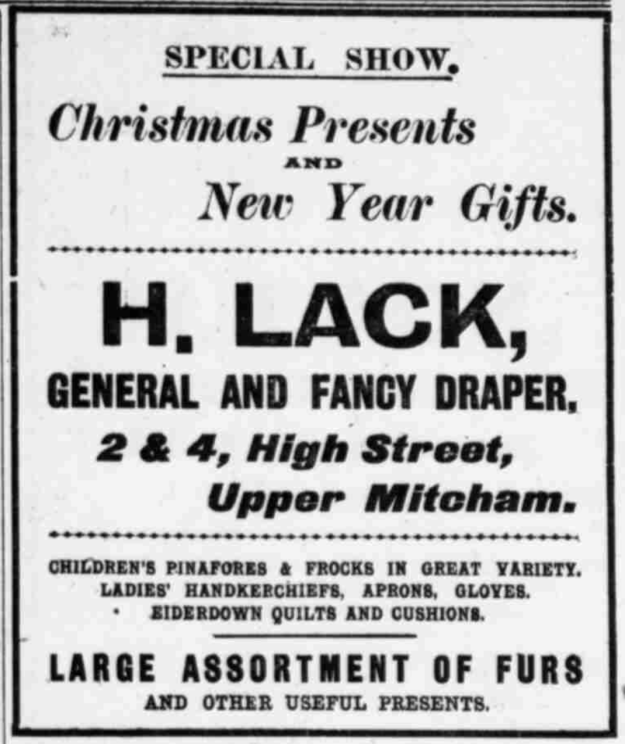
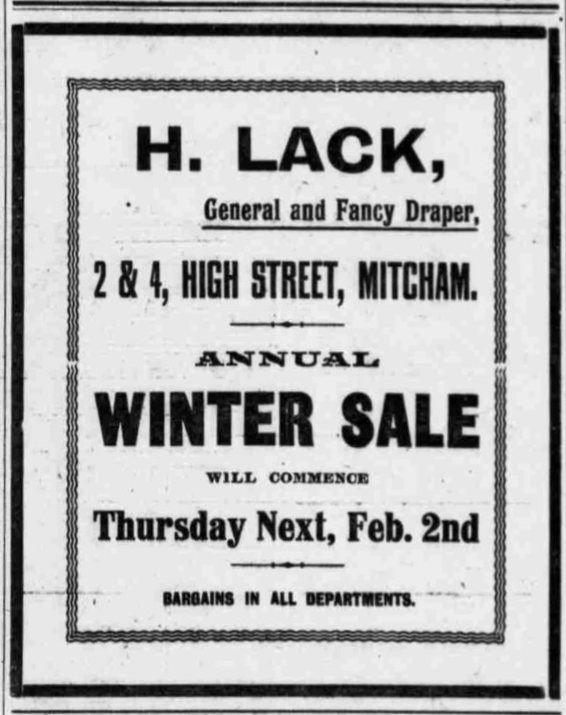
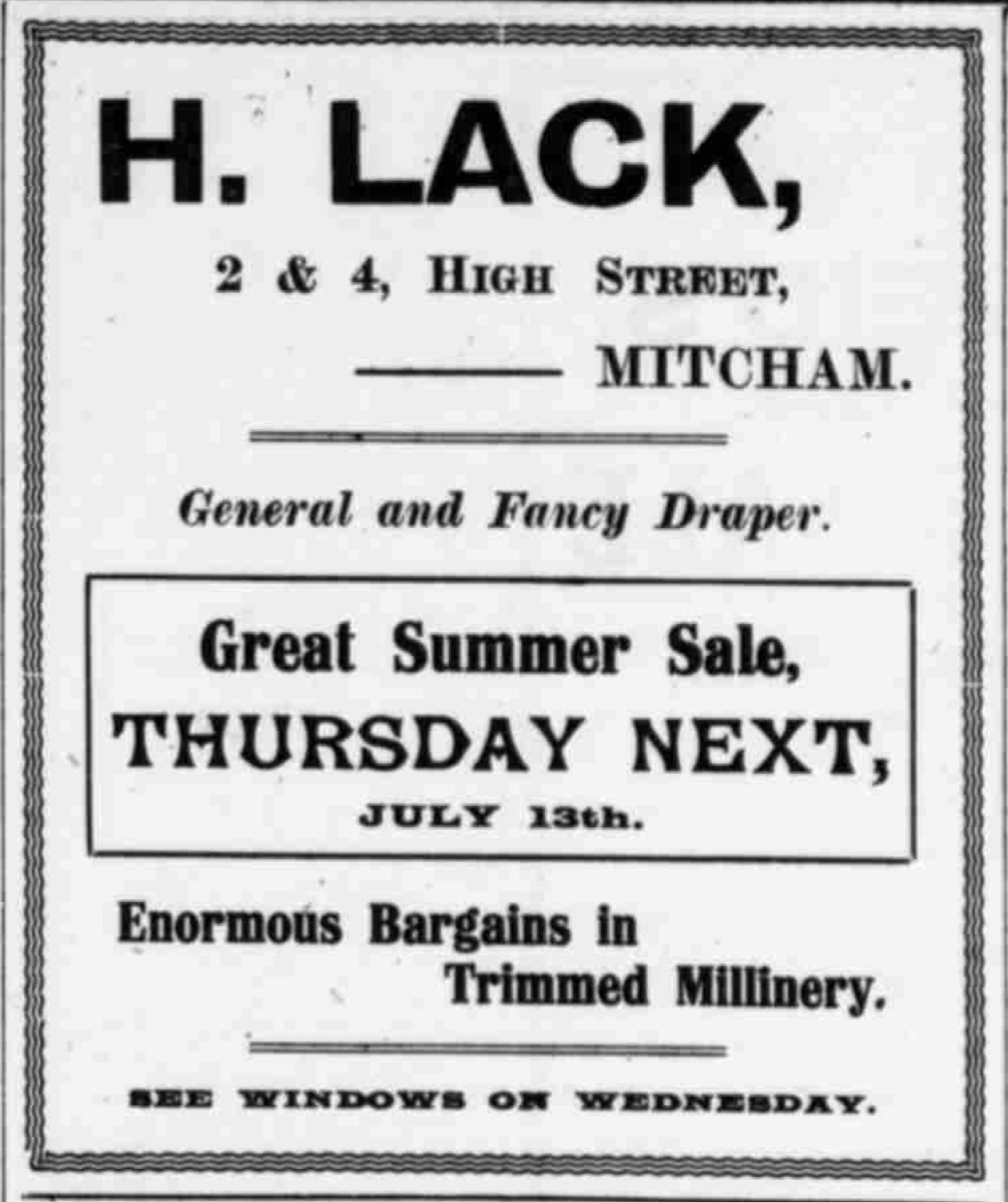
Hannah Lack, draper

Draper who, in 1910, was at no. 2 and 4 High street, Mitcham.

Mitcham Advertiser – Friday 16 December 1910

27th January 1911, Mitcham Advertiser

Mitcham Advertiser – Friday 07 July 1911

This shop was next to the King’s Arms pub, as shown in the 1912 street directory, which lists entries going south.

… here is Sibthorp Road
George Joseph DALE, newsagent
William BARTER, grocer
STANSFELD & Co. Ltd., brewers and wine merchants
Walter MARTIN, butcher
John CUMMINGS, greengrocer
Mrs H. LACK, draper
The King’s Arms P.H., H. & E.F. MOORE

See also the comments below by a descendant of the family and the entry on Wikipedia Lack Brothers

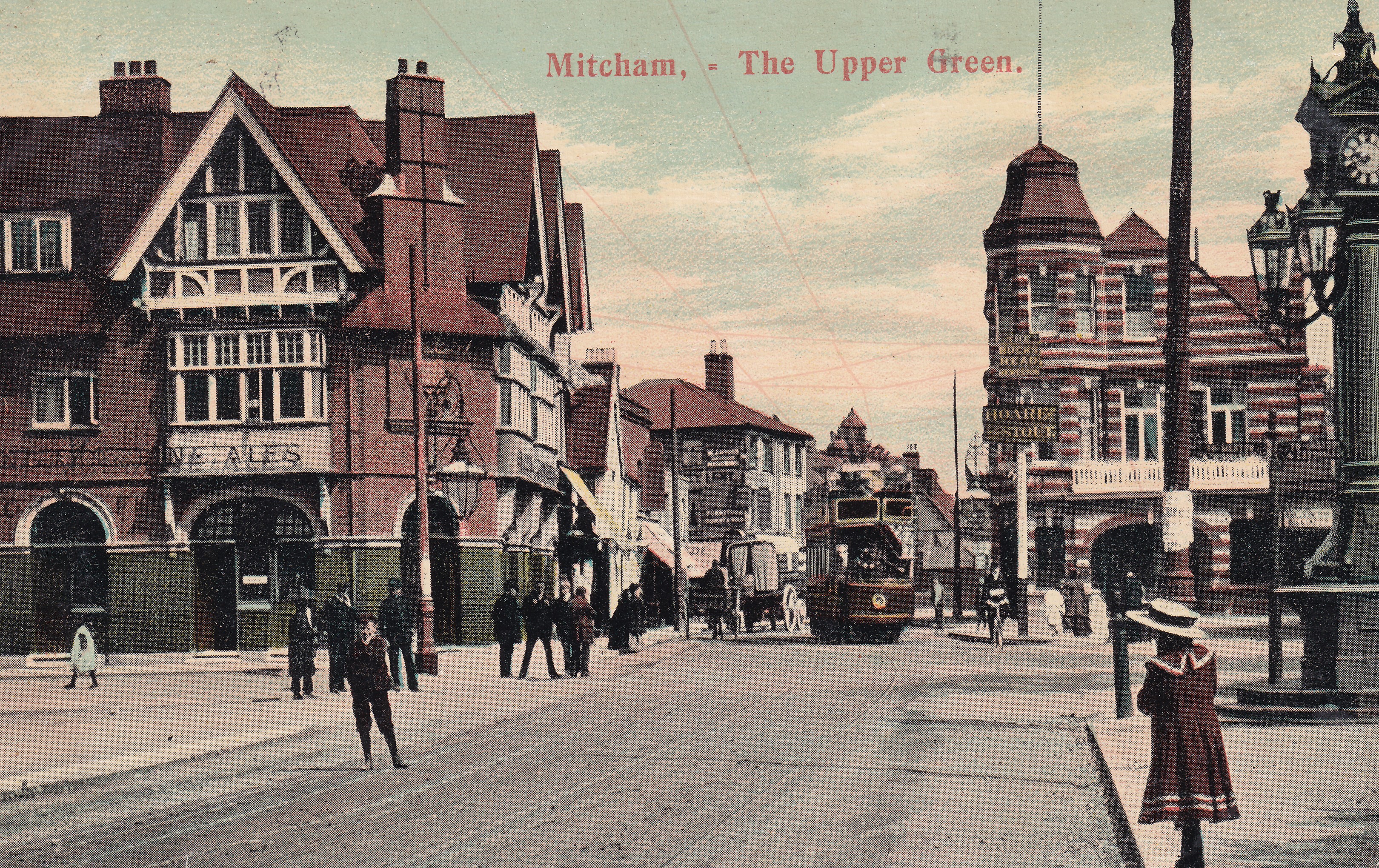
This postcard from the early 1900s shows shops with awnings, the nearest to the Kings Arms is likely to be the draper shop of Mrs Lack.

Postmarked 28th Feb 1907

Mitcham Advertiser – Friday 27 April 1917

A “SPECIAL’S” WEDDING. SERGT. C. LACK AND MISS E. M. RICHENS MARRIED.

Great interest was taken in the wedding at St. Mark’s Church, Mitcham, on Wednesday, of Mr. Charles Lack, younger son of – Mrs. H. Lack, High-street, and of the late Mr. G. A. Lack, and Miss Emily May Richens, elder daughter of Mrs. F. Richens, Newton House, and of the late Mr. John Richens of Tooley-street. The church was filled with spectators.

Mr. Lack was born in Mitcham, is one of the most successful business men in the town, and his social qualities have won him the esteem of all classes. For ten years he has been hon. treasurer of the Tooting, Balham, Merton, and Mitcham Horticultural Society; for 15 years he was a member of the choir of St. Mark’s, and he is now a sidesman; he is hon. secretary of the East Ward Naval and Military Pensions Committee; and since the war began he has been a zealous member of the Mitcham Special Constabulary, of which he is now a sergeant. On several occasions Mr. Lack has been pressed to try tor Municipal honours, but declined, The bride’s family have been domiciled in Mitcham for 30 years, and has always held a high position in the esteem of the inhabitants, and the bride herself has won the particular regard of the people of St. Mark’s, in which parish she has been a constant worker. She has also taken a great and active interest in the military hospital.

Among the congregation were Coun. E. J Mizen (People’s Warden), Coun, Ernest Mizen, Mr Taylor, a former Warden, Mrs. Edward and Mrs. Ernest Mizen, Miss E. Mizen, and Mrs. C. Rutter. Thirty members of the Special Constabulary in uniform formed a guard of honour, and in the church lined the central aisle on both sides. The sergeants present were Sergts, Dale, Cooper, Freeman, Rutter, Billington and McCaul. At the door was the veteran Special Constable Merrick, glowing with Army medals. The service was fully choral, and was conducted by the Rev. James Bevan, of All Saints’, Beddington Corner, a former curate of St. Mark’s, assisted by the Rev. W. K. Roberts, Vicar of St. Mark’s and the Rev. E. J. Baker, Vicar of St. Barnabas. The organist was Mr, J. Hopton. A brief address was delivered at the close of the service by the Rev. James Bevan, and the Rev, W. K. Roberts gave the benediction. Afterwards all joined in singing a verse of the National Anthem. The bride was escorted to the altar by Mr. Tom Richens, her eldest brother, and she was given away by her mother. She was beautifully attired in grey crepe de Chine, trimmed with amethyst bead em- broidery. She wore a grey silk hat, and carried a shower bouquet of liIies and orchids. Her going away dress was a Russian blue coat and skirt, with black and gold hat. There were no bridesmaids.

The Best man was Capt. S. James, King’s Royal Rifles, From the porch to St. Mark’s-road the “Specials” were drawn up in a double line, and when the bride and bridegroom appeared at the church steps they formed an arcade of their truncheons. The Culvers, Carshalton, was lent by Mr and Mrs George Mizen for the reception. Mrs. Richens acted as hostess to about fifty guests, Later in the afternoon Mr. and Mrs. Lack left for Cornwall. On returning to Mitcham they will reside at Home Close, St. Mark’s-road. One of the handsomest of the many beautiful wedding gifts was a canteen of cutlery from the Special Constabulary. From the Horticultural Society was received a beautiful silver rose bowl. Another gift of special interest was a handsome brass and copper paper stand presented by the lady assistants at the High-street establishment.

Note that Home Close, is number 26 St Marks Road, the current home of the Royal British Legion, on the corner with Chalkley Close.

Mitcham Advertiser – Thursday 29 July 1926

DEATH OF MRS. HANNAH LACK.
In Business in Mitcham Fifty Years.

A link with the old village of Mitcham was severed this week by the death of Mrs. Hannah Lack, who was in business as a draper in London-road for fifty years.

She passed away in her 82nd year on Thursday, July 22nd, at The Culvers, Carshalton, the residence of her son-in-law and daughter, Mr. and Mrs. George Mizen.

No Mitcham resident was held in greater esteem than Mrs. Lack. She came to the village, as it then was, 67 years ago and lived in the same house and conducted the same business in the High-street section of London-road, near the Fair Green, until she retired during the war. She was the widow of Mr. George Albert Lack, who died in 1878.

Mrs. Lack was a fine business woman and during her regime the shop flourished exceedingly. In later years she was assisted by her son, Mr. Charles Lack, who took over the business entirely when his mother retired. To the great regret of all the older residents the business ceased to be a few months ago.

THE FUNERAL.

The funeral took place on Tuesday afternoon at Mitcham churchyard. The Rev. W. K. Roberts, Vicar of St. Mark’s, conducted the service. There was a large attendance of the older residents and tradespeople.

The chief mourners were Mr. and Mrs. Joseph Lack (son and daughter-in-law), Mr. and Mrs. Charles Lack, Home Close, Mitcham (son and daughter-in-law), Mr. and Mrs. George Mizen, The Culvers, Carshalton (son-in-law and daughter), Douglas Lack and Lewis Mizen (grandsons), Mr. W. T. Lack and Mr. Percy Martin (nephews), Mr. Stanley Lack and Mr. Charles Lack (great nephews).

Others present at the church and at the graveside were Mr. and Mrs. Stanley Schneider, Mrs. Avery, Mrs. Heasman, Miss Howell, Mr. Ernest Ghinn, Mr. Ernest Ghinn, jun., Mr. Percy Ghinn, Mr. and Mrs. Arthur Tibbitts, Mr. and Mrs. Frederick Mizen, Mr. W. Barton, Mr. H. H. Dance and Mr. J. Cummings.

The exceptional number of floral tributes included wreaths from Mr. and Mrs. George Mizen, Mr. and Mrs. Charles Lack, Mr. and Mrs. Joseph Lack and family, Lewis, Hubert and Howard (grandchildren), Will, Edie and family, Agnes and family, Mona and Charles Lack, Stanley and Cousie, Miss F. Bowhill and Miss G. Chippendale, Mr. and Mrs. Warr, Beatrice and Bertha, Mrs. Sweet and family, Lil and Harry, Gladys and Fred, Mr. and Mrs. Woonton, Mr. and Mrs. Arthur Tibbitts, Mr. and Mrs. H. C. Millen, Auntie Byford, Mrs. and Miss Dale, Mr. and Mrs. Sidney Miller, Mrs. George Miller, sen., Mrs. Hicks and family, Rosie, Fanny, Stanley and Cissie, Edie and Fred, Mary Howell, Mr. and Mrs. George Lack.